
The first quatrain found in The Prophecies is often ignored as one with impact on all future readers, seen simply as an explanation of the ‘magical’ process that Nostradamus used when writing his verses. The French written is this:
ESTANT assis de nuict secret estude,
Seul repousé sus la selle d’aerain,
Flambe exigue sortant de solitude,
Faict prosperer qui n’est à croire vain.
This is translated into English by Crystal Links as this:
Sitting alone at night in secret study;
it is placed on the brass tripod.
A slight flame comes out of the emptiness and makes
successful that which should not be believed in vain.
Notice how changes have been made, such as lines two and four not beginning with a capitalized word. The word “tripod” is magically added, as it was not written (tripode or trépied). Still, there is an air of similarity surrounding this translation, making it almost have that meaning. Here is a picture of this quatrain, which is the French that led to that translation:
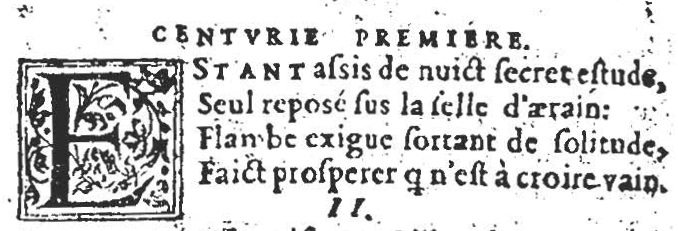
From this it is clear to see the drop cap E that is the first letter of an all-caps word ESTANT. While every first quatrain in a Centurie is printed with an elaborate drop cap, with other quatrains likewise showing line one beginning with an all-caps word, this cannot be seen as some printer’s right. It must be respected as intended to be written in this manner, whereby a word in all-caps would be an all-important word to discern. As such, the Crystal Links translation ignores this presentation (as well as maintaining the punctuation marks written).
Here is a viable English translation that abides by that written in French:
BEING placed from darkness inward meditation,
Alone settled upon the seat of brass:
Blazed sparingly issuing out of solitude,
Made to prosper that which not is to believe frivolous.
The all-caps word ESTANT is the present participle of the verb ESTRE (now ÉTRE), meaning “BEING, SUBSISTING, REMAINING, ABIDING, STANDING, or RESTING.” This makes it the opposite of “Sitting,” but the all-importance must be seen as the state of life that is “BEING” and “EXISTING.” The importance of all-caps then takes the reader beyond a state of self, to the presence of a most divine “BEING,” where one’s soul is joined with that celestial presence, so two soul-spirits are “EXISTING” as one. This is vital to grasp.
This is then detailed by the word assis, which means “set, sitting; seated, placed, settled, fixed, planted; also limited, appointed; taxed or assessed.” A separate listing by Randal Cotgrave shows it used to denote “assessements or impositions.” This becomes a statement that says the state of higher “BEING” is “settled, fixed,” and “planted” with one’s own “Being.” This has been “appointed,” from a divine “assessment” of one’s self-sacrifice to serve Yahweh as His wife-soul. This makes the “BEING” be the soul of Jesus, where’s one’s soul has become reborn in his name. Thus, a “EXISTENCE fixed” and “appointed” is a Saint or Apostle.
To then link that to the preposition de, which links to nuict, this states movement “to” a new state of “BEING,” “from” one that was surrounded by “darkness,” where “night” is when the light of the sun has disappeared, leaving one in a state of “BEING” that is “seated” or “sitting” “with” an “absence of light.” That is the confusion within one’s soul that is lost and unable to see the truth.
When the word secret is relative to this “absence of light” and “darkness” that is surrounding one, the truth is then “hidden, concealed, abstruse, mystical,” and “unknown.” The truth is a “secret” that is a “mystery,” contained “inward” and kept “close” from “counsel.” This then becomes something that requires “study,” through “diligent search, meditation,” and “beating of the brain about matters of learning.” (Cotgrave, 1611) To have “private study” means to personally “care,” show “diligence, labor,” and “endeavor to contrive to accomplish [compass] a matter” sought to know. This is not public education, as much as it demands “affection, desire, good will,” and “great mind unto” understanding that which the public is “in the dark about.
This makes the main theme statement less about Nostradamus setting the stage for his solitary talents being bragged, as it is more applicable to all in the future who will repeat his state of “BEING” that has become “appointed” to escape “from” an “absence of light,” whereby the demand for “private study” requires one listen to the “inward” voice that comes from “meditation.” One is not attempting to figure things out, as one has an “affection” to “accomplish good will.” This is the ministry of a Saint, as a Saint is in the “dark” without the light of Jesus leading one’s “learning.” This is then a main theme that tells readers today, “To understand The Prophecies written by Nostradamus, one must surrender one’s soul to serving Yahweh totally, so one will be reborn in the name of Jesus. That “BEING fixed” will remove the “darkness” through divine insight, just as that Nostradamus received.
With the main theme statement (line one) separated by a comma mark, the secondary theme (line two) then begins a new line of thought based on that, making the importance of Seul need to be understood. This word means “Alone, Single, Only, Sole, Only one, Mere; By itself [singular or several].” This importantly states the union of that “BEING” within a “Single” individual, which sets the “Lone” soul as unique, “By itself,” with all others of like union being a collection of Christians that are “By itself” a “Single” group where each is “Alone” with Jesus within. With this understood, the word repousé is one that implies words of different spellings.
This word can be repoussé (from repousser), which Cotgrave listed and referred the reader to look up repoulsé. He then translated that word as meaning “repulsed, repelled; foiled; or thrust, pushed, or driven back.” The addition of an s and the modification of that s to an l means it would be acceptable to also read the word as répousé, where the Middle French spelling loses the accent, becoming respousé. That word means “remarried,” as “re-spoused” or “married again” and the word can be read as r’espousé, with re- acting like an abbreviated combined prefix. The implication is the one where an individual desired to be joined, as taken by “Only one,” but that union was “rejected” or that first marriage was annulled or divorced, leading one to become “remarried.” Still, if one changes repousé to reposé (tossing away the u), one becomes “reposed, rested; settled, stayed, quiet, grave, and discrete.” It seems Crystal Links chose to go this route with “placed.”
The most accurate application of the word written is to accent the e and keep all letters written in place, with no removals or changes. This makes répousé the primary intent of that written, although the other meanings would be intended to have merit, on a secondary level. Because every use of the word la (lower-case [460] or capitalized [141]) demands it be accented and read as là (there are only three actual uses of là in all the quatrains). This is because there is no importance of an article. Therefore, a rule for understanding The Prophecies says it is okay to add an accent mark when none is present. If one is present, that must be unchanged. Therefore, the secondary theme begins by stating, “By itself married again.”
This makes the connecting word sus become ” on, upon, up, above,” or “over,” where this stands alone as a statement that “One married again” to comes from “above,” which is how Jesus explained to Nicodemus that to be assured of Salvation (inherit eternal life) one must be born again from “above.” This makes the word sus be relative to a higher power that is “over” one (“seated with darkness”), while having come “upon” one, so two are joined together “Alone.” This says to be “married again” to Yahweh (as a soul, still in a body of flesh, one reincarnated from a spiritual union with Him before birth) results in the child of that “remarriage,” which is Jesus, the “Only” Son of His. Thus, from “above” is “there” in that body of life (soul and flesh) is Jesus reborn, gaining that soul assured Salvation.
This is then said to be relative to the word selle, which means a “stool” or “seat,” while also a “saddle” (Cotgrave, 1611). This should now be seen as a statement about the soul in the body of flesh, who (like Nostradamus) has become a “resting” place (reposé) for the divine soul of Jesus. This means Jesus uses one whose soul has “remarried” Yahweh as a “seat” from which he will operate. This becomes a servant to Yahweh and the Lord born again from “above,” where Jesus sits “upon” the “saddle” of his new flesh. In terms of John’s Apocalypse, this is the return of Jesus on a “white horse” (hippos leukos). When this then links to d’ærain, meaning “of brass, copper, or bronze, this now relates to Greek mythology and the oracle of Delphi.
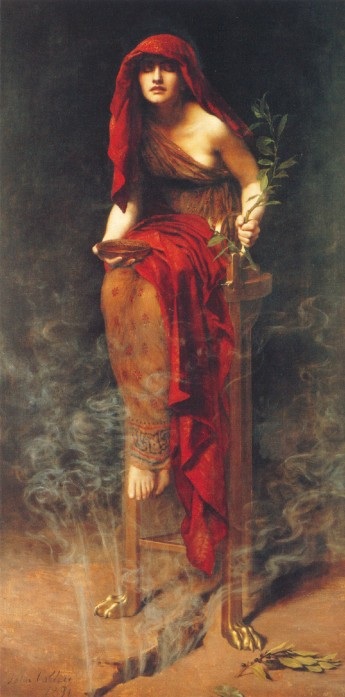
This makes the secondary theme statement be focused on one becoming a Prophet of truth, where Yahweh “Alone” knows the future; and one must become “married again” to this “Only” source, so one can become a tool that guides those seeking the truth. In the mythology of Pythia, the oracle of Apollo at his temple in Delphi, people questioned and were told the truth; but they were always finding the truth different from their interpretations of it. This is how people are drawn to Nostradamus to tell them the truth about the future, with them going away thinking they know what to expect; but they find out those preconceptions were far off the mark. With this how Nostradamus explained The Prophecies to be, the secondary theme ends with a colon, meaning this “saddle of bronze” will be clarified in line three.
Go to Quatrain I-01 Part 2


 Nostradamus Blog