Tag Archives: Nostradamus & Salvation

Quatrain VIII-01


This is a rather well-known quatrain, in the fact that it has made the rounds as one of the hits of Nostradamus (hit meaning he got one right). Let me introduce you to that one.

Quatrain VIII-01 states in French:

………………..PAU, NAY, LORON plus feu qu’a sang sera,

………………..Laude nager, fuir grand aux surres,

………………..Les agassas entree refusera,

………………..Pamplon, Durance les tiendra enserres.

Crystal Links shows this:

………………..Pau, Nay, Loron will be more of fire than blood,

………………..to swim in praise, the great one to flee to the confluence (of rivers).

………………..He will refuse entry to the magpies

………………..Pampon and the Durance will keep them confined.

Erika Cheetham (1973) had the opinion that the all-cap words were more sensational when the comma marks are tossed out and the letters made to say NAPOLEON ROY.  That would require reading the “au” of PAU as “o.”  She did admit that the three all-cap words are small communes in western France.

John Hogue (1997) agrees with Cheetham, calling the rearrangements cryptograms, with Corsican spelling making an anagram possible, while throwing in one rearranged set of words (roy being one) says Destroyer King.  He then mentioned that the Amazing Randi (a debunker of magicians, having been one and knowing everything is a trick) listed this quatrain being said to be about Napoleon I his seventh greatest charade in his debunking history.  Hogue then argued with Randi’s inability to see the insignificance of three small communes as reason to leap onto the Napoleon assessment.

This is a translation that would make dead Randi remove this quatrain of Nostradamus as one he debunked.  And … by the way … Randi never debunked Nostradamus.  He debunked those making things up and using Nostradamus’ name.  Nostradamus wrote what he wrote (as published in 1568).  This is that:
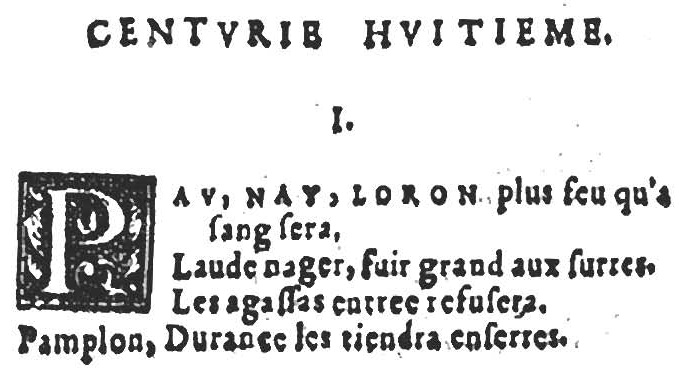
Here is a logical translation of this French into English, maintaining the all-caps, capitalized words and marks of punctuation:

………………..STAKE, SHIP, HIM GOLD SOME added dead that in lineage will issue from,

………………..Praise to float, to escape mighty to them cork ones [or over is],

………………..They cried out access will cast off,

………………..By reason of ample one, Duration [or A long life] them will hold restrained ones.

As you can see, there is nothing about Napoleon. People that want to see Napoleon get all hot and bothered because Nostradamus wrote L’antechrist trois in quatrain VIII-77 and the Hollywood production with obese Orson Welles read lines that made it appear Nostradamus predicted “three Antichrists.” That then made Hitler one and the one to come the second; so, … hmmmmm … I know, make Napoleon the third one! That is wrong on all counts.

The world has been filled with antichrists since Jesus lived on earth; and the Apostle John wrote about plural antichrists in his letters. Napoleon is actually a folk hero to the French, as he represents their last time as a world power (they should not have cut the heads off of innocent royals). So, quatrain VIII-01 is not about Napoleon.

An all-caps word is like a capitalized Et being like a most important ampersand. A capitalized word is one of importance. A word written in all-caps is most important to grasp. The main theme here begins with a crop cap P, with the letters AU connecting to that. Again, all ten of the first quatrains in a Centurie have a drop cap and a word in all-caps (one exception being quatrain X-01, where the letter A is in drop cap, followed by a separate word that begins with a capitalized L (L’ennemy). That makes A be the all-important word to grasp. Here, the main theme statement begins with two all-important one-word statement, which are PAU followed by NAY.

The word PAU is listed in Cotgrave’s dictionary, where he simply defined it as meaning “A STAKE.” Dropping the article, the importance here is “STAKE,” which is a wooden rod hammered into the ground (a PAL or “POLE”). It us used to mark boundaries, while also being used in acts of punishment, where some people were burned at the “STAKE.” That then leads to NAY, which is read as NAI, meaning “SHIP,” with Cotgrave referring the reader to see it as synonymous with NEF, which adds the meaning of “VESSEL OF THE SEA, SAIL; or the “NAVE” of a church” (which is made to resemble a bark or barque). When a “STAKE” is read as the boundary of Heaven, as marking the conditions of entry, to follow this with an all-important “SHIP,” which is the Roman Catholic Church, that most importantly says they are responsible for making that “STAKE” be known by all Roman Catholics. Thus, the reason the Church is known as the “BARK” of Saint Peter is it is a “SHIP” that fished for men’s souls; but when “STAKE” is seen as threatening, the “SAIL” of the Church must always be turning into the wind (as zigzaging to keep from being blown off course), following the divine insight of Jesus.

With this in view, the comma mark that sets NAY as a one-word statement of much importance then pauses for reflection on that, before leading to the all-caps LORON. To read this as the small commune Oloron-Sainte-Marie is quite a stretch, by having to add a capitalized O to make it become that. The etymology of that name is said by some to come from the Basque word olore, meaning “fragrance” or “scent.” Still, that requires a non-existant O. This means the simple solution is to divide the word into L‘OR ON, where the contracted L’ becomes the masculine pronoun “HIM,” attached to “GOLD.” This is what distracts “ONE” or “SOME” from steering the “SHIP” towards the “STAKE” of Heaven. This then implies strongly that the popes of Rome must find Yahweh as the “STAKE” that the voice of Jesus within lead “HIM” to steer the “BARK” of Saint Peter to, with Jesus within being “HIM GOLD” that divinely possesses “SOME,” with the pope being “ONE.”

This then ends the three all-caps words, taking one to a statement that “HIM GOLD ONE” must be “added,” making a pope become “more” than simply a man, as he it then led by an inner “fire” or “light” that sets the “SAIL” towards the “STAKE.” However, if one does not become “more” than just a man, that means the man pretending to be a holy leader will be “dead,” as the soul of Jesus will be “departed” from that man’s soul. This places a pope in the same category of all lost souls in bodies of flesh as being “deceased,” alive only as long as the flesh allows.

This option of “light” and “dead” then points to “that in” or “that with,” where “that” choice of “light” or “dead” is up “to” the soul-body. This means one’s “lineage, kindred, parentage” is either holy and divine or ordinary and worldly. The meaning of “blood” is then the metaphor of Jesus being that everlasting waters of Salvation. Still, when the saying is “blood” is thicker than water, this becomes the difficulty of committing solely to Yahweh and being reborn as His Son (His holy “blood” or sang rael, poured out from the Holy Grail or San Greal). This decision made by a soul is then what “will be, exist, stand, rise,” or “issue from” within that soul-body. Thus, the main theme statement has zero to do with Napoleon and everything to do with knowing the “STAKE” that sets the boundaries of Heaven and being a “SHIP” that sets “SAIL” to that goal. It can only be obtained by joining with “HIM GOLD ONE,” becoming the Son reborn, related through “blood.”

After the separation of a comma mark ending the main theme line, the secondary theme statement begins with a capitalized Laude, which becomes the Ablative form of the Latin word Laus, meaning “Praise, Glory, Honor, Merit, Value,” and “Esteem.” Latin should be seen as a hint towards Roman Catholicism, as it is the official language of Vatican City. This makes the “blood” be dependent on who one gives “Priase” to (Satan is the “ONE” offering “HIM GOLD” of the material kind). This “Honor” will cause a soul in its body “to float” the turbulent winds and seas, without the threat of sinking. When demonic possession is the spirit one finds “Value” from, they will be able “to swim” after the “SHIP” sinks.

An internal comma mark then pauses this view, where the objective is “to escape” and “flee” from the “mighty, substantial, high,” and “lofty” demands of human life. The word grand always must be read in context with nations and peoples who give credit to Jesus and God for being “great,” in comparison to others with lesser worldly blessings. This is also a statement of the “noble” ones who have power and influence over many, such as royalty and popes. This is to find Jesus as the “great” one “in them” who believe and give him credit and “Praise.”

This then leads to the word surres, where surre is the name of an acorn from a cork-producing oak tree. This is then “with them acorns” that become the fruit of the tree. When cork is read, this become a method “to float.” Still, because Cotgrave did not list this word in his dictionary, it can be divided into sur res, which states “over are again.” This use of res (as the second-person present Indicative of rêtre) says of each of “them with” Jesus, then he is “over you,” as “you are reborn” from “above.”

With the secondary theme statement placing focus on how a “SHIP” navigates the turbulent water of worldly existence, the comma mark ending line two separates that line of thought from line three. Following the plural pronoun “them” of aux, line three begins by importantly highlighting “Them” that are not those divinely possessed, but the “dead who at lineage will be,” who cause turbulence that attempts to sink the “SHIP” before it can reach the “STAKE.” Thus, “They cried out” (from agassas being the second-person past simple form of agasser) as “Them annoyed, urged, incensed,” and “provoked” (from agassas being agaça-s, the plural number to the past simple form of agaçer). This says “They” will be “urged ones,” where an inner demon is given a mission that says “entrance” to Heaven, via compliance to the “STAKE,” “will be refused, rejected, repelled, denied, renounced, cast off,” and “foresaken.” That makes “Them” be agents of evil.

Again with a comma mark ending line three, that line of thought that focuses on the influencers that sink the “SHIP” for the fishermen of souls, line four begins a new line of thought. This appears to be one Spaish city and a French river, which certainly adds nothing of value to this quatrain’s flow of words. The first word is made into an important one-word statement by an internal comma mark, where Pamplon must mean more than Pamplona, Spain. That meaning comes from reading this as P’amplō-n, where the contracted P’ represents Par, meaning “By reason of” ot “Through.” The word amplō is the a return to Latin, with that being the Ablative and Dative form of the word amplus, meaning “ample, wide, extensive,” and “important.” The suffix -n is the adding “one” to is “By reason of ample.” This then relates to an ability to ignore “Them” who seek to block one’s “entrance” into the divine realm, as those able “to escape” such diversions because of “noble” Jesus “in them as the “blood over the reborn.”

Seeing that importance in Pamplo, the word following the comma mark is a capitalized Durance. While this is perfectly spelled to reflect the name of the river that flows from the southwestern Alps, across southeastern France, until it meets the Rhone River, near Avignon. That becomes meaningless; but the word Durance means “Durability, Duration,” and by extension a “Long life.” This says that a soul given “ample” protection by the presence of Jesus’ soul, as one’s Lord within, then that soul-body is filled importantly with the “Durability” to resist all temptations and tricks of Satan, in order to have a “Long life” that equates to eternal Salvation. Rather than succumbing to the calls to rejoin the “dead” of soul, the “light” within keeps them focused on the “STAKE” of Yahweh. This is then a result that has “them” who Jesus “will hold” and “keep” safe, as “they will enjoy” being so “restrained, enclosed” and “held hard ones.”

Hopeully, this quatrain can be seen as one that most importantly tells one how to become Saved, which cannot come from a pope or a king. Each individual must realize that self-will always fails eventually; and Satan will never tire of tempting one’s beliefs that stand apart from Yahweh and Jesus. Only with Jesus as one’s Advocate, sent by the Father to grant and maintain eternal life for one’s soul, can one resist those who are “annoyed” one has inner calm, causing them to “cry out” as distractions meant to divert one’s course. There is nothing about Napoleon in this quatrain; but Napoleon could see both the Church and State of his time were corruptions that should be led, not followed. One must have that attitude when seeking Yahweh as the only goal that is worthwile.

Leave a comment

Filed under Nostradamus

Quatrain I-63


Quatrain I-63 states in French:

………………..Les fleaux passés diminue le monde,             

………………..Long temps la paix terres inhabitées:

………………..Seur marchera par ciel, terre mer, & onde:

………………..Puis de nouveau les guerres suscitées.

Crystal Links posts this as the English translation:

………………..Pestilences extinguished, the world becomes smaller,

………………..for a long time the lands will be inhabited peacefully.

………………..People will travel safely through the sky (over) land and seas:

………………..then wars will start up again.

Erika Cheetham (1973) guessed it meant “Air travel in the 20th century,” perhaps alluding to World War III (in that century). John Hogue wrote (1997) this describes the Cold War era, adding that commercial air travel took off during that time.

While all of that is well and good, as far as slapping ole Nostradamus on the imaginary back, telling him, “You got it right!” it is not much to write home about.  If one stops for a moment and asks oneself (assuming one read the Preface and explanation letter to Henry) if that hindsight adds anything of value to the themes Nostradamus wrote, regarding what one could expect to find in the quatrains?

The answer is “No.”  There is nothing in either letter that has Nostradamus instructing a reader to look for the times when man flies through the air and tensions between two countries can lead to wars.  Double check my math on that.

This becomes an example of how Jesus said (as Nostradamus quoted in his Preface), “Absconisti haec à sapientibus, & prudentibus, id est potentibus & regibus, & enucleasti ea exiguis & tenuibus,” (found on page 4).

That says (from Latin), “You have hidden these things from the wise, & to the wise, that is to be powerful & kings, & you have analyzed them in detail & thin,” (Google Translate)

The Latin Vulgate of the last half of Matthew 11:25 shows: “abscondisti haec a sapientibus et prudentibus et revelasti ea parvulis,” with the last segment saying “and hast revealed them to little ones”. (Vulgate.org)

It is another example of the plain and simple being placed before those who ignore the instructions, because they think they are smart enough to solve divine things (spiritual matters) with a Big Brain (wisdom).  Whereas Matthew quoted Jesus adding it was “little ones” to whom the hidden truth was “revealed,” Jesus (through Nostradamus) added, “to the Big Brains [the wise] that [a Big Brain] is powerful.”  It is what “kings” seek as their advisors.  However, just like Humpty Dumpty, “all the king’s horses and all the king’s men couldn’t put” the puzzle of a Nostradamus’ broken egg “together again.”

Jesus said (through Nostradamus), “The Big Brains [you] have analyzed The Prophecies’ pieces [the quatrains] in detail,” but writing things like “This quatrain is about 20th century air travel and the Cold War” comes up “thin.”  That means “you” missed what has been hidden from the wise.

Quatrain I-63 deals with Salvation.  In order to go through the End Time that is coming, one needs to know how to save one’s own soul from eternal damnation.  No one can save the soul of another, but there are steps one can take to save oneself.  Quatrain I-63 is a quatrain that places focus on those steps.  It, therefore, can be seen as an introductory quatrain, to be grasped and heeded, before jumping on one’s horse and charging into the scattered quatrains, one by one, in no particular order.

Here is my translation of quatrain I-63:

………………..Them judgments of God transported over ones lessened him all things visible under the cope of …………………………….heaven,

………………..Continual opportunity there peace fear lives:

………………..Faithful will walk by reason of spiritual, flesh deeply emotional, & billows:

………………..Able with unheard of before they debates awakened ones.

The main theme statement (line 1) begins by placing important focus on “Them,” when one remembers to never translate articles (A, An, The), because nothing important (symbolic of capitalization) comes from that.  This means Les is the plural pronoun “Them” or “They.”  To understand who “They” are, the detailing word becomes fleaux (also in the plural number, in agreement with “Them”). 

This word only appears twice in the quatrains, here and in quatrain II-06 (look that one up).  As a repeated word fleaux has importance, with the uniqueness of its only being used twice adding to that.  Thus, the Crystal Links translation leans towards the sensational, as “Pestilence” (they anoint it with capitalization), when the normal translation would be “scourge.”  Figuratively, Wiktionnaire says it means a “calamity,” while the old usage was applied to a whip for separating grain from chaff.  That site adds a usage “by extension” where it implies “anything that is harmful, disastrous, or fearful.”

In the 1611 dictionary produced by Randal Cotgrave, the word was translated as meaning “a flail to thresh with” (as flayau), while adding a second spelling (fleau) that “Also“ was “a beam of great balance” (or scale), while representing “the tendril or tender shoot of a vine whereby it catches hold of what is next to it.”  Cotgrave then added, “It is also much used, as metaphor, as a scourge, plague, or judgment of God.  This matches the Crystal Links translation, without the association of God.  That implication is best placed into translation; so the main theme now begins by focusing on “Them judgments of God that are passed ones.

The word passes is a plural past participle of passer, which can be translated in many ways, a few of which are “transported, hold on course, depart from, overrun, decay, and vanish away.”  Crystal Links seems to have made this “extinguished,” which falls in line with the use of “to pass” as a statement of death.  I have chosen to use “transported,” but the intent is to see movement from one state of being to another.  When this is elative to “judgments of God,” this becomes relative to spiritual changes within one’s soul-body.

This is then said to be diminue, which means “diminished, lessened, impaired, abated, extenuated; and qualified” (Cotgrave, 1611).  This now says there are “Them” who have “judgments of God carried over ones abated” or “extenuated,” which now speaks of reincarnation or individual transfiguration, where the sins of the past (relative to each of “Them”) are forgiven, albeit never forgotten.  This then leads to the masculine personal pronoun le, which says “he” is the reason for this “qualified” exemption, where “he” is the soul of Jesus, the Son of God,” whose “judgment” is to send His Son into the soul of “Them” that have “held on course” in service to God.  This is then a dual spiritual presence of souls in one body of flesh, which makes Jesus be reborn into the “world.” 

That presence in “Them” is a statement of Christianity being a collection of “Them” who serve Yahweh as His Son reborn, when then “traveled” around the “world,” making Jesus become available to “all things visible under the cope of heaven.”  In that, as “cope” is “a long enveloping ecclesiastical vestment” (Merriam-Webster) and “heaven” is metaphor for the “spiritual” realm.

This makes the main theme statement have nothing to do with air travel and everything that is relative to “Them” souls [“heaven”] that have received favorable “judgments of God” that has “Them” be “hold on courses” that becomes a “diminished” path of self-direction.  This is because “he” [Jesus] has become the Lord over their souls (each individually, his soul in all of “Them”), for the purpose of saving the “world.”  This is a powerful main theme statement; and it governs every subsequent line in this quatrain.

With line one ending with a comma mark, that line of thought is separated from a new line of thought presented in the secondary theme statement.  The capitalized first word then states importantly that a “Continual” or “Extended opportunity” is the result of one’s past sins being forgiven and the presence of Jesus (“him”) coming into one’s “world.”  This is the Extended opportunity” or “time” that is eternal Salvation of a soul.  With Jesus “there” with one’s soul or “here” in the “world,” a state of “peace, agreement,” and “accord” has been reached, through “atonement.”

This then leads to the word terres, which might be mistaken for the plural number of “lands” or “countries,” but this is the second-person present Indicative form of the verb terrer, which is a direct statement to “you” that says “terrify, deter, fear, scare,” or “affright.”  This says the “peace” brought on by divine possession by Jesus will bring “there” a change from a “Long time” of “fear” that has “inhabited” a soul or attempted to.  This is the ‘terrorism’ of Satan, who tempts souls to act out of “fear,” whereas Jesus removes all “fear” when his soul “lives” within one.

When the two theme statements are seen as one leading to another, the purpose of Yahweh sending His Son into the “world” is to offer Continual times” of “agreement,” as ministers leading lost sheep away from the “fear” that makes their “lives” uneasy.  With this seen, line two ends with a colon, meaning line three will offer clarification or examples relative to this “afraid life” that needs “peace.”

Line three then begins with a capitalized Seur, which can be read as “Sister.”  This works when one realizes that a soul in a body of flesh is feminine essence (regardless of physical genitalia), so “Them” who are lost and seeking redemption must become bridesmaids (males and females alike) to Yahweh, thereby making the relationship of a gathering of unsaved believers be as a “Sister,” not a Brother.  A Brother would signify one possessed by the masculine essence of Jesus’ soul, changing one into an Apostle or Saint in the name of Jesus.  Still, the primary intent of a capitalized Seur is to the adjective “Sure, Certain, Safe, Secure,” and “Out of danger.  Because Cotgrave added it is a word meaning “Trusty, Loyal,” and “Faithful,” the word “Faithful” is my choice of translations to use.

The word “Faithful” goes beyond simple belief, as belief is based on trusting someone who taught or told one something to remember.  “Faithful” is then a state of being that knows from experience and has true “Faith” as a “Certainty,” without bending to a belief that is ill-conceived.  It is then from being “Faithful” that one knows “fear” from it “inhabiting” one’s soul; but it is also knowing how “fear” is turned to “peace” through submission to Yahweh and gaining the “Continual opportunity” for Salvation.  It is then “The Faithful” who “will walk” the path of righteousness, which is “by reason of” Jesus (“him”) guiding one as one’s inner Lord, “spiritually.”  Here, the word ciel means “sky” and “heaven,” which must be understood metaphorically as referencing the “spiritual” realm.  When Jesus told Pilate his kingdom was “not of this world,” he spoke truthfully.  His kingdom is the soul-body of those to whom his soul is sent by the Father above.

At this point an internal comma mark pauses this statement about ministry by Saints in the name of Jesus (who were the first Christians), before proceeding to the word terre, which now means “land, earth, ground,” or “soil.”  Once again, the metaphor is the same as with ciel, where “heaven” and “earth” should be grasped as meaning “spirit” and “flesh.”  When Yahweh made Adam, he took “dust from the ground,” which means he used atoms of matter to make “flesh.” 

This then leads to the word mer, which ordinarily means “sea,” but symbolism is still in play here.  The use of water is symbolic of “emotions,” with a “sea” representative of “vast emotions” or “deep emotions.”  This becomes a statement that the “Faithful will walk” in ministry “for” Jesus (in his name), whereby their “body of flesh” will be “deeply emotional” about being able to serve Yahweh as the Son reborn into “flesh.”  With this seen, another internal comma mark places a pause in that understanding.

 Following the comma mark is an ampersand.  This is a symbol that never translated as a word (no “and”).  Instead, it acts as a sign to look for importance to follow that mark.  Following it is one word, onde, which means “wave, billow, surge of the sea,” as well as an acrobatic cartwheel move.  When the essence of “wave” is seen as an undulation of water, this becomes invisible “waves” of spirit within one’s soul-body that is felt.  This importantly explains the “flesh” being filled with “deep emotions,” as the soul of Jesus does not lie dormant or still.  He “billows” directions, instructions, and commands that lead one away from any potential “fear” that would attempt to “inhabit” one’s soul.  This makes the presence of Jesus with a soul eternal, as the “Continual opportunity” granted by Yahweh to His wife-souls, which “Extends” beyond one life in the “flesh,” as Jesus becomes one with one’s soul forever, to keep it Saved.

Line three is another that ends with a colon, meaning the wording of this quatrain needs extra clarification that must be caught.  This implies it is not a simple matter of translating the words so they have no important meaning, as syntactically readable.  The clarification of “wave” or “billow” is then importantly said to make each individual “Able,” where Puis was listed by Cotgrave as the first-person present Indicative form of Pouvoir, where he wrote, “I am able” or “I can.”  The same word can mean a “Draw-well,” which also has intent to understand.  The “wave” within is the soul of Jesus directing one into ministry, so the element of “I am” must not be overlooked as the meaning of YHWH, which was the name told to Moses when he asked, “Who shall I say sent me?”  The answer was “I AM WHO I AM,” which means “You Moses” are sent as Me, so if anyone asks, tell them “I am Able.”  When a “Draw-well” is added depth, this is a statement of Jesus telling the Samaritan woman at the “Well,” “the water I give them will become in them a spring of water welling up to eternal life” (John 4:14b).

This is then an “Ability” that comes “from new” and “unheard of before” powers, which are only possible through divine possession by Jesus’ soul.  In ministry, as was the case with Moses, this will bring forth “debates” and “contentions,” as those possessed by demon spirits will reject a Saint in their midst.    It will only be to those whose hearts and soul are seeking eternal Salvation that the words of a Saint in the name of Jesus will “awaken” their souls, leading them to see to also be “Able” to lead lost souls to Yahweh.

As can be seen from this in-depth interpretation of what seemed to be a meaningless quatrain (there are none of those), the purpose of this is to let those whose hearts, minds, and souls are “awakened” to the truth and lead them to the “Continual opportunity” of Salvation.  Due to the nature of The Prophecies bringing “fear” and “fright” to lost souls, one needs to become a soul that personally experiences the presence of Jesus, as “Them” whose “judgments of God” have “transported Them” to a “new” state of being.  In the example of Saul, who was struck blind for three days after the soul of Jesus asked him why he persecuted him, he changed his name to Paul, which means “little” or “small.”  That is a “lessening’ of his self-ego, which allowed” him” to follow Jesus (“he”) into the “world” as a Saint.

Leave a comment

Filed under Nostradamus

Quatrain X-43


Nostradamus wrote in Old French the words of quatrain X-43 that are this:

            Le trop bon temps trop de bonté royalle :

            Faiz & deffaiz prompt subit negligence

            Legier croira faulx despouse loyalle,

            Luy mis à mort par sa benevolence.

One way to translate this into English has it read as this:

He mightily upright opportunity mainly with virtue him kingly:

Act & overcome unlooked for prepared drowsiness

Lively will believe it false to wife it allowable,

Him placed at death by reason of his favor.

Certainly, the same words of Old French can be translated to present other ideas.  Some can be in line with this above thought, while others can be very confusing and misleading.  That is the nature of divine language.  The fact that Nostradamus wrote words in divine language says he was a true prophet.  The words he wrote are, therefore, not his but those of Yahweh.

The same divine language is in every word of original text in the Holy Bible.  The English translations of those words written in divine language are just like the translations of the above quatrain of Nostradamus: They sound an inviting tune that oddly seems to miss some notes or go offkey.  Rather than adjust the song of an angel so it sounds pleasing to the mind, it is easier to make stuff up that is confusing and misleading.

The work produced by Nostradamus is entitled Les Propheties, which cleanly translates as “The Prophecies.”  Of course, many read those words of English and have their mind think, “The Predictions,” which further leads them to think Nostradamus is just a man writing down his thoughts.  In the same error of judgment, English-speaking Christians think, “That Paul sure was a man with a lot of thoughts about Christianity.”  The error is in missing that the words came from the pens of men who were Saints, not ordinary men.  Saints do not think, “What shall I write today.”  Saints hear the voice of Yahweh telling them, “Write this down, exactly as I say this.”

All the words that seem offkey and confusing are by heavenly design, because to understand them requires one also to be a Saint.  To know what a prophet wrote, one must also be a prophet.  That means reading the books of the Holy Bible and The Prophecies of Nostradamus are not about one thinking, “What do I think this means?”  Instead, it is what Yahweh says to your soul, when He asks: “Why don’t you think about this a different way?  I will pat your back when you get closer to the truth.”

This quatrain above speaks of that.  It is a divine possession that overcomes one’s soul.  Yahweh offers His Spirit to those souls who sacrifice themselves to Him, as His wife-souls in bodies of flesh.  Those who get enough pats on the back can be seen as His bridesmaids, where the wise ones do all the work necessary to keep oil in the lamp of truth.  That lamp burns bright to keep one awake and alert to the truth, so one does not fall asleep to the dreams of false shepherds.  Seeing truth brings vigilance for more truth, so those wives-to-be (in both male and female bodies of flesh) will be ready when the bridegroom comes, and Spirit and soul are joined as one in Holy Matrimony.

The joining of a soul with the Spirit of Yahweh means the immediate resurrection of the soul of Jesus, alongside the soul of Yahweh’s new wife.  Just as your mother did not have somebody down at some store in the mall make your body of flesh, which she came in and visited every day for nine months, you were born from within your mother’s womb.  Jesus must also enter the wife-soul as the womb in which he is reborn of flesh and blood – Yours.  That means a Saint has a name like Saul, but when Jesus is reborn within that soul, Saul no longer has the ego to say, “My name is Saul.”  Instead, one bows one’s egotistical head and declares, “I am nobody; but I speak in the name of Jesus, as a Christ blessed by the Spirit of Yahweh.  I do not think of things to say in his holy name.  I just say what he tells me to say.”

In the main theme statement above (line one), the English translation I have been led to share says, “He mightily upright opportunity mainly with virtue him kingly”.  The capitalized pronoun, “He” (Le), is both a Saint and a wife-soul married to Yahweh, who speaks in the name of Jesus.  As such, “He” stands newly upon the earth “mightily,” through divine possession by Yahweh.  “He” has become “upright” because of the possessing soul within his or her soul-body no longer being whoever they were before, as one has become in the name of Jesus.  Jesus is the inner Lord who keeps a soul-body “upright” (bon) in a righteous way of living on earth.  This state of new being is because one has taken advantage of the “opportunity” (temps) presented to him or her by Yahweh.

These “times” (temps) are sourced in life becoming “too much” (trop), where the “good” (bon) seen in the promise of religion (Judeo-Christian) is the beacon that leads a soul in misery to offer itself to Yahweh, in a committed relationship.  A soul must reject the proposals of the worldly domain and demonstrate it realizes it is “time” to submit to a higher power.  By oneself offering to serve Yahweh as His wife-soul, Yahweh proposes an everlasting relationship.  However, for a wife-soul to prove this commitment and complete subjection, one must prove one’s devotion by doing the work involved gathering the oil of truth to place in one’s lamp.  Before Yahweh will say “Yes” to a bridesmaid, it must prove to be wise (not foolish) by developing a “time”-tested commitment to sacrifice self for a higher purpose, through servitude out of love. 

When Yahweh comes in the middle of the night (metaphor for when unexpected), those in love with Him will be awake because of having kept the light of truth burning in their lamps.  The wedding ceremony is then the outpouring of Yahweh’s Spirit upon one’s soul and flesh, cleansing one’s soul of all past transgressions.  It is through this Holy Baptism of Spirit (not water) that the presence of Jesus’ soul enters a wife-soul, through the Consummation of Marriage.  The soul of the Son then becomes the Lord that is “mainly” (trop) ruling over everything a wife-soul of Yahweh will do.  Together as one, the soul of Jesus resurrected alongside the soul born into a body of flesh lives with “virtue” (bonté) and “uprightness.” 

This is because the soul in a body of flesh (regardless of human gender) has become “him” reborn into one’s flesh, with him being the ruler over that new “royal” kingdom (royalle becomes l’royale, with l’ a lower-case le).  The Spirit of Yahweh (in divine Marriage or Union) has made one’s soul-flesh a Holy tabernacle in which the soul of Jesus can become High Priest.  This is his kingdom not be of this world, but the spiritual (soul) presence trapped in a body of flesh.  This become the truth of Jesus being “kingly” (l’royale).

This is where punctuation must be read as a direction of importance.  The main theme statement ends with a colon, which is not often the case in the quatrains of Les Propheties.  A colon’s usage projects “a punctuation mark used chiefly to direct attention to matter (such as a list, explanation, quotation, or amplification) that follows” (Merriam-Webster).  This means an explanation of this main theme, as a clarification of “him royal,” will be found to follow, in the secondary theme statement.  Because the secondary theme statement begins with an important one-word statement, cut off by the use of an ampersand, the explanation of “Him mightily upright opportunity mainly with virtue he kingly” says “Acts”. 

In the secondary theme statement (line two), I have been led to translate it into the English shown above as, “(You) Act & overcome speedy without forethought carelessness”.  This follows a colon mark ending the main theme statement, making the secondary theme be a clarification or example of that theme following it.  This begins with a one-word statement that is capitalized Faiz, where this should be read as a plural form of Fais.  That is a form of the verb Faire, in the first and second-person singular present Indicative (as a present Impératif), which is rooted in what “I” or “You do, make, perform, commit, work, or effect.”  The plural is then a statement of the multiplicity of ones that each “Act” as both the “I” of Jesus” and the “You” of a soul joined with him.  When one realizes the four Gospels are followed by the Book of the “Acts” of the Apostles, the importance of capitalization clarifies one’s divine marriage, becoming reborn from above as Jesus again in the flesh, the purpose of that divine presence is so “(You) Act” as your Lord within commands.  

At the point this is realized, an ampersand is presented.  That symbol does not symbolize the word “and.”  Instead, it is a marker symbol that announces, “What follows here is important to grasp.”  Following the importance of “Acting” in the name of Jesus, it is important to know such “Acts” will “overcome” any ordinary and common desires of life, to act sinfully.  They will “overcome” (desfaiz) one  in a “speedy” (prompt) way; but those who “Act” as Jesus directs will “defeat, destroy,” and “ruin” (desfaiz) those impulses “quick,” with him “ready at hand” (prompt).  This will not take long, as if one will languish worrying about sinning or rejecting sin, as Jesus will “Act” with “sudden” (subit) response with “unthought of” (submit) need to be concerned about “negligence.”  The presence of Jesus’ soul with one’s wife-soul of Yahweh is forever and eternal, whereby he will never “neglect” a servant soul, not let it fall into “drowsiness” or Spiritual “sleepiness” (negligence).

This means the Book of Acts was not about a bunch of men and women thinking, “What shall I do next, so people will think I am special because I walked around with Jesus when he lived?”  Instead, the “Acts” done by Saints come from “unlooked for carelessness” (submit negligence).  That says to think with a human brain, trying to figure out what people look like when they want to be seen as righteous dudes is neglecting Yahweh’s commands, sent through His Son.  One will “Act” as commanded, immediately, without hesitation.

The secondary theme statement does not end with any punctuation marks, meaning that theme continues into the next line.  Still, in all quatrains of Nostradamus, line three will be found to present supporting elements to the main theme, relative to that stated in both themes.  As such, my translation above says in English: “Lively will believe false witness of wife the allowable”.  Here, the continuation follows line two ending by saying, “quick unlooked for negligence”.  Line three then begins with the capitalized word Legier, which says, “Lively, Wavering, Quick and Light.”  That makes it important to realize that “Quick” as an Old English term written in the Nicene and Apostle’s Creeds, saying “He will come again in glory to judge the quick and the dead, and his kingdom will have no end.”  This makes “Quick” be an important statement that continues the secondary theme, while supporting the main them, where the presence of Jesus’ soul within a wife-soul makes one “Lively,” not dead.  This means being dead is being without this divine possession “coming again to judge” the way one serves Yahweh.

When the secondary theme leans in a direction that says what one does when “unlooked for carelessness” brings “Wavering” (Legier), which is a human trait of spiritual “negligence”, this becomes relative to what one “will believe, trust, and have confidence in” (croira).  When the capitalized “Act” is how one responds to the directions of internal Jesus, one become “Alive” (no longer dead) and “will have faith” from personal experience of this divine presence.  When the word faulx is seen as an Old French spelling of faux, meaning “false, counterfeit, untrue, lying, deceiving, unfaithful, and treacherous,” to then read the word as l’faux adds the pronoun le to this, as “he” who tricks unsaved souls to sin, who is Satan. 

When croira is read as “will think assuredly, where thinking becomes an action of a human brain, led by the influences of the world testing one’s soul, as professed to be a Christian (when not committed, just a foolish bridesmaid), “thinking” will lead one to become “with spouse” to Satan.  To be the wife-soul of Satan means to be dead spiritually, willingly doing everything one is influenced to do, as “it allowable” (reading loyalle as l’loyale). This states the dual nature of possession, where demon possession is a soul being “of spouse” to Satan, while divine possession by the soul of Jesus protects one against “him false,” so what Jesus leads one to do as “of wife” to Yahweh, his commands are “it allowable,” due to “it” (a saved soul) proved to be “loyal” to Yahweh.

Line three ends with a comma mark, which symbolizes a pause or disconnect from the line of thought that explains faithlessness, identifying sinners as the wives of Satan (demonically possessed, rather than divinely possessed).  That means line four is free to head in a different direction, separate from line three, while still addressing self-sacrifice to an eternal spirit.  Here, the English translation I was led to write above says, “Him placed at death for his favor.”  Here, again, is a capitalized pronoun being Luy, translating importantly as “Him.”  This, once more, is both a soul-body that has been divinely possessed through Spiritual marriage to Yahweh, having been reborn in the name of His Son, which is a masculine identification (because all that is eternal is masculine, while all that is material is feminine).  This makes “Him” be one who is in the name of Jesus.  Wherever “He” is “placed, put, laid, planted, grounded, thrust into,” or “set” (mis) is then a Spiritual transfer “to” (à) one who has self-sacrificed, to marry one’s soul to Yahweh.  In the same way a human girl “dies” (mort) of her daddy’s last name when she says, “I do,” to all the Covenants of marriage spoken at the altar of union, every soul-body must experience “death” of self, becoming “dead” (mort) to the old.  This, repeating what I said before, is why Saul the Pharisee changed his name to one meaning “Little” or “Small.”  Saul had become “Him,” Jesus, so Saul was “laid to dead” (mis à mort).  This self-sacrifice was “for” (par) a better reward, on a heavenly and divine level of eternal salvation.  It is “by reason of” (par) oneself offering love and commitment to Yahweh, to be tested and proved a viable marriage candidate seeking “his favor” (sa benevolence).  Once approved by Yahweh, a wife-soul will become reborn from the “dead” – resurrected – due to the soul of Jesus being sent in for “his benevolence” to forevermore lead that soul.

Now, when one realizes this is one quatrain out of nine hundred fifty quatrains, with all of them written under the divinely inspired title “Les Propheties,” one should ask, “Why would Nostradamus be led to write such a spiritual lesson, when all I have ever been told [false witness] was he was a fraud, looking into some crystal ball, or using the evil practice of astrology, with all the TV shows about him saying he predicted Hitler, war, famine, and all kinds of terrible things to come?”

Well, the answer is Nostradamus was led to write a divinely inspired epic poem, not a bunch of random thoughts about what the future might hold.  As an epic poem, there is a beginning, middle, and end, with the beginning being Yahweh’s warning to those who read His Word that says, “Join with me in divine marriage and realize where your soul will be headed by turning away from this proposal.  Join your soul in sacrifice to Me and be reborn as My Son in human flesh, so you will hear the voice of My Son Jesus telling you what the meaning is.  Join with Me and let My Son lead your soul to Salvation, so you do not perish in the world’s self-caused ruin.  Join with me and become My Son reborn, so you can Act in his name and tell others the truth I offer through divine prophecy.”

This quatrain states the first step towards understanding The Prophecies is all about dying of self and ceasing all worship of brains that think up ways to ruin the world. To find it first printed in 1566, as in the middle of Centurie Dixieme (tenth group of one hundred) – the last ‘chapter’ of Les Propheties, says everything was written before the first publication in 1555. From that epic poem written, with a beginning, middle, and end, this was part of the beginning. Everything was then tossed into the air and scattered into a meaningless order, which became the way it was and has been presented in print. Still, the story of these divine prophecies means staying “Alive” amid the End Times requires one “Act” as directed by an inner Jesus. The only way to have that neighbor to love as oneself is to commit oneself to Yahweh and start now proving your love and devotion to Him. Show Him your soul is willing to serve Him eternally and He will send you the Advocate for that eternal Salvation, to be reborn again from above.

Leave a comment

Filed under Nostradamus