
The following shows a portion of page 2 of the Preface, as presented in the 1568 Lyon edition of The Prophecies. For those who slept through high school, the word “preface” means, “an introduction to a book, typically stating its subject, scope, or aims” (Oxford Languages). Thus, the following is “stating the subject, scope, and aims” of The Prophecies. To understand the poems that make up the work introduced, one must understand what the author wrote will be found. A small part of that introduction says this:
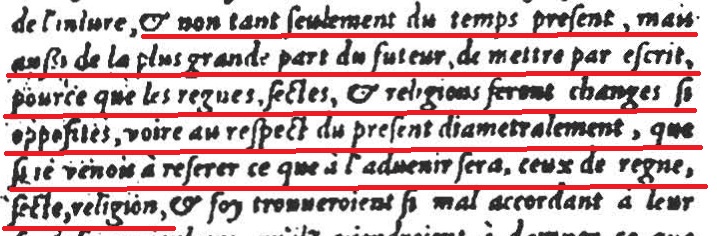
This literally translates to state, “, & not so much only of the time present, rather even as to there more substantial part of it future, from to set through published in writing, for that cause what them governments [regnes], philosophers [sectes], & beliefs in gods [religions] will be making changes in sort adverse ones, surely in it respect to him at hand diametrically, which even as I arrived at to recite this who in them to befall will be, those to rule [regne], company of one opinion [secte], worship of things held sacred [religion], &”.
To put this in a poetic style for better understanding, it presents broken apart by marks of punctuation in the following manner. See the ampersands as signals of importance being stated in that segments of words that follow. See how the comma marks separate each segment into explanations that support the important segments. See how one-word segments give emphasis to the meaning behind that one word.
& not so much only of the time present ,
rather even as to there more substantial part of it future ,
from to set through published in writing ,
for that cause what them governments ,
philosophers ,
& beliefs in gods will be making changes in sort adverse ones,
surely in it respect to him at hand diametrically ,
which even as I arrived at to recite this who in them to befall will be ,
those to rule ,
company of one opinion ,
worship of things held sacred ,
Those are 52 words that become a most important theme that must be grasped.
These instructions act as a foreword to the reader to expect to find contained within the verses of poetry (the quatrains) stories (in epic poem style) that detail these “diametrically opposite changes.” As such, “that any I to view in to refer this which at them to happen will be” states that Nostradamus was shown the specific futures when Royalty [regnes], the common Artisans [sectes], and the Roman Catholic Church [religions] of society and each of their falls upon ruin. As they are the cornerstones of a safe and secure present, for them to collapse leaves the masses of people without the protection of Jesus and God (or other gods worshiped). All then (in the sixteenth century) created a trinity for the souls of mankind to be led by (kings, educated advisors, and popes). All now (the twentieth century and beyond) create a trinity for souls to be led to be enslaved by Satan, thus eternally damned (no kings, commoners rising through philosophy and politics, and branches of Christianity attacking one another).
We are in the middle of The Prophecies foretold. The future shown to Nostradamus has become our present, with a predictable future of doom and gloom. The past that is found in these three storylines of “diametrically opposite ones” to lead humanity is still the recent history of the present. Much exposed in The Prophecies confirms rumors of this fall from Grace; but the ‘defense’ of ‘conspiracy theory’ keeps serious investigation from confirming the rumors. Those pasts left alone has sealed the fate of the future.
Each heading has an extensive story told about the last times the royals led religiously, when the common man and new philosophers rose to take leadership roles sacreligiously, and when the Vatican turned away from Jesus and knelt before Satan. It is these failures that will interweave and create nations of people led by souls serving evil, whereby the End Times will come and bring misery upon the Earth.
This article will focus on one quatrain. It alone is one out of 950 that tell the whole story. It connects, like a puzzle piece, to many others that expand on this one aspect of the story. Quatrain X-55 is a key quatrain in the storyline of the decline of Royalty. It is told in many quatrains. It is presently an ongoing story that has yet to reach an end. That end is prophecied in the linking quatrains of this story of “reigns” becoming “diametrically opposite” from what is expected.
X-55
……………………………………..Les Malheureuses nopces celebreront
……………………………………..En grand joye, mais la fin malheureuse,
……………………………………..Mary & mere nore desdaigneront,
……………………………………..Le Phybe mort & nore plus pyteuse.
This can be seen translated viably into English, saying:
……………………………………..Them Misfortunate ones wedding ones will be magnifying the reputation of
……………………………………..Upon noble rejoicing, rather there cunning contemptable ones,
……………………………………..Husband & womb of a woman wife of a son [they] will be despising,
……………………………………..He Shining dead & daughter-in-law more wretched.
In this quatrain there are two uses of the word Malheureuse, one capitalized and one lower-case, with one written in the plural and one in the singular. Randal Cotgrave translated this word (in 1611, as the feminine spelling of malheureux) to mean, “unhappy, unlucky, unfortunate, sinister, cross, unprosperous, disasterous, miserable, and wretched.” The same translations are to be used for both; still, the website Wiktionnaire offers: “The one who is vile and contemptable,” along with an archaic meaning as “prostitute.” All implications of this one word are applicable.
The main theme statement (line one) begins with a capitalized Les, which is a plural pronoun, not an article. As a stand alone word that is capitlized, the word translates as “Them” or “They,” which importantly points to a group of people, who are then detailed importantly as being “Unhappy ones.” The capitalization then relates to the British royal family, which had become “Sinister ones” and “Cross ones,” because “They” were limited to breeding with others of special blood, where royalty can only be explained as a birthright to “reign” because of a bloodline linked to the physical Jesus [another story for another time]. This is confirmed by the word nopces, which means “weddings, bridals,” and “marriages.” “They” are most “Unhappy” with “weddings” to related royals.
When the main theme line ends with the future tense word that says, “will be celebrating” or “will be magnifying the reputation of,” this is a statement of the public looking forward to royal “weddings.” This comes with all the pomp and circumstance of the royal family all dressed up with ornate carriages pulled down the streets of London, amid throngs of “Them Wretched ones” that see the future of the Commonwealth assured by the “marriages” of royal blood, so Jesus will rise again in the offspring of those “bridal unions.”
Because the main theme statement does not end with any mark of punctuation, the central idea presented continues to flow into the secondary theme statement (line two). This is particually relative to what “will be spread abroad the reputation,” where line two begins with important focus placed on “Upon, Into, In, At, On,” or (as a word of continuation) “Thereof.” This then presents the word grand, which means “mighty, substantial, lofty, high,” and “great,” where this often repeated word in The Prophecies has a close connection to Christian nations and their rulers (regnes). This can be seen as those of Christian nations being all of the adjectives above, because they give credit to Jesus and God for being superior to others (non-Christians), in having possession of wealth, power, and influence. Thus, the word grand, when applied to royalty, has the meaning “noble.” So, the “weddings” that “will be celebrating” are now said to be “Upon” and “Thereof” those who seen royals as “noble” Christians being joined, to maintain the bloodline of Jesus in the world. This is “celebrated” with “great joy, gladness,” and “delight.”
With this stated, an internal comma mark pauses this “happiness “lightness of heart” and “mirth,” before going into an excpetion that is stated as “but” or “rather.” This then states “there” will come the “end” of this “celebrating” by the public, when fin is read as the feminine noun. This is because when fin is read as the masculine noun, it means “subtle, cunning, crafty, fradulent,” and “beguiling.” This makes the feminine noun relate to the bride, whose fairy tale imaginations of “marrying” a prince will come to a sudden “end.” This will be because the bridegroom fits the masculine description of fin, as one who allowed a “wedding” for “fraudulent” reasons. This then combines the two noun definitions in the second use of malheureuse (itself a feminine spelling) that says this “marriage celebrated” will suddenly turn and make the bride be “unhappy, unfortunate,” and “miserable.” This is because she will learn the “disasterous” truth that is “sinister” and “wretched,” as her husband will prove to be “one who is vile and contemptable,” seeing his bride as little more than a “prostitute.”
Before you run to the bookshelf and pull down your British Royal Family history book, let me save you the effort. This is a storyline of the “reigns” held by the last remaining royal house of any merit, where it will prove to be irrevokably “diametrically opposite” and “contrary” to what royal family members should be, with these two themes painting a picture of the “marriage” that existed between Charles (Prince of Wales) and Diana Spencer (daughter of an appointed Earl).
With line two ending with a comma mark, that separates this statement of “unhappiness” from that stated next in line three. Still, the repetition of maheureues and Malheureuses, where the British royal children were tired of being paraded around royal circles, meeting the same distant cousins time and again, as some charade of which one he or she would feel comfortable “marrying,” must be realized. That “Unhappiness” was a product of the times.
After World War II the Western world changed and became rebellious. This filtered “Into” the “great” houses and Charles (as homely as he was even when young) acted like he would rather play polo than date a young lady and propose marriage to her. His siblings would suffer the same ailments, where their hearts were connected to their maturing genetalia and they wanted starlets and movie actors, not some other stuffy royal. This would begin to dilute the royal blood because of “Them Unfortunate ones” of royal blood being limited when making “wedding” plans. The royal bloodline found mixing it with that blood of commoners (which Diana Spencer was) lessened the reason for having royal houses and children born to rule. Thus, this sense of being “Them Misfortunate ones” made them feel like they were in some James Dean Hollywood movie, as rebels without a cause.
Seeing this, line three begins with the capitalized one-word statement that is “Husband.” This importantly shouts that the “cunning contemptable one” with “sinister” reasons for falsely “marrying” a young innocent woman (Diana was barely 20 at that time) was Charles. The capitalization then forces one to delve into the importance of becoming a “Husband,” rather than a man ‘hooking up’ with a ‘significant other.’ The word strongly implies for the purpose of “marriage,” which is for “Mating,” to bring forth a child. In royal houses, this is what keeps the assension line to the throne alive with choices, as living tree bearing fruit. A prince needs to sire a child, which means (as one with the royal blood of Jesus within should not bring forth bastards that count) “marrying” a wife that will make the “Husband” fulfill his royal duty and responsibility.
With this understood, an ampersand then halts that focus on a “Husband,” where it becomes important to grasp the depth of meaning from mere, which means “a mother.” While this would lead one to quickly surmise that the bride would become the “mother” of a little prince or princess, in the storyline of Charles, the element of “mother” also fits Queen Elizabeth II. It was her that (basically) forced Charles to stop mounting his polo pony and find a wife. She made it clear to Charles that if he ever expected to take her place and become king, he would have to become a “Husband” and make a baby.
This then follows the “sinister” and “contemptable” reason that Charles was forced to become “cunning” and “crafty.” He was actually in love with a married woman (Camilla Parker Bowles), but it was not a sexual love. Charles would never become a child-rearing “Husband” with Camilla or any woman (for that matter). Thus, the word mere also means “womb of a woman.” The only reason Charles “celebrated wedding” with Diana was to secure the “womb of a woman” as his to command. He chose Diana, seeing her as one so young, naive and commonly bound to serve the royal family that she would roll over like a “prostitute” and get pregnant (by someone close to but not Charles).
This then describes Diana as a nore, which means the “wife of a son,” which is more a statement of a possession owned by Charles, rather than call he “daughter-in-law.” This is because the royal family makes the laws; and, while Diana was given the title of princess, she was the possession of Charles. Because Diana was not of royal blood, Queen Elizabeth II was “Unhappy” with the decision Charles made (as well as many of the decisions her children would make) and for this reason the “womb of a woman” possessed by Charles as “the wife of a prince” “will be despising” her ‘in-laws,’ with “Them Unhappy ones” with her being able to be part of that exclusive family.
When this is seen, line three ends with a comma mark, separating this state that “will be disdaining, contemning, scorning, loathing,” and “making vile account of” Diana. She will become a “mother” and also a fresh voice for British royalty, where the press fell in love with her, along with the common people. Her popularity and doing things unnatural to royals increased this level of “disdain” towards her by the royal family. One can even see how the “despite” Charles had for her led Diana to later have an affair, where she became pregnant with Harry (the proverbial red-headed bastard child), which she announced before the press, leaving Charles without a way to say, “It is not mine. I never once had sexual relations with that woman.”
This leads to line four using a capitalized Le to announce an important male as “Him” or “He,” who is closely linked to those who “will be despising” Diana. This would follow “Husband” as another reference to “Him,” to who Diana was married and possessed as a wife, as a “woman with a womb.” This leads to the mystery word of this quatrain, which is a capitalized Phybe. This can be related to the Greek spelling of “Phoebe,” which is Phoíbē, where that name is mythological.
The meaning behind the name would be the importance to discern, which says “Bright” or “Shining.” In the mythology, as a wife of King Danaus, an Egyptian link can be seen. This can make “Him” be a lover of Diana, “Shining” and “Bright” as a couple in love. With “Him” being a Muslim, the name “Phoebe” is often synonymous with Artimis and Selene, as Moon goddesses, as is Diana; and Nostradamus would make references to such mythological goddesses as being Muslim. To then have Charles (“Him”) see the “Shining” of Diana as a potential wife to an Egyptian film producer (Dodi Fayed), with custody rights to William and Harry, Charles is developed as one who hates Muslims (as in possession of blood that sees Islam as unpure). Therefore, the word mort (“dead, murdered, killed”) becomes ominous.
With this element of the “Bright” light so many loved being “dead, slain,” and “made away” with, an ampersand becomes a symbol to seek the deeper truth contained in the words that follow that mark. Here the word nore is repeated, which was used as “wife of a son” in line three; so it now translates as “daughter-in-law.” This can be seen as a signal of divorce, where Diana was no longer possessed by a prince and had indeed been proposed to by Dodi Fayed, with plans to meet his father, who had a business in London. It is that rumored plan (denied by those in support of the British crown), including the rumors Diana was pregnant when “killed” (also denied), which “adds” to this quatrain implying Charles put out a hit on Diana (with others either incidental or also targeted victims), making it “more piteous” to think about.
The “pity” goes beyond the loss of three human lives, as this is the ruin of a royal family. What makes it “more piteous” is the “end” of the British royal family will come from the acts of Charles. No longer will the royal family of Britain be seen as worthy of claiming bloodline as a reason for being “great” and “noble.” Charles will not be the only one to bring that lineage to disgrace, but when he is discovered for what he is, he will be the last straw. The “diametrically opposite” version of “rules” by birthright will be quite “contrary,” as no longer viable.


 Nostradamus Blog