
These quatrains listed as “Naval Battle” are all linked to one suprise attack on a U.S. fleet in the Persian Gulf. I posted an article in 2016 about this still unfulfilled future event, due to tensions rising there then. Certainly, now that 2025 has brought the United States a step closer to this deadly battle, I feel it is time to review those quatrains again. Now, I am listing them individually, to make them more readable to the illiterate smartphone addicts with the attention span of a gnat.
—–
Consider the verbiage of quatrain IX-43, which clearly addresses this issue of religion. Quatrain IX-43 states in the Old French:
Proche a descendre l’armée Crucigere
Sera guettee par les Ismaëlites
De tous cottez batus par nef Raviere,
Prompt assaillis de dix galeres eslites.
In line one the capitalized word “Crucigere” shows the importance of “Cross-bearer, where the implication in the 16th and 17th centuries was, “an order of friars who wear crosses on their habits.” Modify this statement about a Christian sect with “l’armée” – “the armed” or “the army” – and one has just been given a vision of a “Crusader.” This is then followed, in line two, with “les Ismaëlites,” which literally means, “Those descended from Abraham, through Ishmael” – “Arab Muslims.”
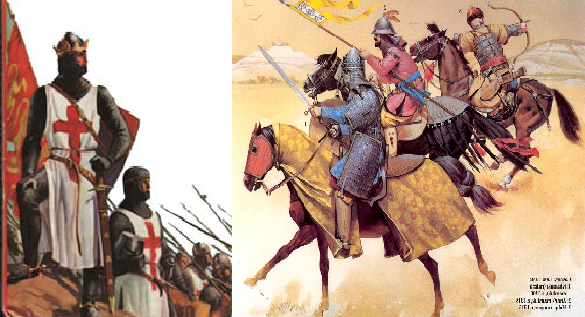
That establishes a history of conflict between the two religions, because “armed Cross-bearers” were invaders of the Middle East, intent on taking land and killing Muslims. The use of the word “guettee,” in line two, means the watchtowers of the Muslims will have their prey “watched,” which connects synonymously with the use of “erte” in quatrain VII-37. The use of “nef,” in line three also links this quatrain to the previous three mentioned here; but the presence of “dix galeres eslites” (“ten galleys elite ones”) certifies this match, where Christian and Muslim are identifying the opposing sides in a prepared “List” or “Joust.” The lack of capitalization of “dix” is then stated as “chosen ones” or “picked out ones,” as the root intent of the English use of “elite.” Where the “superiority” is stated, rather than implied through capitalization.
A couple of notes of interest come from line three’s word “batus” and “Raviere.” As the past participle of the Old French verb “batre” (now “battre”), “batus” means, “beaten ones, knocked ones, battered ones, and churned ones” (among other choices). Still, as the noun “batus,” the meaning is stated as, “An order of friars, which in their nightly processions whip their backs extremely.” The word “raviere” (also spelled “rabiere”) means a “bed of turnips.” With the word capitalized one is looking for a very important “Bed of turnips,” which on the surface seems quite meaningless. However, when one remembers the capitalized “Rubriche,” in line three of quatrain IX-100, we found a most important “Marking in red.”
The aspect of turnips is they are an underground vegetable, meaning they grow under the surface. A turnip can be mistaken for a radish, because there are bright red turnips. From seeing this potential, one could see “Raviere” as a “Bunch of red taproots,” being Soviet-made submarines. Still, when the word is read as Ravi, meaning “Ravished, Snatched away hastily, Pulled away violently, Take away forcibly, and Bear away suddenly,” with the -ere suffix being Old French for -er or one who does what it is connected to, the capitalization makes a “Bunch of red taproots” from Soviet-Russia be designed to attack ships. The religious meaning for the root Ravir (as to Rapture) means “Taken away suddenly to heaven.”
For all of this exposure, quatrain IX-43 can present one possible translation as:
……….Close to has to cast down the armed Cross-bearer
……….Will be spied into by them Arab Muslims
……….With all coated ones beaten ones by reason of ship Ravishers,
……….Prepared assaulted ones with ten galleys superior ones.
The use of a capitalized “Proche” matches the description of “Dix naves proches” (“Ten ships close by ones”), found in line two of quatrain X-02. To read “cast down,” where the implication is to defeat one, the sailing terminology can be also seen, as going fishing, while dropping anchor. Still, the use of “envoyés” has one recall how “Ten” caused a response of “messengers cast out.”
The secondary theme matches the report in quatrain VII-37, where the “watchtowers” were “not” normal intelligence. The use of “advert” was also a level of intelligence that allowed “warning,” which could come from spies set within the ranks of their enemies.
When line three uses the term “coated ones” or “coded ones,” it links one’s thoughts back to the “hot mist” that was said to linger after ships had “strangely Turned red.” Line four repeats the theme of “ten ships,” making quatrain IX-43 easily fit into the story line of a disastrous naval battle in the Persian Gulf.
See if you can add to this. What do you see?


 Nostradamus Blog