
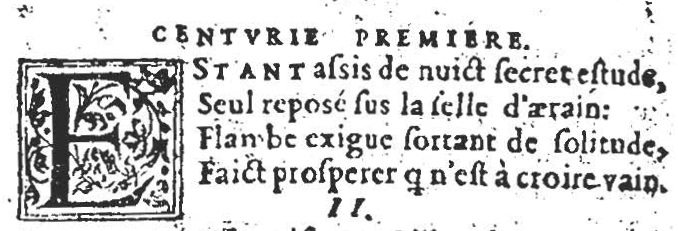
I have broken this quatrain’s interpretation into two part because it is rather deep and involved. As the first quatrain found after the Preface, it makes an important statement about who will be able to understand what is written in the poetic verses. These four line then become a microcosm of the macrocosm that is the Preface. For one to realize the truth of this first poem, one needs to discern the truth of the Preface. This quatrain then confirms portions of that explained in introduction.
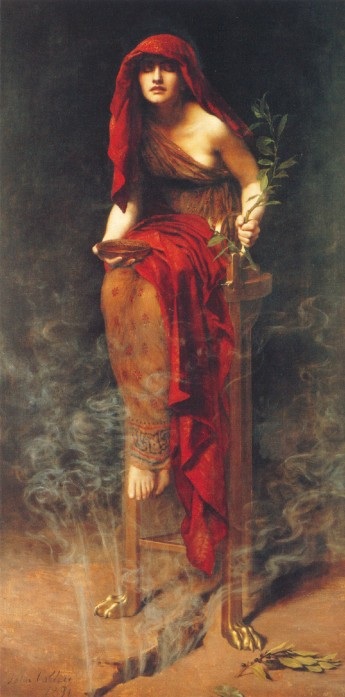
With the two main themes stating Yahweh as the source, with His “BEING appointed to” a wife-soul, such that the “darkness” that clouds the words, placing them in a “hidden” form, requiring devotion to “study,” rather than quickly read, this demands one receive the Advocate that is Jesus’ soul. With one coming from divine creation and returning each life ended to Judgment, for one to stand “Alone” in the world as a soul “remarried” to Yahweh, devoted to being His servant, that brings from “above” the resurrection of Jesus “there,” within the flesh of the reborn Son. This is not to be pampered or to have one brag about being saved by Jesus, it is to enter ministry in that name. Thus, one’s soul-body becomes the “saddle” or “seat of bronze” upon which the soul of Jesus sits, uttering divine Prophecies of truth.
The secondary theme then has line three clarify this “seat of bronze” or “brass.” The first word of line three is a capitalized Flambe, which means “a Flame” and “a Great blaze of fire,” with the accented (past participle) Flambé adding “Flamed, Blazed, Glistered; and also Blasted with flaming or hot scalding lead” (Cotgrave, 1611). In Part 1, I wrote how the translation of “saddle,” in which Jesus was positioned, became a depiction of him on a white horse, as Revelation 19:11 depicts. In Revelation 19:12, this return of Jesus is portrayed with “the eyes of him like flame of fire.” This depiction continues in Revelation 19:15, where it states, “out of his mouth comes a sharp sword so that with it he can strike down the nations;” adding “he will shepherd them with a rod of iron,” which will be “of the fury of God Almighty.” This becomes Nostradamus as the “white horse” that wears the “saddle upon” which Jesus speaks (“out of his mouth”) through The Prophecies, as sent by “God Almighty.” The stories of the quatrains “Blaze,” such that the “nations” that rule over souls will be “Blazed with flaming lead.”
Detailing that important word is exigue, which is Latin (Vocative of exigu), meaning “cramped, small, few in number, and narrow.” The French equivalent is exiguë (feminine of exigu), means “small, modest, and insufficient.” This says this important “Blaze” of The Prophecies is so difficult to discern (even as clear pictures of war, famine, disease, and death are found in the quatrians) that this “Great blaze of fire” coming will seems “small” and insignificant to the masses. So many false shepherds will have cried “Wolf!” – with no wolf to be seen – that the chances of the future actually manifesting seem “small.” This (when John’s Acopalypse prophecy is applied to the ‘second coming of Jesus’ or the promised Messiah for the Jews [who reject Jesus]) becomes a story people do lip service endorsing, when few actually believe.
That leads to the word sortant, which is the present participle of sortir, meaning “outgoing, going out, issuing, coming forth, going beyond, furnishing, delivering, and bringing out of,” This says, much like when Saul changed his name to Paul (meaning “Small, Little”), with “few in number” quatrains making sense, from that “narrow” scope of the whole, there will be an “issuing” and “coming forth” of truth, which will be “delivering” and “bringing out of” a deep, amazing truth that now is when the future has come. It is like being in the middle of a mine field, after someone has triggered the first of many dangers that surround.
Keeping in mind this is explaining or clarifying those who are “Alone” as souls “remarried” to Yahweh, reborn as His Son from “above,” the truth will then be possible “there” (or “here” on earth) via one like Nostradamus, who is the “saddle” or “seat of brass” that speaks the truth of Prophecy in the name of Jesus. This is then said to come “to” those who have sacrificed the rewards and desires of the material realm, for a higher goal (eternal Salvation). They find great warmth and comfort listening to the revelations of Yahweh in “privacy.” They enjoy the “solitude” of prayer and hearing the instructions they each must follow. Each of these souls in flesh reborn as Jesus will have gone to the “wilderness” (their proverbial forty days fasting from worldly wants), no longer willing to waste their souls in commitment to a “desert” that offers only “loneliness,” void of the moisture of everlasting waters.
With this clarification grasped, line three ends with a comma mark, separating it from line four’s train of thought. Line four then tells of the promise that comes from servitude to Yahweh, as the Son reborn into flesh. Line four then begins with the past participle of the verb Faire, such that Faict means “Done, Acted, Made, Wroght, Forged, Composed, Framed; Fashioned; Performed, Exploited; Achieved; Finished and Accomplished.” As a noun, it means “Fact, Act, Action, Word, Deed; Feat; Performance, Achievement, Exploit; and Argument in pleading.” Following line three’s focus on that “small issuing out of privacy,” the importance of “Act, Acted,” and “Action” makes this be the name of the book that tells what the Apostles “Performed,” as they “Fashioned, Forged,” and “Accomplished” the spread of the way of life that was true Christianity. The brother of Jesus, James, was led by the soul of Jesus within his soul to write, “Faith without Works is dead.” Thus, line four is putting important attention on that “Done” and “Performed” by Saints who are told the truth of The Prophecies (as well as all divine literature).
The details to this “Work” is then so other will be able “to prosper” and “thrive,” after they have been “given success unto” how to commit to Yahweh and gain eternal Salvation by being reborn from “above” as Jesus. This is all “who” and “whom” will be “born abides” in the name of Jesus (reading n’est as a contracted né to est), versus those “who” and “whom” “not is” so divinely possessed (reading as ne est). This is not determined by Yahweh, nor by Jesus, as it is “to” the one “who” seeks to be “with” eternal life assured, willing to submit and commit fully unto “remarriage” of one’s soul with the Spirit of Yahweh, begatting the soul of Jesus as His Son reborn in His wife-souls. This becomes a matter of “belief.”
The word croire means “to believe or think assuredly; to trust, have confidence in, give credit unto; also to lend, put in trust with, and commit into the hands of” (Cotgrave, 1611). This is where one must understand the difference between “belief” and “faith,” where many “think assuredly” those two are the same. They are not. “Belief” is a matter of learning what someone one “trusts” has told one, such as a teacher in school, a foreman at work, or a pastor at church. This becomes an exercise of memorization, where the only thing known certainly is the one telling one what “to believe.” Such memorization is the testd and scored, meaning one is more conditioned “to believe” that which is judged as the right answer. “Faith,” on the other hand, is personal experience that is greater than “belief.” “Beliefs” can be shattered when a “trusted” teacher proves to be a liar or a fraud. That comes to dreamers when they wake up; but “faith” is always confirmed by life; and this judgment is “private” and “Only” known by those with experience.
A minister once shared with the congregation that he was a licensed pilot, which was a talent he shared with his students in a university. His students “believed” he could fly an airplane because he told them he could. However, he said on stormy days he would tell the students that he would be flying from that college town to a larger city after class; and anyone wanting to join him could go along free (round-trip). When the thunder and lightning was all about, there were never any who expressed “faith” in his flying abilities, taking him up on his offer. That is the difference that must be discerned here.
This then leads to the last word of this quatrain, wich is vain. This means “vain; empty, void; frustrate; frivolous, trifling, idle, without purpose; also faint, weak, feeble, forceless.” This becomes a statement of whether one is “born abides,” as a servant of Jesus, the Lord within, “who” one experiences and “trusts” completely with “faith” or if one “not is” divinely possessed by the soul of Jesus and known nothing of that presence. Those “to put confidence in” the directions of Jesus (without being frightened by the sounds and sights of thunder and lightning) will be “empty” of self-will, self-ego, and self, just as a virgin bride places her complete trust in her new husband to lead her properly. It is those “who” sacrifice only “to prosper” in the material realm, “who” reject Yahweh and have no “belief” that Jesus can be anywhere other than far away in heaven, sitting on an invisible throne next to God. They deny divine possession and the “Work” necessary to bring that within one’s “BEING.” Their souls will be “void, empty” of promise, as their lives will become “idle,” from “frivilous” pursuits. They will find when Judgment comes how true it is that “vanity” is a deadly sin.
This means quatrain I-01 speaks of the commitment Nostradamus made so long ago, whereby the words can ring true as him telling about a typical night while writing quatrains. That serves no purpose as a Prophecy. That role manifests when one’s eyes are open to the demand that one become a rebirth of Nostradamus the Apostle and Saint, which means also being a soul-body committed to Yahweh in “remarriage” Spiritually. “Only” with Jesus within as one’s Lord can one realize the truth of the future that is now upon us. The purpose is not to stop the world from being the world – sin can only exist in the material realm – one can only save one’s own soul. One does that through sacrifice of self unto Yahweh and being reborn in the name of the Son. That then leads to “Action” and “Deed,” which is telling other lost seekers how to submit to Yahweh and be saved.


 Nostradamus Blog