
On page 8 of the Preface to The Prophecies of Nostramus is a section that explains the source as God (Yahweh), which had nothing to do with Nostradamus having some special talent with occult tools, which allowed him to accurately predict the future. If one reads Les Propheties as The Predictions, then one will never be able to understand the truthNostradamus’ work contains.
Here is that section:
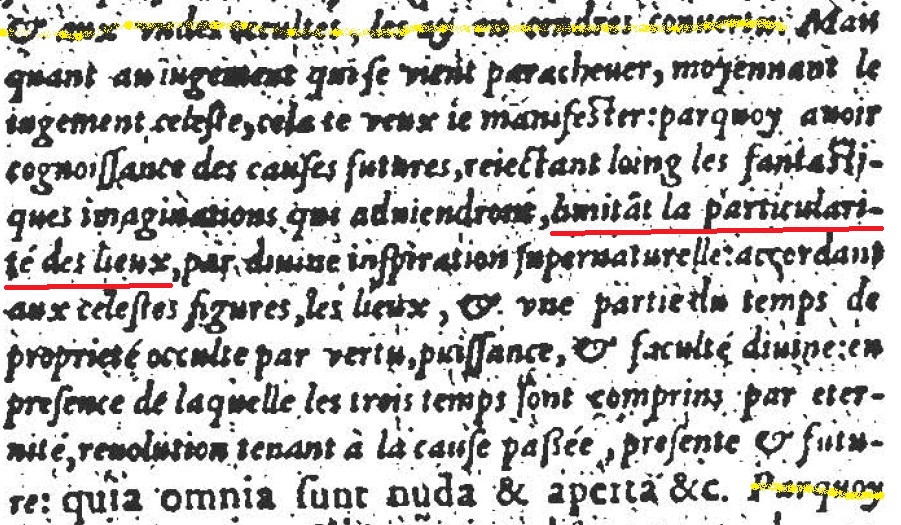
By taking note of the marks of punctuation and other symbols, this seemingly long ‘sentence’ (82 words) can be broken down into segments, which each acts as an independent sentence of words. These words of French and Latin can then be translated into English as this:
More in regard of with the determination that oneself comes to achieve,
being the means for him final decision of a judgment divine,
that you intend I to make clear:
for which cause to have understanding of them causes future ones,
rejecting far off them fantastic ones imaginations which they will be coming to pass,
limiting there particularity to them places,
coming from God inspiration metaphysical:
agreeable with them heavenly ones representations,
them qualities,
& one distinguished from the time of propriety concealed for goodness,
authority,
& ability coming from God:
upon presence of which them three times are comprehended through everlastingness,
the accomplishment of a circular course holding with reason course passing along,
in sight,
& to come:
[Latin] wherefore all things they are naked
& exposed
& so forth.
In the middle of this is written limitant la particularitié des lieux, which translates as “limiting there particularity to them places.” This must be seen as an instruction that says the names of “places” in the quatrains are not always what they seem to be. This does not mean every apparent name of a “place” is not that, but only a “limited” number have that “place” as the primary intent of translation.
This means the names of “places” are usually capitalized, giving the appearance of proper nouns. However, the rule of capitalization states that the word capitalized is important to grasp and discern. When there is the name of a “place” (simply for example Paris), one must ask, what is important about that “place”? This is especially important in quatrains that present what seems to be a whole line of verse that is little more than the names of “places.”
Most frequently, such capitalized words are somewhat misspelled and followed by a comma mark. The misspelling must be seen as a clue that the name of a place might be implied, as being important on a secondary level of intent; but with “God,” the “divine” and “celestial” stated to be the source, there is no room for mistakes, such as in spelling. Everything must be taken as written for a specific purpose, where the misspelling is “limiting there particularity to them places.” When a comma mark separates one capitalized word from other words in a line of verse, as an important one-word statement, the urge to look deeper at what that capitalized word means must be felt strongly.
In some cases, the name of a “place” has a history that becomes the primary intent. In other cases, the etymology behind the name, which is why the name was given to a “place” is the importance. In some cases, where a properly spelled name of a place has obviously nothing to add to the line of thought leading to the “place,” that word should be looked at for alternative ways to read the letters.
One such example is Lorraine, which is a correctly spelled region of eastern France. The etymology, as rooted in “land of Lothar,” a Frankish king from the 9th century, adds little (if anything) to the places where it appears written (in 4 quatrains, 2 as Lorraine and 2 as Lorrain). This means the letters can divide into L’or raine, then stating “It gold frog” (as Lorrain -> L’or rain, then “It gold bough”). Depending on the line of thought surrounding this seeming “place,” this alternative translation must be considered.
To begin to reach this point of analysis, one must then realize that Nostradamus instructed understanding this “limitation” placed on “places” demands insight that comes from Yahweh, through His Son Jesus “one” with one’s soul-body-brain. That “inspiration metaphysical” includes understanding the symbolism behind the planets and luminaries, which comes from knowing the language of astrology. The number “three” (trois) is symbolic of “divine” possession, with this being an “everlasting” union between one’s soul and the soul of Jesus. His inner “presence” bring eternal Salvation, as an Apostle or Saint; and that is who will see the truth of this written by the hand of Nostradamus, as one with the Mind of Jesus.
The purpose of understanding The Prophecies is to lead other souls (those lost) to their own state of “everlasting” union with the soul of Jesus. That is the ministry of one reborn from above in his name. Thus, as Paul was such an Apostle, as a predecessor to Nostradamus and the model of all so “divinly inspired,” this reading ends with a quote from Paul in his letter to those who understand the language of Hebrew. There the Apostle wrote, “Nothing in all creation is hidden from God’s sight. Everything is uncovered and laid bare before the eyes of him to whom we must give account” (Hebrews 4:13, NIV). That says the future of The Prophecies is from the All-Knowing Mind of Yahweh, passed on to His Son’s servants to expose the corruption in the world. It is aiding and abetting that corruption (active and passive) that all souls will be held accountable for in Judgment.
The lessons of disbelieving are found repeated in Scripture, where those who doubt a Prophecy presented by an angel of Yahweh, will be punished for that doubt. Sarai laughed when visiting angels said she would become pregnant when she was 89 years of age. She would pay for that doubt by dying well before Abraham would die. The same was applied to Zachariah, the husband of old and barren Elizabeth, when an angel of Yahweh told him Elizabeth would become pregnant with a son to be named John. Zachariah asked how could that be; and for that doubt he was made mute until after that miracle birth occurred. To think The Prophecies is the work of a fool or charlatan is to doubt the claims of the Preface, as Nostradamus speaking as an angel of Yahweh. Those who doubt will be held accountable by Yahweh.


 Nostradamus Blog