
All Material Copyright of Katrina Pearls
(apart from the obviously stolen stuff)
Reproduction by Permission Only
When one realizes that Nostradamus explained The Prophecies was a work written so that
the words have double meanings, it becomes a simple matter of relinquishing all personal
desires to translate in solute oratione solely as “in plain prose”. Doing so rejects the use of
the word amphibologique in explanation, or recognizing it as a word indicating such
multiplicity of meaning. To see translations that are “not amphibological” is to find only
ambiguity.
This means that a review of the complete context surrounding this Latin phrase has to also be
checked for amphibological wording. As such, we find that Nostradamus wrote, in his
preface, “comme plus a plain j’ay redige par escript aux miennes autres propheties qui
sont composes tout au long, in solute oratione, limitant les lieux, temps“. This literally
translates to read, “like more to smooth (or plain) I have reduced by writing (or set down in
writing) with (or of, to, in) them my other ones prophecies which are composed (or done in
verse, or written) ones all in the long (or length, or tedious, or out-stretched), in unrestricted
style [of language or speech] (or in free prose), limiting the places, times”.
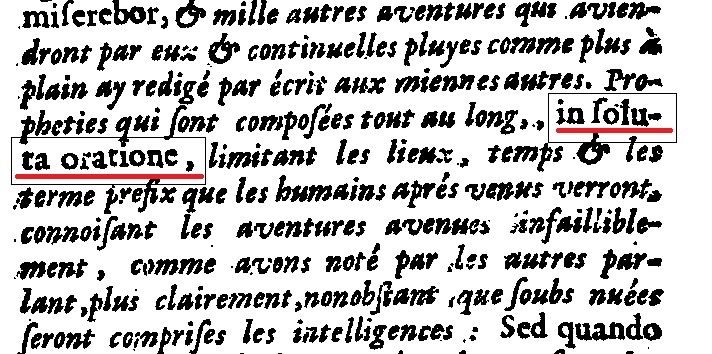
Just from reading through these words, we can see Nostradamus referring to multiple
prophecies. This is based on the plural ending on mienne and autre, which shows another
set of multiple prophecies are known to be from the pen of Nostradamus. This multiplicity is
then the source of the multiple possibilities, as far as in solute oratione is concerned. As a
separated grouping of Latin words, they can be read as a recognized idiom, and they can be
read with the flexibility of each word being free to follow the extent allowed for the meaning of
the individual word. The standard translation would then be a reference to the other
prophecies, like in his Almanacs. They were written in standard understandable language,
much like prose. However, the words of The Prophecies were not designed to be read in
such a standard manner, which causes them to be unintelligible. This means, as a reference
to The Prophecies, and not the Almanacs, Nostradamus is making the statement that they are
written in unrestricted style (of language).
In this series of words, another such idiom is placed, which also follows the same
amphibological way to find whole meaning to the words. This is where Nostradamus penned
the word redige. In modern French, this word is plain and simple, accepted to mean, “written,
or drawn up,” as a written contract. In modern French, the word “reduire” is the verb meaning,
“to reduce,” with the past participle being “reduit.” It is obvious that Nostradamus did not
write “reduit,” which leads one to believe, “j’ay redige par escript” means, “I have drawn up,”
or “I have written,” rather than, “I have reduced.”
Well, in 1611, when a preserved Old French to Old English dictionary was written, the past
participle “redige” was stated to translated as, “reduced, brought back or into; digested,
ordered; urged, or compelled unto.” The same basic translations were also listed for
“reduire,” “reduict,” and “reduit.” In fact, the author of that dictionary, Randal Cotgrave, made
note that the idiom, “redige par escript” (the exact phrase written by Nostradamus) can
translate to mean, “set down in writing”. This would lead one to believe the evolution from two
words having the same multiple meanings, to two words with separate meanings was
beginning, but not yet complete. Therefore, Nostradamus is making the statement, “like more
to smooth I have set down in writing (or drawn up in writing) in my other prophecies [the
Almanacs, etc.] which are composed ones all in the length.” But, he is also stating, “like
[adding] more to [the words] plain [without other words in combination with each] I have
reduced [cut out what standard speech adds in] by writing [The Prophecies] with my other
prophecies [the Almanacs, etc.] which are understandable ones [because] all [of those
quatrains are worded] in the [standard form of prose in] long [form]”.
What this was conveying was nothing new. It was the philosophy made public by William of
Ockham, who was a master of the philosophy of logic, while also being a Franciscan friar, in
the 14th Century (he died 206 years before The Prophecies was first published). William is
perhaps best known for his philosophical argument called Occam’s Razor. A simple
description of this philosophy is, “less is more.” According to Wikipedia’s definition, “The
principle states that the explanation of any phenomenon should make as few assumptions as
possible, eliminating those that make no difference in the observable predictions of the
explanatory hypothesis or theory.” However, the paradox is that the essence of Occam’s
Razor is, “Plurality ought never be posited without necessity.”
For The Prophecies the necessity becomes plurality due to the bare presence of individual
words, which cannot be joined (for conversation understanding) until that plurality is
understood. This means a language without the singular restriction of syntax (not
amphibological) is the only way to the true meaning of The Prophecies, with all ambiguity
removed.


 Nostradamus Blog