Tag Archives: Nostradamus & naval battle

Quatrain II-40 – Naval Battle 6


These quatrains listed as “Naval Battle” are all linked to one suprise attack on a U.S. fleet in the Persian Gulf. I posted an article in 2016 about this still unfulfilled future event, due to tensions rising there then. Certainly, now that 2025 has brought the United States a step closer to this deadly battle, I feel it is time to review those quatrains again. Now, I am listing them individually, to make them more readable to the illiterate smartphone addicts with the attention span of a gnat.

—–

Still one more quatrain to consider (as far as making my point about a story of a great naval defeat still to come) is II-40.  The Old French verbiage of it states:

Un peu apres non point longue intervalle,

Par mer & terre sera faict grand tumulte:

Beaucoup plus grande sera pugne navalle,

Feus, animaux, qui plus feront d’insulte.

The Crystal Links website shows this translating as:

Shortly afterwards, without a very long interval,
By sea and land a great uproar will be raised:
Naval battle will be very much greater,
Fires, animals, those who will cause greater insult.

Notice how the use of an ampersand has been transformed into the word “and.” The usage of ampersands is divine and not a statement about a conjunction. There are 682 ampersands placed in 950 quatrains. In addition to that, there are ninety (90) times the word Et is written, with every one of those beginning a line of verse. Neither should be read as “and” or “And.” It is a sign or signal that preceeds importance that must be seen to follow, with a capitalized Et being a statement that the whole line to follow is most important to discern. Thus the ampersand here separates the important statement that can be read to say, “By reason of deep emotions” (Par mer) from that which follows, importantly stating “country will rise made substantial sedition:” A “country” (terre) “will stand acted mighty sedition” importantly speaks of civil unrest and revolution.

Here is a viable translation that maintains word order and punctuation (including ampersand signs).

One few following not moment of time long pause,

By reason of deep emotions & country will rise made sedition:

Very much more mighty will exist fist of the sea,

Deaths, beasts, which added will be forging to triumph over.

In this quatrain, one simply finds “pugne navalle,” where quatrain IX-100 began its main theme by stating, “Navalle pugne.”  In that quatrain we saw “grand” stated, where “grand” (line two)  and “grande” (line three) are found here.  In The Prophecies of Nostradamus, the word grand (in several forms) projects a air of “Christianity,” which is opposed to Communism and Islam, although all major powers are “substantial” as “mighty” opponents. Still, grand must focus one’s eyes on those nations that give credit for their “might, substance, height” of power and influence to their recognition of the “noble” agents of Jesus and God (kings and queens of rule and the Church of Rome).

Finally, line four here begins with a capitalized “Feus,” which tells of tremendous “Fires.”  This matches the use of “fue” in line two of quatrain IX-100. Still, the word Feus is capitalized, making this be an important statement about “Fires” and “Lights,” while the same word (Feu) also means “Dead, Deceased, Departed,” which important follows “fist of the sea” (pugne navalle). That becomes a statement of many “Dead ones.” They will be killed by “beasts” calling themselves human beings. The use of plus says “more” than one enemy will cause so much “Death,” as those “making” this future materialize have “Very much deep emotions” of hatred, seeking to “triumph over” one who praised God for his “country” being “mighty.”

In the news today the “sedition” against Donald Trump is already at hand, where the Communists have been “added” to the Islamic presence (all while millions of killed illegal immigrants are ready and poised to begin a civil war in the United States). When the “battle naval” will be the suprise destruction of a U.S. fleet in the Persian Gulf, it will trigger waves of attackers all around the world in “Christian nations.” This will be when the Iranian nuclear capability had nothing to do with what was just recently bombed (June 2025). The Iranians have “added” already-made nukes by paying their Commie pal Vlad ‘the Beast’ Putin, before the attacks of September 11, 2001. All the news of Iran trying to develop their own nuclear weapon is a red herring. When the Iranian finally make their promise that America will suffer “everlasting consequences” for bombing them, they wanted that excuse and prayed to Allah that Trump and Israel would cross that line. Now they feel nuking the world will be justified by their god.

Still, do not believe me for what I write. You must see for yourself what is written. Can you see the truth? Or, are your eyes and brain too filled with the “Moon” changing your emotional states, blinding you with “rage” or “patriotism”?

This ends this six-quatrain series about Naval Battle.

Leave a comment

Filed under Nostradamus

Quatrain V-35 – Naval Battle 5


These quatrains listed as “Naval Battle” are all linked to one suprise attack on a U.S. fleet in the Persian Gulf. I posted an article in 2016 about this still unfulfilled future event, due to tensions rising there then. Certainly, now that 2025 has brought the United States a step closer to this deadly battle, I feel it is time to review those quatrains again. Now, I am listing them individually, to make them more readable to the illiterate smartphone addicts with the attention span of a gnat.

—–

Another quatrain that adds details to this series is V-35.  The Old French states:

Par cité franche de la grand mer Seline,

Qui porte encores à l’estomach la pierre:

Angloise classe viendra soubz la bruine,

Un rameau prendre du grand ouverte guerre.

Crystal Links translates this as such:

For the free city of the great Crescent sea,
Which still carries the stone in its stomach,
The English fleet will come under the drizzle
To seize a branch, war opened by the great one.

Notice how they take liberties with punctuation and word order. This becomes a paraphrase that generally links “sea” (mer) of the “Moon” (Seline) to an “Englishman” (Angloise) in charge of a “fleet” of “rank” (classe). This is relative to something “underneath” (soubz) that creates a “hot burning mist” (bruine). The last line places focus on “mighty open warfare” (grand ouvert guerre).

The word cité is most frequently read as “city,” which is the noun translation. However, the same spelling is the past participle of the verb citer, meaning “to cite, summon to appear, or warn to appear.” Being “cited” is like a traffic summons that tells one when to show up for court. By seeing this, those who proudly claim to be “free” (franche) will be “summoned to appear,” with them being “mighty” Christians (grand), which is like the “Cross-bearers” of quatrain IX-43. The capitalized use of Seline, where the Greek goddess Selene was representative of the “Moon,” which is a celestial orb that is constantly changing shapes, the “Moon sea” would be a body of water in the Islamic world, like the Persian Gulf. That can be seen as the “stomach” or “womb” of the Middle East. The use of mer, where a “sea” is water, can metaphorically be a statement of the emotions that are relative to the “Moon,” as ever-changing. Thus, a call for help could be seen as an “Islamic anger” (Seline mer) suddenly erupting.

In this quatrain we again see “classe” used [read as Latin], with this time the “fleet” identified as “English,” which is an important word, due to the capitalization.  This also relates to “rank” and “order” (French classe) that is led by an “Englishman” (Angloise is the feminine version of Anglois). This could mean an Admiral of “rank,” who speaks “English.” Thus, this does not necessarily mean Great Britain, but a nation with a “fleet” that speaks “English.”  Language would be very important if one’s intelligence depended on fluency in a foreign language, and Farsi is where American intelligence struggles to find trusted fluency. 

Once again we also find the word “bruine” in a line telling of a “fleet,” with the word “under” or “beneath” linked to this “hot burning mist.  Finally, the last two words in line four are “ouverte guerre,” which represents the same words in the reverse order, as was found in line two of quatrain  VII-37, meaning “evident warfare” here.

Once again, it is not what I see, as my seeing something only affects my faith and Salvation. What do you see? Do you care to see beyond the surface of words, to see what images are flashed into your mind?

Leave a comment

Filed under Nostradamus

Quatrain IX-43 – Naval Battle 4


These quatrains listed as “Naval Battle” are all linked to one suprise attack on a U.S. fleet in the Persian Gulf. I posted an article in 2016 about this still unfulfilled future event, due to tensions rising there then. Certainly, now that 2025 has brought the United States a step closer to this deadly battle, I feel it is time to review those quatrains again. Now, I am listing them individually, to make them more readable to the illiterate smartphone addicts with the attention span of a gnat.

—–

Consider the verbiage of quatrain IX-43, which clearly addresses this issue of religion.  Quatrain IX-43 states in the Old French:

Proche a descendre l’armée Crucigere

Sera guettee par les Ismaëlites

De tous cottez batus par nef Raviere,

Prompt assaillis de dix galeres eslites.

In line one the capitalized word “Crucigere” shows the importance of  “Cross-bearer, where the implication in the 16th and 17th centuries was, “an order of friars who wear crosses on their habits.”  Modify this statement about a Christian sect with “l’armée” – “the armed” or “the army” – and one has just been given a vision of a “Crusader.”  This is then followed, in line two, with “les Ismaëlites,” which literally means, “Those descended from Abraham, through Ishmael” – “Arab Muslims.”

That establishes a history of conflict between the two religions, because “armed Cross-bearers” were invaders of the Middle East, intent on taking land and killing Muslims.  The use of the word “guettee,” in line two, means the watchtowers of the Muslims will have their prey “watched,” which connects synonymously with the use of “erte” in quatrain VII-37.  The use of “nef,” in line three also links this quatrain to the previous three mentioned here; but the presence of “dix galeres eslites” (“ten galleys elite ones”) certifies this match, where Christian and Muslim are identifying the opposing sides in a prepared “List” or “Joust.”  The lack of capitalization of “dix” is then stated as “chosen ones” or “picked out ones,” as the root intent of the English use of “elite.” Where the “superiority” is stated, rather than implied through capitalization.

A couple of notes of interest come from line three’s word “batus” and “Raviere.”  As the past participle of the Old French verb “batre” (now “battre”), “batus” means, “beaten ones, knocked ones, battered ones, and churned ones” (among other choices).  Still, as the noun “batus,” the meaning is stated as, “An order of friars, which in their nightly processions whip their backs extremely.”  The word “raviere” (also spelled “rabiere”) means a “bed of turnips.”  With the word capitalized one is looking for a very important “Bed of turnips,” which on the surface seems quite meaningless.  However, when one remembers the capitalized “Rubriche,” in line three of quatrain IX-100, we found a most important “Marking in red.” 

The aspect of turnips is they are an underground vegetable, meaning they grow under the surface.  A turnip can be mistaken for a radish, because there are bright red turnips.  From seeing this potential, one could see “Raviere” as a “Bunch of red taproots,” being Soviet-made submarines. Still, when the word is read as Ravi, meaning “Ravished, Snatched away hastily, Pulled away violently, Take away forcibly, and Bear away suddenly,” with the -ere suffix being Old French for -er or one who does what it is connected to, the capitalization makes a “Bunch of red taproots” from Soviet-Russia be designed to attack ships. The religious meaning for the root Ravir (as to Rapture) means “Taken away suddenly to heaven.”

For all of this exposure, quatrain IX-43 can present one possible translation as:

……….Close to has to cast down the armed Cross-bearer

……….Will be spied into by them Arab Muslims

……….With all coated ones beaten ones by reason of ship Ravishers,

……….Prepared assaulted ones with ten galleys superior ones.

The use of a capitalized “Proche” matches the description of “Dix naves proches” (“Ten ships close by ones”), found in line two of quatrain X-02.  To read “cast down,” where the implication is to defeat one, the sailing terminology can be also seen, as going fishing, while dropping anchor.  Still, the use of “envoyés” has one recall how “Ten” caused a response of “messengers cast out.”

The secondary theme matches the report in quatrain VII-37, where the “watchtowers” were “not” normal intelligence.  The use of “advert” was also a level of intelligence that allowed “warning,” which could come from spies set within the ranks of their enemies.

When line three uses the term “coated ones” or “coded ones,” it links one’s thoughts back to the “hot mist” that was said to linger after ships had “strangely Turned red.”  Line four repeats the theme of “ten ships,” making quatrain IX-43 easily fit into the story line of a disastrous naval battle in the Persian Gulf.

See if you can add to this. What do you see?

Leave a comment

Filed under Nostradamus

Quatrain VII-37 – Naval Battle 3


These quatrains listed as “Naval Battle” are all linked to one suprise attack on a U.S. fleet in the Persian Gulf. I posted an article in 2016 about this still unfulfilled future event, due to tensions rising there then. Certainly, now that 2025 has brought the United States a step closer to this deadly battle, I feel it is time to review those quatrains again. Now, I am listing them individually, to make them more readable to the illiterate smartphone addicts with the attention span of a gnat.

—–

With quatrain X-02 and IX-100 shown to be telling the same story, with separate details making the story gain depth of field and yield a specific prophecy that has yet to occur, let me add another quatrain to consider.  That quatrain is numbered VII-37 and states:

VII-37

Dix envoyés, chef de nef mettre à mort,

D’un adverty, en classe guerre ouverte:

Confusion, chef, l’un se picque & mord,

Leryn, stecades nefz, cap dedans la nerte.

Again, before I present one viable translation, look and see how the capitalized “Dix,” meaning “Ten,” is repeated.  It is in the main theme line, along with the word “nef,” meaning “ship.”  In line four, we find “nefz,” which is the plural of “nef.”  In the use of “classe,” especially in a quatrain where sailing vessels are mentioned, and with the word “guerre” following the use of “classe,” the translation is commonly said to be “fleet.”  We found “classe” also in the secondary theme line of quatrain X-02.  Such links act to bond this quatrains to the other two.

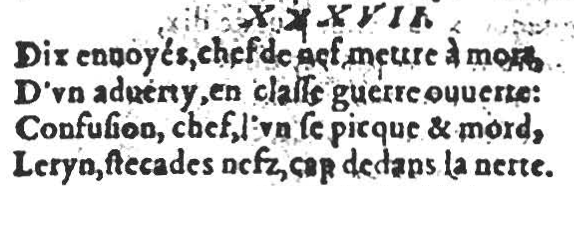
For the translation of this quatrain, I will present a copy of the print, as shown in the 1568 Lyon edition.

Looking above, you can see how page bleed has made it difficult to read some words.  The second word is possible to be read as “ennoyés” or as “envoyés,” as the type for a “v” is the same as that for a “u” (as seen in “advert” and “ouverte”).  In the Old French dictionary from 1611, an unaccented “envoye” refers one to look up “ennoye” (again unaccented).  When the use of a “y” is seen as acceptable to switch with an “i,” the spelling as “ennoie” becomes a third person singular (simple and subjunctive tenses) for “ennoyer,” which means “to flood” or “to inundate.”  The past participle of “ennoyer” is “ennoyé.”Another way to state things that are “inundated” is “they are underwater.” That would be an important clue as to the stealth abilities of “Ten ships.”  However, the 1566 Lyon edition clearly shows the word to be “envoyés

By my pointing this out, I hope the student can see how there is never just one translation to consider.  There are many errors in the 1566 Lyon edition, which caused a need for a revision in 1568.  It may be the correct word set in type was “ennoyés” so that must be considered in translation.  However, based on using “envoyés,” one translation of quatrain VII-37 can now be shown so it states:

……….Ten sent unto ones, principle commander to ship to place with murdered,

……….Of one informed, into fleet warfare apparent:

……….Confusion, paramount, the one itself this thrust into & bites,

……….It nothing, places of combat ships, promontory within there not a place that stands high.

This quatrain begins with a capitalized “Ten,” meaning this number is of significant importance.  It matches the capitalized “Ten” of quatrain X-02.  Erika Cheetham and others have failed to see how the repeating of this number links these two together, more so because this quatrain references “ships,” just as quatrain X-02 added supporting details to the main theme of a “Veiled galley,” stating “Ten ships.”

In the quatrains of The Prophecies, the word “dix” is presented seven times.  Three times it is capitalized, with the other four in the lower case.  In quatrain VIII-69, the importance of “Ten” is related to “years,” and not “ships.”  While there can be a way to link “Ten years” to “Ten ships” and “Ten envoys,” because the 1991 sale of Soviet attack class submarines to Iran was protested in the U.N. and the delivery of the weapons was agreed to be “Ten years.”  Still, I am not going to interpret quatrain VIII-69 here and now; but know that two of the three capitalized presentations of “Dix” link those quatrains together.

When one sees the possibility of “ennoyés” being intended to be read (in addition to “envoyés”), “Ten underwater ones” makes the connection stronger.  Still, when “envoyé” is seen as meaning (as a noun), “A special messenger sent by a Prince from  foreign country,” and as the past participle of the verb “envoyer,” “Sent; delegated; addressed or directed unto;  also to cast or thrust out,” these definitions can all be applied to a military presence.  “Ten ships” (at least) would be the important number “sent” by Russia to Iran.  Those “Ten” would then be awaiting the arrival of an “envoy” of “ships” – a “great fleet” – “sent” to deliver an important message to Iran.

These first two words of line one are then separated from the remainder of the main theme by a comma.  This statement is then directly relative to the sending of warships to the Persian Gulf – warships intending to deliver a powerful message – warships that will send ships “underwater” by ships already stationed there.  The direction is because a “head” person – a leader of merit – wanted a “ship” in “place,” where “death” had already occurred and was planned to take place again.  This makes the main theme relate to the sending of warships by the command of the President of Russia, the receipt of those warships by the President of Iran, and the order of the President of the United States to “address” a murderous act committed by Iran (military or terrorist actions), as a declaration of war.

Following a comma at the end of the main theme, the secondary theme is set up to be separate in time and/or space, while relative to this sending of “Ten” to a “place with death.”  The capitalized first word is a combination word, “D’un,” where the capitalization of the preposition “de” is one with the word “un,” making the result be to place focus on a most important “One.”  The importance of the directional preposition is all directions are importantly part of this “One.”  We have to consider “To one, From one, Of one” and perhaps most importantly “With one.”

In quatrain IX-100, I brought out the importance of “Le” being read as a powerful “It.”  The implication was that “It” was a most powerful weapon, as would be a nuclear bomb.  When reading “D’un” as an important possession of “One,” as “With one,” it becomes easy to see how “It” can be related to Iran’s quest to develop a nuclear bomb.  Should Iran successfully test such a bomb, it certainly would cause a reaction by the Americans, such that a show of strength could be the order given in response to such a test.  This would then begin the “To-From” of “sending messengers” by “leaders.”

The use of “adverty,” which means, “advertised, informed, certified, warned, admonished, advised; signified unto; and giving notice or intelligence of,” this means the important “One” is too big to keep secret.  When Pakistan first developed their nuclear bomb and successfully tested “It,” the nation cheered wildly, making Abdul Qadeer (A.Q) Khan a national hero.  I would imagine Iran would celebrate in a similar manner, making American satellite surveillance simply a matter of confirming what would probably be broadcast internationally through the news media.  Thus, the secondary them is initiating a focus on important publicity “Of one” being “With one.”

As was with the main theme statement, where a comma separated it into two fragments, a comma is placed in line two similarly.  This creates a separation from the intelligence obtained “Of one,” so the flow following expands on that new information.  That expansion states, “in fleet warfare evident” or “apparent, open, overt.”  Certainly, this says the “intelligence gathered” shows a “weapon of warfare” is relative “To one,” with the results of a successful application of that technology being “clear” and “plain” to see.  The aspect of “classe” as “fleet” could mean the launching of a warhead from a ship at sea (the Indian Ocean or Arabian Sea); but it could also mean the significance “Of one” comes from placing “It” “in a class” of “war” tools that is greater than lesser bombs.  In this regard, “fleet” could mean that many “Of one” have been produced.

The secondary theme then is explaining why “messengers” have been sent, because the only purpose of a nuclear bomb is “death,” which is such a weapon in the hands of “inferior” nations makes the world unstable, with “war” a threat more openly communicated.  The world has seen this with Kim Jong-un, who readily tests missiles and threatens the West and America with use of his bomb.  Recent reports say Jung-un is working with Iran to develop their bomb.  Therefore, line two ends with a colon, making line three clarify this aspect of the “open” threat of “war.”

That which is “open warfare” or “evident contention” or an “apparent debate” (from “guerre ouverte”) is clarified as a most high degree (capitalization) of “Confusion, Disorder, Chaos,” or something “Confounding.”  This state of “Confusion” could be due to Iran making its nuclear capability come about much faster than expected.  In respect to the recent agreement struck by the Obama Administration, overseen by Secretary of State John Kerry (January 2016), the White House reasoned it would be “Ten years” (quatrain VIII-69) before Iran would have enough uranium-235 to make “One” bomb.  A major state of “Confusion,” setting off a “Hurly-burly” (busy, boisterous activity – tumult and uproar) of officials scrambling to see why their intelligence did not forewarn them of this progress, is not only clarifying an “overt” activity of warfare” weaponry, it is supporting the main theme of “Ten messengers” being ordered into harm’s way.

While there may be those who reckon that such an unexpected test would be from not developing their own nuclear weapons, but from having purchased some on the international “black market,” the comma following “Confusion” says that a subsequent clarification of that which has “apparently” taken place is of “paramount” importance.  The word “chef” is repeated as this next step, but instead of being a word stating (as a noun), “chief, general, head, or principal commander,” it reads as an adjective, denoting the highest degree of importance, with “paramount” being a call for the one with the highest degree of authority to bring calm to the din.  Still, because of this great level of importance, a secondary meaning for “chef” can be read, as “the end of a place, time, or business.”  That would mean this situation was “paramount” because of the threat to the world’s continued stability – the End Times.

Following another comma, the colon’s list of clarifications of “chiefly” (adverb usage) comes “the one itself this thrust into.”  As a clarification for line two beginning with “Of one” (or “To one, With one, From one”), we now see this is “the one,” where a combined article and noun is written (“l’un”).  The “Confusion” that becomes “paramount” is related to it being “obvious” that “one” has been witnessed.  The statement “the one” then precedes the word “se,” which is a personal pronoun relative to people or numbers, as a reflexive pronoun.  This means “the one” is “oneself” or “itself” (as an inanimate object), which is then described as “picque.”

The word “picque” appears six times in quatrains, one of which (obviously) is in quatrain VII-37.  This word’s spelling is found in the 1611 Old French dictionary of Randle Cotgrave stating the meaning to be, “A spade at cards,” which is not the intent in any of the six uses of “picque” in the quatrains of The Prophecies.  However, Randle Cotgrave added to his definition, “also, as pique.” 

The word “pique” is then defined to mean, “A pike [A long spear formerly used by infantry]; also a pikeman [a soldier who holds a spear]; also, A pike [a stab or piercing], debate, quarrel, or grudge.”  In this regard, where a “spear” is being stated as relative to “the one itself,” it is then worthwhile to know that Nostradamus wrote the word “pique” in two other quatrains, with the plural spelling (“piques”) in two more.  In the quatrain that follows VII-38, Nostradamus began the secondary theme line with the capitalized “Picquer,” which is to be defined as the infinitive form of the verb “piquer,” without the “c.”

Before I interpret this use in quatrain VII-37, I would like to address this “extra c” that appears in many Old French words, where by 1611 it was common to refer one to look up a spelling without the “c.”  One can see this as Nostradamus having been hung up – “Confused” – about which spelling he should use, adding it some places and leaving it out in others.  That can lead one to see Nostradamus as the author and imagine his mind a whir, trying to figure this future prophecy out.  That should not be seen as the case, as Nostradamus explained his source was God, with him simply letting the mind of Christ move his hand, while it held a quill to paper.  Therefore, the presence of, as well as the absence of a “c” has meaning.

That meaning is as an simple anagram where the “c” needs to be removed from the middle of the word and attached at the beginning, as “c’pique.”  This then acts as an abbreviation of the French word “ce,” this means “this.”  You may have noted that my translation shows “this thrust into.”  The translation is from “c’piqué,” where the past participle form of “piquer” is read [adding an accent mark is allowed … remember].

Remembering that line three is offing a list of clarifications to the “overt” display of “warfare,” which would be a test of new weaponry, the result has been major “Confusion,” followed by this new state of being be seen as of “paramount” importance, with an enemy having reached unwanted heights of technology, the next statement is telling us why this is “paramount.”  It is because “the one itself” placed on display is “this spear,” or “this thrust into” an enemy.  A “spear” alone can only do damage to one at a time, but when “the one” of concern is seen as the evil weapon alone, by “itself,” that evil then being “this thrust into” by means of a “spear,” becomes an explanation of a nuclear warhead on a guided missile.  Once that is “thrust into” an enemy, many are wounded by one strike.

Once that meaning has been derived, line three reaches an ampersand, the mark that denotes an important statement to follow, while additionally [how to see “and” implied] showing a difference – similarity duality, and adding information as a conjunction run-on.  The important statement is then “mord,” which is the third person simple form of the verb “mordre.”  This then means, “[he, she, it] bites.”

The complete defined use of “mordre” was stated to be, “To bite, or set the teeth in; to gnaw, chomp, nibble; to pinch, nip, snip or snap with the teeth; also to sting; also to smell; also to conceive, apprehend, understand.”  Each of these meaning can now be placed into that third person simple form, where the ampersand now says this tested weapon is “the one” that is designed to be “thrust into” an enemy, so that “it bites, it gnaws, it snaps, it stings, it smells, it understands.”  Relative to a statement listing a series of clarifications as to how one would react to an “evident” test of a forbidden “warfare” tool, those who were initially quite “Confused” will finally come to “understand” this new reality.  That will be what “bites,” what “gnaws” at them, what “snaps” like a rabid dog at them, what “stings” the ego, what “smells” like a conspiracy.  Most of all, it is what one finally “understands.”

Following a comma at the end of line three, one comes to a reflection of the “Confusion” that began line three.  Line four contains three quite confusing words: “Leryn, stecades,” and “nerte.”  These words have been translated by others as indicating “Lérins Islands”[two islands near Nice] and “Îles d’Hyères” (Islands of Hyères) [four islands near Marseille], which are also called the Stoechades, because they are known for their lavender.  The Latin word for lavender is “stoechas.”  As for “nerte,” Erika Cheetham footnoted it, saying it was either Old French for “black,” or from the Greek word “nerthe,” meaning “underneath.”  All footnoted words are words of uncertainty, as the Old French word for “black” was [and still is for French today] “noir.”

Because the word “nerte” is found in the 1611 Old French dictionary, not meaning “black,” but meaning “A myrtle shrub” [the same meaning today], it becomes a word like “picque,” which was defined as meaning “A spade at cards.”  When the word does not fit the flow of context, then an alternate view is required (such as seeing “picque” as “c’pique”).

The words “Leryn” and “stecades” do nothing to establish a setting because islands off the coast of southern France are not focal points for nuclear tests.  In what unfolds later in the epic story told by the quatrains of The Prophecies, one could see how seeing those specific islands act as a premonition of what will come, as far as “open warfare,” but as supporting evidence for the secondary theme statement (what all fourth lines present) coastal France can only be misleading as a primary view.

As for “stecades,” the 1611 Old French dictionary shows the word “steccades,” with an extra “c” (remember the extra “c” in “picque”?).  The word “steccade” is defined as meaning, “A place vailed in for combat or lists.”  A “list” was a jousting contest, meaning a “steccade” was a place set aside for such trials of combat.  This is a perfect definition in the context of weaponry testing.  A “steccade” is a place set aside for practicing use of “spears” (also known as lances) or “piques.”

As for the capitalized mystery word “Leryn,” it should be seen that a capitalized “L” is representative of a capitalized “La” (in quatrain X-02) and a capitalized “Le” (in quatrain IX-100), when seen as an abbreviated form in a compound word.  This means “L’” would sonnect to the front of a simple anagram consisting of the letters “eryn,” where “y” can be exchanged for “i.”  This means the word “rien” is a possibility.

The French word “rien” means, “a matter, thing, something, anything.”  To attach a capitalized “L” to this “thing” or “matter,” is to indicate a most important “One thing,” as “A thing,” or “The matter.”  When one sees how this reflects “l’un se,” or “the one itself, this is then the “One thing” from which all things of matter come – “The atom.”  As such, the French use of “rien,” when combined in a statement with a negative (“ne”), the word transforms from “something” to “nothing.”  This transformation capability of the word “rien” is then the transformation capabilities of an atom that is split, causing “nothing” be the sudden release of energy from mass (“matter”).

Seeing this possibility of translation, line four ends with an important statement about “it bites,” while also meaning “he understands,” such that the understanding is who has possession of such “A thing” that is an “evident” tool for “warfare,” especially “the one” who “oneself” had raced to have more of “the one itself,” than the other.  All of those had been mounted atop “spears” or “lances,” in places set aside for practicing “warfare.”  This could point to the realization that Iran was only acting like it was going to produce its own nuclear capabilities, when it had already secretly bought them from the Soviets years before.  This then means that sending a fleet of ships into a place set aside for jousting, where one’s lance wins when it “pricks” an opponent off its horse, is the “Confusion” of practicing a showdown or really having a showdown involving “ships” (“nefz”).

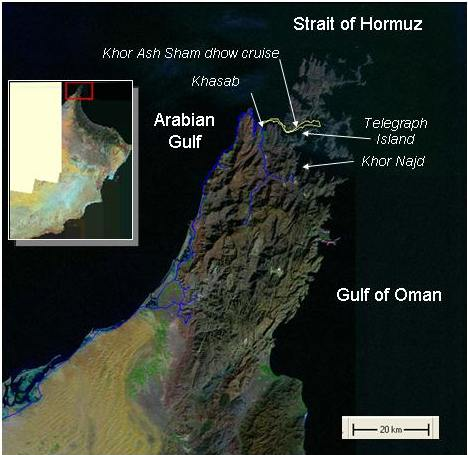
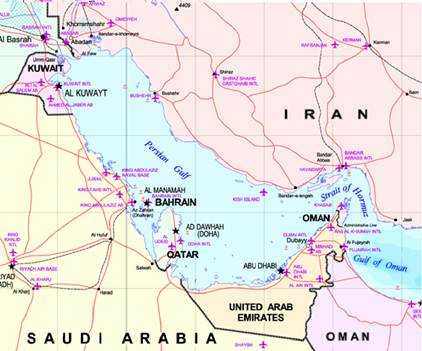
This then refers to a “cape,” where “cap” is defined as, “A promontory, cape, hill, or nook of land outstretched into the sea; a head of land lying out into the sea.”  Whereas there are several small capes that stretch out into the Mediterranean coast of southern France, consider this “promontory” of Oman:

This picture grasps how this promontory is possessed by Oman, while being separated from the greater land of Oman, by the land named United Arab Emirates. 

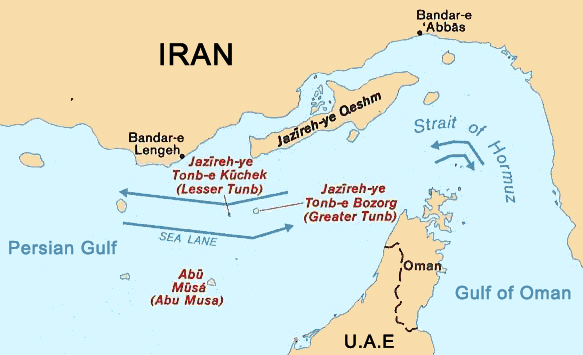
This graphic then shows how narrow the Strait of Hormuz is around this “cape.”

From seeing this geography, line four then states how this “cape” forces one to travel “within” a narrow strait, in order to get to and from “there,” where the Ten envoys” lie in waiting for a naval “fleet.”  This leaves the word “nerte” to be translated; and if Erika Cheetham is correct that it meant “black” in ancient French, then “black” is a symbolic term used by Nostradamus to indicate Islam.  That would place “there” in the land of Muslims.  Still, since I cannot confirm this, and although a Greek root, meaning “underneath” also confirms “Ten underwater” (from “ennoyes”), there needs to be a clear understanding of the word “nerte.”

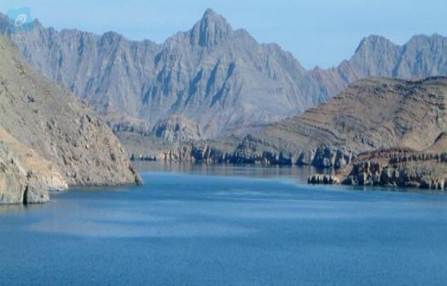
That comes from seeing the word as “nerte,” where it too becomes a compound word, with a negative attached as a prefix to the word “erte.”  The word “erte” means, “A place that stands high, or is somewhat high to look at.”  The promontory of Oman [Musandam Peninsula] looks like this:

Thus, Randle Cotgrave further defined “erte” to mean, “a steep or craggy ascent; a watch tower.”  This perfectly fits the description of the “cape” of Oman, across from the Iranian side of the Strait of Hormuz.  Still, when the negative is attached, the meaning becomes the opposite, as “not a steep promontory” or “not a watch tower.”  This would be understood as the watching eye was coming from beneath the water, and not from land overlooking it.

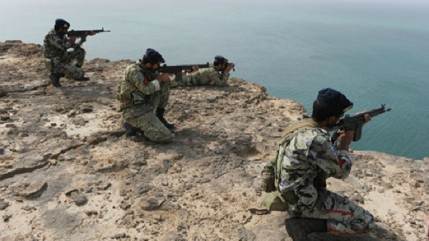
Here is a 2011 picture of Iranian soldiers in a military exercise, supposedly to guard their coast at the Strait of Hormuz:

Certainly, the focus that I have put on Iran and a trap set for the U.S. Navy in the Persian Gulf is not directly supported in the three quatrains that have stated “Ten” and “ships.”  One has to realize that Nostradamus explained in his letters how the future would involve Christians versus Muslims, where those two religions were symbolized by the colors “white” (Christianity) and “black” (Islam).  Still, there are more quatrains that fall into this series that tells of a most significant event in the coming history of the world.  It is already planned, but the timing has not yet been right.  That means there is still hope to avert this story and change the heading of the world towards a renewed faith in God and truly Christian oversight.  However, this event will always be waiting for the time when that faith has completely been lost.

Leave a comment

Filed under Nostradamus

Quatrain IX-100 – Naval Battle 2


These quatrains listed as “Naval Battle” are all linked to one suprise attack on a U.S. fleet in the Persian Gulf. I posted an article in 2016 about this still unfulfilled future event, due to tensions rising there then. Certainly, now that 2025 has brought the United States a step closer to this deadly battle, I feel it is time to review those quatrains again. Now, I am listing them individually, to make them more readable to the illiterate smartphone addicts with the attention span of a gnat.

—–

In Erika Cheetham’s 1973 edition of The Prophecies of Nostradamus, she pointed out that the verbiage of quatrain IX-100 (only two quatrains before quatrain X-02) was similar.  Her notes begin by saying, “There seems possibly to be a connection between this quatrain [X-02] and  IX. 100.”  That connection is more than possible, it is certain. 

Here is what Nostradamus published in 1568 (edited from 1566):

IX-100

Navalle pugne nuit sera superee,

Le feu aux naves a l’Occident ruyne:

Rubriche neufve la grand nef coloree,

Ire a vaincu & victoire en bruyne.

Before I present a translation, look at the word that make the connection Ms. Cheetham referred to.  The capitalized word “Navalle” is the immediate focus of importance.  Line two tells of the “naves,” or “ships,” which is a word repeated in quatrain X-02 [“Dix naves proches”].  We are then shown supporting details to the main theme and clarification to line two through a reference to “grand nef” – “great ship” – where “grande” and “Grande” were in quatrain X-02, while the main theme was about a “nef cachera” – “ship will catch.”  In quatrain X-02, line four began “Great vanquished,” where the feminine spelling of “Grande vaincue” matches line four of quatrain IX-100, which states, “Ire a vaincu” as the masculine form for “vanquished.”  All of this repeating verbiage IS how quatrains link together to tell a story in deep detail.

Knowing that, one translation of quatrain IX-100 then can be:

Naval punch darkness will be vanquished [or overcome, surmounted, surpassed],

It fire [or light; dead, deceased, departed] at them ships has the West ruined:

Marked red strange here great ship colored,

Wrath to vanquished & victory upon hot mist that blasts.

Here, we add the word “pugne,” which is Ancient French, meaning “grip,” but more related to the Latin root, “pugnus,” meaning, “fist.”  One makes a fist while gripping something.  Because the old name for boxers is “pugilists,” where they exchange punches with the fists, the Vocative case spelling.  Still, “pugne” means “a handful” and “a punch,” where it is applied navally and also at “night.”

Something that can enhance an important “Veiled” encounter is “darkness.”  Thus, another meaning for “Ten” can now be applied to the time of day, where 10 PM is after nightfall.  While that would be a secondary application of “Dix,” we are learning from the statement of “nuit” when the sucker-“punch” will  be thrown, and how that strike will make everything go “dark.”  Still, even though this punch “will be” such that the one struck “will be vanquished,” it will not instantly be fatal, in the sense that the strike “will be overcome.”

It is worthwhile noting that the use of “superee” is synonymous with the uses of “vaincu” and “vaincue” inquatrains X-02 and IX-100.  This use here, in the main theme statement of quatrain IX-100 directly links to line four of quatrain X-02, as both line speak of overcoming, surmounting, and vanquishing.  In this way, Nostradamus displayed the multiplicity of word meanings in the use of synonyms.  As such, a search of one word in a concordance for The Prophecies will only show a limited number of choices.  Add in the fact that words like “ruyne“ and “bruyne” are also spelled as “ruine” and “bruine” and an even further limitation is cast.

The secondary theme statement (line two) then ends with a colon.  That mark signifies the statements in line three [each word makes multiple statements] will clarify that theme by example, especially that “ruined,” or make a list or points supporting that already said.

In quatrain X-02, I discussed the capitalization of “La,” stating that an article cannot convey the level of importance that the adverb “” can.  The first word of line two in quatrain IX-100 also begins with what appears to be a capitalized article, in this case “Le.”  There is no need to accent this word (although that is a possibility – “”means “width, strip or length” in paper terms), as “Le” becomes important as a pronoun.  In this case the importance is shown as “It,” which relates with the “pugne” done “Navally.”

Seeing this, “It” creates “light, fire, death, deceased, and departed.”  “It” is what is “from them” who represent the “ships” of the East, which are sent “to them” that are the “ships of the West.”  By this reference, and although we still do not have a specific name for the “Great” of “the West,” the implication can be deduced as the United States.  “It” is, therefore, a weapon that is known to be what “the West has” on their “ships.”  “It” is what makes one “Great.”  However, now “It” will be what “has the West ruined – subverted – destroyed – wrecked – overthrown – and utterly undone.”

If you get the big picture of just how important “It” is, as a weapon of power, you can grasp the next capitalized word – “Rubriche,” which means significantly “Marked in red,” or “Made red.”  Still, as common citizens who are the absolute last to know what the latest in warfare technology has created, there is some doubt that a nuclear bomb would be used where so many “ships” are “nearby” to one another.  when “feu“ is most commonly used to denote “fire,” it is easy to see how “fire” and “red” are somewhat synonymous.  Still, as “fire” creates “light,” the “darkness” can be unveiled.  However, when “feu” has a secondary meaning as “death, deceased, and departed,” the factor of “fire” and “light” can be seen as some form of laser technology having been developed – much like the ray guns of 1950’s science fiction.  It can then be assumed the United States and Russia share this technology, but Iran would be the “least” nation expected to possess “It.”

The importance of something “Marked in red” is then said to be a “new, strange, uncouth, fresh” kind of “red.”  “It” even can be said to be a “Marking” that was (in Nostradamus’ time) “unknown, unused, and unheard of before.”  This could be a “Marked in red” hue that glows, pulses, or glitters, unlike anything Nostradamus had known.  This strange “Red marking” has not only “colored” the “ships of the West,” symbolizing their destruction, but it has “Marked a red-letter” day for those who had previously deemed themselves “great.”

Following the comma at the end of line three, which separates this significant reddening from line four, in time and/or space, we find capitalized the word “Ire,” which means, “Ire, Anger, Fuming, Wrath, Rage and Indignation.”  As line four represents where supporting details can be found directly relating to the secondary theme, it is an important statement about the deep hatred that exists between Americans and Iranians, because the two reflect the long time hostilities between Christians and Muslims.  This act was done out of severe “Anger,” while the act was done because of the extreme “Indignation” America had shown towards Iran, for their support of terrorism.  This “Wrath” unleashed cannot be undone, thus once it takes place the whole world will have been “vanquished” and “destroyed.”  Still, for the moment, the “Anger” shared by Communists and Islamists alike will win the day, and their enemy’s “fleet of ships” will be “overcome.”

In the middle of line four is an ampersand, which is a special mark in all of the quatrains and letters that signifies an important statement will follow.  It also acts to denote where opposites and similarities are divided, before being joined together as one.  This means an ampersand can never simply be read as “and.”  It is a very complex mark.

The important statement that follows concerns this “victory” that was brought about from extreme “Rage.” The use of the word “bruine,” which is spelled with a “y” in three quatrains (including this one) and with an “i” in three others, plus with a “y” in the plural once and as an adjective (“bruyneux”) in yet one more quatrain, means (as a feminine noun), “A hot mist that blasts and burns plants.”  Accented, as a past tense verb, it means “Blasted or burned with mist; hoary, as a thing that is covered in a misty rind.”  Because the color red is part of the determination of meaning, one could eliminate the dew-like image of hoary, unless this was part of a cooling down change.  Most likely, the mixture of “fire” and sea water would create a “hot blast” that would leave a mist; and this would be yet another detail about how this weapon is used.

Leave a comment

Filed under Nostradamus

Quatrain X-02 – Naval Battle 1


Back in 2016, due to aggression in the Persian Gulf by Iran, I posted an article that lists six quatrains Nostradamus wrote, regarding a naval battle. Now, after recent news has reported Iran being bombed by Israel and the United States militaries, Iran just recently retailated by sending a wave of missiles towards the U.S. military facility in Qatar. That addressed U.S. airplanes based there, which is not from from the island nation of Bahrain (just to the north of Qatar), where U.S. naval presence is based.

I will not present each of the six quatrains listed in 2016 and offer views on them individually. Just know they do not stand totally alone. While each is a divine prophecy, they gain greater strength when read as connected, in an epic poem. The epic poem that is The Prophecies of Nostradamus warns of the End Times that will be brought on by faithless human beings following demonically possessed false shepherds. The epic poem tells how to avoid this soul destruction that will bring about the earth no longer being able to sustain life as it has been (a brave new zombie world); but people prefer to skip how to save their individual soul and leap onto the frightening stuff. Onward to the frightening stuff.

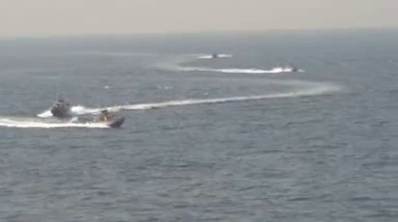
Not long ago (a few days now), the news was that four Iranian patrol boats came close to a U.S. navy destroyer in the Persian Gulf, near the Strait of Hormuz.  Later, the news reported that the American ship fired a warning shot (a flare) when two of the Iranian boats came as close as 300 yards to it. 

On the television news recently, a retired U.S. general was interviewed about this incident.  He said the Iranians were testing the response of American ships, which is restricted by directives from the Commander in Chief – Barack Obama.  While the official word from the White House was that the Iranian behavior was unacceptable, the general pointed out that the president has done nothing to establish a position that will keep future tests like this from happening.  The general added that Iran is acting in ways that demonstrate its readiness to take control of the Middle East region, as the supreme power for other Islamic nations to depend on.

Within seconds of the talking head “reporter” agreeing that this is an important development, she said, “Now a look at the stock market.”  This shows that important news is little more than entertainment for an audience that will forever have bad news reported, but never any reports of something being done to stop that flow of bad news.  Therefore, one should expect Iran to keep testing U.S. ships in the Persian Gulf, in the Strait of Hormuz.

Later that day, as I ate lunch and watched the news, I caught the tail end of a report about a Chinese spy that was caught giving China the secret codes for the technology U.S. Navy ships have to instantly communicate with one another.  This seemed to be a problem, simply because the Chinese have since installed a similar program in their fleet communication capabilities.   The viewing audience was told to stay tuned for a prime time series about the spies caught stealing American secrets, which would portray the one who was caught stealing this naval intelligence program.

There was no mention of the possibility that China could sell this technology to other foreign governments, whose militaries would love to “tune in” to the chatter going on between US Navy ships.  That seems like a worse danger to the safety and security of American ships and sailors.

Such news reports as these reassure me that what I have seen from putting multiple quatrains together, about a tragic naval defeat in the Persian Gulf, will come true (if “reassurance” is the right word).   Erika Cheetham saw two of these quatrains linking, and she saw them as possibly about the surprise attack on Pearl Harbor, on December 7, 1941.  President Franklin D. Roosevelt called that “a date that will live in infamy.”  Still, as with every quatrain thought to have already been fulfilled, if it has happened once, then it can happen again.  The two quatrains she noted as about Pearl Harbor (possibly, not certain) are perfect for setting up a scenario that makes the recent news reports of utmost importance … should being forewarned truly mean being forearmed.

The first quatrain I would like to present to you for consideration (as forearming information) is quatrain X-02.  It states (in Old French):

Voille gallere voil de nef cachera,

La grande classe viendra sortir la moindre

Dix naves proches le torneront poulser,

Grande vaincue unies a soy joindre.

One translation (there is always more than one way to put words to a prophecy) says:

[It] Vailed galley willing of ship to catch,

There great fleet will come to issue here inferior

Ten ships close by it turning to violent challenge,

Great vanquished united ones has itself to grapple as enemies.

The main theme statement (line one) begins with the capitalized word “Voille.”  A capitalized word always indicates an important statement, made in one word.  The word “voile” is actually not a word, although it is easily seen as being the same as the word “voile,” so the word is translated according to the primary intent.  Still, “voile” is a simple anagram, where the extra “l” must come out and be attached to the beginning.  Therefore, the true important word stated is “l’Voile,” where the importance of “Veil,” “Sail,” or “Ship” (since a vessel with a sail was a ship in the 16th century) is individualized as “the Veiled.” 

The reason “the Ship” is not the primary intent is the following word “gallere” means “galley,” which was a large sailing ship in the 16th century.  This means the importance of “the Ship” is its ability to be “Veiled,” such that it is a “galley” with the ability to be hidden.  It is like “A Ship behind a curtain.”

This has deeper meaning itself, whereas the people most commonly wearing veils are women in the Middle East, who are Muslim.  Since the Middle East is known for sand and oil, rather than having large sailing ships, the “curtain” that keeps the ship from being seen is one developed by Russians, who were known for the secrecy they demands behind their forceful “veil” of iron – the Iron Curtain.  Therefore, from a perspective of modern historical knowledge, line one is making the statement about a stealth naval vessel, implying it was manufactured in the former Soviet Union, and sold to the Iranians.  This sale was initiated in 1991, soon after the Iron Curtain collapsed.

The word “voil” is an Ancient French form of the verb “volonté,” meaning “wish” or “will,” where a “willingness” or “desire” is the root cause for a cloaked sea vessel being developed, manufactured and sold.  The owner of such a secret ship has only one reason for that possession, which is to use it in an act of revenge, from the element of surprise. 

This willingness is then where one finds the third word in line one that can be translated as “ship.”  The “wish” is to have the capacity “of a ship,” to use “to a ship,” to be freed “from a ship” that is superior to all the other ships one has been known for having.  This means this past history of being weak in naval war capabilities will play a role in drawing in a “ship,” so it can be “caught.”  Thus, the “desire” is to have a “ship” that will act as a trap that will “catch” other ships.

With the main theme focusing on a veiled alliance, where weapons are sold for cash, between two nations with a common enemy (or enemies), line two is separated by a comma at the end of line one.  This separation makes the secondary theme free to associate with that enemy.  Line two then seems to begin with a capitalized article, “La,” but the primary intent of this important word is not as “The,” but as “There,” where “La” is accented as “.”  An accent mark can be added where one is not shown, but one shown can never be erased.

The adverb “la” is then written in two places in line two, one capitalized and one in the lower case.  If multiple translations are possible of a word, then multiple uses should be fitted into the text.  Since “la” can mean, “there, here, or then,” the opposite duality of “Here and there” or “There and here” makes for good application, but “Then” can also can and should be a consideration.

Because the trap is to be set up where least expected, drawing the enemy “There” is most important.  The enemy is identified then as “great,” which is a statement about an individual or collective of individuals seen as one, who are of “great” power, wealth and influence.  This greatness is then modified as being known for its “fleet,” which is rooted in the Latin word “classicus” or “classis,” meaning “the armed forces, especially the fleet.”  The use of a Latin derivative in any quatrain is pointing to an association with Rome.  As an enemy to both Russia and Iran, the common factor is religion, where both have disregard for Christianity.  Therefore, the initial focus in the secondary theme is drawing to “There [Iran, Persian Gulf] the mighty fleet of the keepers of Christianity,” America.  That “fleet will come” into that trap, in order to protect the weak nations that have plenty of oil, who need protection.  The West sees those “inferior” powers as worth protecting, while they see Iran as “lesser” in power than America.  The trap depends on that “great fleet” not expecting an equal or greater power lurking underwater, as “then” and “here” (the Persian Gulf) will be an “inferior” entity.

The news about Iran trying to develop a nuclear device gives the impression that the only way to obtain such weaponry is to make it yourself.  In this sense, even if Iran had processed enough uranium-235 to make one atomic bomb, the number of such weapons held by the United States (not to mention its Western allies) would be far superior.  This means the secondary theme is referencing the attitude, based on intelligence “here” in the United States, as of that time “then,” that it would be okay to send in a “fleet” … “There,” because of that “great” imbalance of power.

Because line two does not end with any punctuation, the statement of line three becomes an immediate flow of thought in reference to a fleet of a powerful nation arriving to present an ultimatum to an inferior power.  Based on the last word of line two being “less, lesser, inferior to” and “least, smallest, most low,” line three then begins with the capitalized word “Dix,” which is the number “Ten.”  The capitalization tells the reader that the “lesser” or “inferior” number is “ten,” but that number if relative to a very powerful “Ten.”

Because line one is the main theme of the “inferior,” as far as the “great fleet” is concerned, with that inferiority based on a single nation’s military might, without consideration to a “Veiled” alliance and purchased “ships” of stealth capabilities, line two is focused on the enemy of that union.  Line three, however, despite being a direct flow of thought about the arrival of American warships into the Persian Gulf, is offering supporting detail to the main theme of an Iranian-Soviet [call it Russian if you want] pact.  “Ten” then becomes the number of “ships” purchased, while “Ten” also represent the level of threat this confrontation will have reached.

According to the Wikipedia article about the U.S. Navy’s Fifth Fleet, it is stated:

“The Fifth Fleet of the United States Navy is responsible for naval forces in the Persian Gulf, Red Sea, Arabian Sea, and parts of the Indian Ocean. It shares a commander and headquarters with U.S. Naval Forces Central Command (NAVCENT) in Bahrain.”

About Bahrain, another Wikipedia article states:

“Bahrain is an island country situated near the western shores of the Persian Gulf in the Middle East. It is a small archipelago centered on Bahrain Island, its largest land mass.”

Google states the report made by the Washington Post that, as of February 23, 2016: “The 5th Fleet is currently deployed in the Persian Gulf, and as of Feb. 23, the naval forces included: two carriers, 20 ships, 103 strike aircraft, approximately 20,000 sailors and marines.”  This is a total of 23 sea vessels, but one would assume not all would ever be in the Persian Gulf at one time, with the Fifth Fleet also patrolling the Arabian Sea and the western fringe of the Indian Ocean.  Another report stated 18 ships were in the Persian Gulf, with five more headed there.  Whatever the number, it is more than the “ten” stated in line three, which are “Ten ships” of significance.

When the next words in line three it stating “close to ones” or “neighboring ones,” this is saying that the “Ten ships” are “ones nearby” to the enemy ships.  This makes the aspect of “Veiled” be closely related to the “Ten,” where for them to be “close to” the enemy “ships,” they would have to either be invisible (not likely) or submerged.  This means American submarines would not be able to detect their presence, nor any sonar readings of surface ships.  I get the impression that the “Ten ships” are stationed on the sea floor.

From that fixed position, we are then told they “will be turning,” as if waiting for the fleet above to pass.  This is probably why Iranian patrol boats have been testing American warships, as a distraction from underwater activities that take place simultaneously.  In this case, the “turning” will be “to violently challenge” the superiority of the larger fleet.  This violence will come as a “pulse,” “to push, thrust; inforce, compel, or violently put on; to drive on or beat in; to jostle or jolt.”  This becomes the moment of action that will have been planned for decades.

Line three then ends with a comma, denoting a separation of time and/or space.  This then leads to the capitalized word “Grand,” which now acts as supporting details for the use of a lower-case “grande” in line two.  It is having large “fleets of ships” that makes America a most powerful “Great” nation.  It has been our willingness to confront evil powers and fight so the weak are protected.  America is “Great” because it has “violently challenged” the likes of Saddam Hussein and Adolph Hitler.  Now, in line four, where the supporting details for the secondary theme of American warfare greatness is found, that “Great” state will suddenly be “vanquished.”  San “inferior” power will “overcome, subdue, foil, surmount and overmaster,” through the elements of equal weaponry and surprise.

In the eyes of America’s enemies, this defeat will be “just,” as the playing field (or battlefield) will have been made “equal.”  Just as America is called the “United” States, and just as America is “united” with Bahrain and Saudi Arabia (et al) in the Middle East, Iran and Russia will have become “united ones” against the “Great” Satan (as Iran has often called America).

Now, as I have made several leaps of assumption by naming Iran, Russia, and the United States, when neither is directly stated, I expect people to challenge what I have stated here, about quatrain X-02.  A brave and courageous individual will raise a voice and question these leaps.  However, a coward will simply disbelieve and walk away silently.  The questions can be answered by seeing how this one quatrain does not stand alone as a single prophecy.  It is one piece of a string of pieces, where the leaps are confirmed in the additional statements made in related prophecies.  When many quatrains of similar verbiage are realized parts of a single story, The Prophecies of Nostradamus become evident as an epic poem, where the random presentation is like a box of puzzle pieces that need to be put together to see the whole picture.

Leave a comment

Filed under Nostradamus