
Then, at the bottom of page 5 is found this:
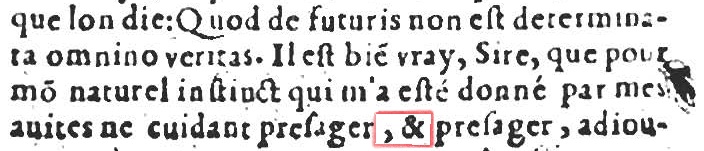
Quod de futuris non est determinate omnino veritas . Il est bien vray , Sire , que pour mon naturel instinct qui m’a esté donné par mes avites ne cuidant presager ,
Notice the combination of a comma followed by an ampersand (, &). If one reads this as a place to divide the letter and rearrange it, see how that links to that found on the top of page 6, with several segments seen as irrelevant to this being stated.
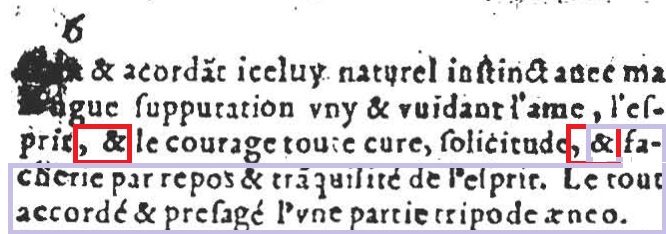
& facherie par repos & tranquilité de l’esprit . Le tout accordé & presagé l’une partie tripode æneo .
Notice another combination of , & that reflects a separate division point, but one that is not part of this red together, which is pieced together from the bottom of page 5, to top of page 6 (as numbered in the 1568 Lyon edition for the letter to Henry). Splicing these two segment lines together, one now sees an English translation that is this (again keeping the segments separate, based on marks used):
Although to course of future not is decided entirely truth .
It is as it should be true ,
Master ,
that for my natural inspiration which myself has been given by bad you warn not knowing to prophesy of things to come ,
& weariness through quiet
& tranquility from him soul .
He everything granted
& prophesied of things to come it one distinguished tripod of bronze.
This reading selection begins with Nostradamus having written in Latin. Latin is the language of the Roman Catholic Church and in the days of Nostrdamus there were no other languages allowed for translating the books of the Holy Bible. This is because Latin is closer to the languages of Hebrew and Greek, where one written work reflects a multiplicity of possible meanings that lesser languages cannot match. Thus, to take a Bible quote and translate it into German (Martin Luther) or English (King James) places a watered down version into the hands of people who are not prepared to understand the truth of Scripture. As such, Nostradamus often paraphrased Scripture in his letters, when he wrote in Latin, giving those word an elevated meaning to grasp.
In this selection, Nostradamus began by writing in Latin “Quod de futuris non est determinate omnino veritas.” Google Translate shows a translation from Latin to English as, “That there is no absolute truth about the future.” That translation follows the normal syntactical rules o such translation; but divine syntax does no allow such paraphrasing to be the primary intent of meaning. All order of words written must remain in place, unchanged. Therefore, a literal translation into English could be this:
“Although future not is determined completely truth”
This becomes an elevated statement that says a divine “future” that is “What, Who, That, So be, Although,” or “In what way” of Yahweh is “completely truth,” which is to be “determined” by “What future” humanity chooses. If humanity chooses to serve Yahweh as His souls in peoples, then a prophesied “future” will “not determine” the fate of their souls. This is why The Prophecies were written as they were, so not to influence those “Who” this “future” would “not be” for them to “determine” as “completely truth” for them to be warned. In essence, this is an important statement that divine Prophecy is not a dog and pony show that is to prove the existence of Yahweh, where idiots will demand someone predict the “future,” based on what Nostradamus wrote, so it can be judged by incompetent souls as “completely truth.”
Can you then see how the Latin “omnino veritas” is matched by the French bien vray, where the Latin translates as “totally truth” and the French as “thoroughly a truth”? The capitalized Il states importantly (through capitalization) “He” and “It” “is,” as a statement of “being,” which is “good, right, aptly, with good reason, and quite” (as an adverb), while also “wealth, substance, possessions, benefit, favor, and a good thing” (as a noun) that is “a truth, true, just, right, sure, certain, undoubted, and natural of itself” Cotgrave, 1611). This becomes a statement about “He” “Who” is one with “Him” (Yahweh and Jesus), so two together (joined as a Trinity) makes one be led the “right” way (righteousness), from the “truth” guiding one from within, spiritually.
When the capitalized Le is read as the masculine pronoun “Him,” this leads to a separated one-word statement (set apart by comma marks, of capitalized importance), where Sire (“Master”) is a statement of Jesus as one’s “Lord” and “King” Spiritually, while giving the impression that Nostradamus was addressing the physical man, Henry II, King of France.
The long series of words that follow include the words mes avites, where the word mes is one of three listings by Cotgrave for that specific word, where he wrote, “In composition is as much as Mal, perverting and turning to ill the sense of the words it proceedeth.” The word it proceeds is avites, which should be read as the second-person plural past simple form of avir (as avîtes), meaning “you warned, advised, or noticed.” This makes for a statement that said Nostradamus was thought to write his works “that” deemed as “quite true” [his Almanachs] that was due to “my natural inspiration,” coming from his knowledge of astrology, where “my with been given” from years of practice. This then infers that it can be seen as “evil” to claim divine insight leads one to cause “you” to be “warned” about the “future,” because people (“you”) have been “advised” that people outside the Church should “not” be “imagining, thinking, or supposing” that Nostradamus has a talent “to prophesy” on mundane issues.
Here, there is a break point that jumps forward to the next page, where three of four segments are begun by an ampersand, making those important to discern.
The first important statement focuses on “anger” (reading facherie as fâcherie, yielding fascherie), which points to a “weariness” that come over Christianity and faith in Yahweh and Jesus, which will come “through” long periods of time when there seems to be “quiet” and “rest.” In 1966 (April 8), Time Magazine published a cover with the question, “Is God Dead?”
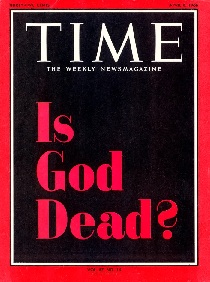
That is the result of “weariness,” even “anger,” especially in Jews, who rejected Jesus as their promised Messiah (Machayach), only to have nearly two thousand year pass, making some think God is at “rest” or in “repose.” The importance of the ampersand then explains a timing element to The Prophecie and why nobody can make sense of the quatrains, because the people in France in the sixteenth century believed and saw God alive and acting in their lives. Thus, it will be different times when the “future prophesied” by Nostradamus will be realized.
The next important statement then points to a state of “tranquility” being present, where tranquilité is closer to an English spelling (“tranquility”) than the proper French spelling of tranquillité (an extra l). Still, both mean “tranquility, stillness, calmness, quietness, peaceableness; a calm; and rest” (Cotgrave, 1611) The ampersand is then denoting the importance of an inner “stillness” that comes “from him” (Jesus) being one with one’s “soul” or “spirit.” This is how one knows Yahweh is alive. It is the true source of faith, where one knows Yahweh is alive, through the Son. Belief is being taught things that over long periods of time not proved, due to one tragic event after another, all blamed on God not helping, lead souls to experience “weariness.” That produced faith that there is nothing beyond death (“repose”), and the “anger” that makes one believe God is dead. This, of course comes from the whispers of Satan; but with Yahweh and Jesus within (Spiritually), one knows “tranquility by reason of” being one with “him spirit” to spirit.
This then follows a period mark that ends that series of line segments, beginning a new series with a capitalized Le, which (as a pronoun) means “Him, He,” or “It.” As the prior word stated “he spirit” or it soul,” the importance of “Him” is Yahweh. As the One God, “everything” and “all” are His creations, including all “souls” sent into human bodies of flesh and the Son Jesus, whose name means “YAH Saves.” For Nostradamus have become one “soul” devoted and committed to serving Yahweh totally, his divine union with Yahweh’s Baptism of Spirit consummated that Spiritual marriage and brought forth the Son into the womb of a wife, which was Nostradamus’ “soul,” making Nostradamus a Saint (or Apostle). This was not because some Roman Catholic priest told Nostradamus to believe in Jesus and be saved, because the only true form of Salvation comes from “Him” knowing a “soul” is His servant, sending “Him” His Son, to protect that wife-soul from “all” and “everything” Satan can present. This is not by human will, but by the gift of Yahweh, where “everything” a Saint will do in the name of Jesus is “granted” by the divine. As far as writing The Prophecies about a very distant “future,” “everything” written was “granted” by the “soul” of Jesus, as Nostradamus’ Lord and Savior.
This then leads to another line segment that begins with an ampersand and ends with a period mark. Here, Nostradamus wrote, “prophesied of things to come it one distinguished tripod of bronze.” This has nothing to do with Nostradamus placing a bowl of water on some “brass” or “copper tripod,” which he would peer into to see the “future” (some mystical art called scrying). This should be read as a statement that “everything granted” by “Him” includes the tales in Greek mythology of the Oracle of Delphi, where Pythia was the high priestess of the Temple of Apollo there. As mythology is metaphor, Pythia reflect upon one who served a god (Apollo), with Apollo being the god of truth (like Jesus is the Light of Truth). The tripod is then the willingness to serve the spirit (the fumes emitted from a crevasse in the rock), so that spirit fills one and “grants” them to speak the truth in “everything” stated. This is Nostradamus explaining that he was seated on the “tripod” when he prophesied the truth of Jesus in The Prophecies.
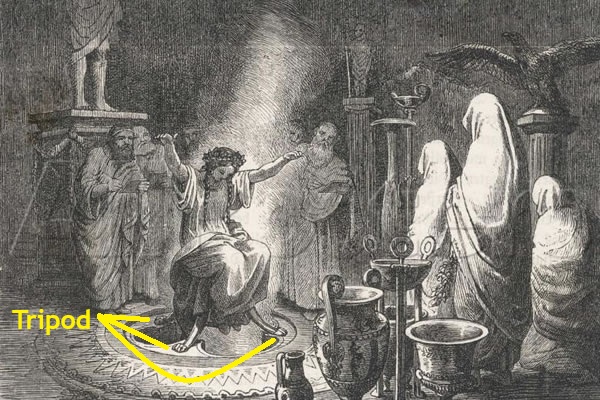
This small amount of words written by Nostradamus yields a vast amount of explanation about the source of The Prophecies. Again, this is not some easy read that can be mastered by some speed reading class. Divine Scripture and this work by Nostradamus comes from the same soure, as for “Him everything is granted.” This includes understanding, because (if one knows the lessons of the stories about the truths told by the Oracle of Delphi) thinking you know what the truth means always leads to failure, with the truth still being as it was told.
P


 Nostradamus Blog