
In June, 1558 (on the 27th), Nostradamus finished writing a letter that would be sent to his king, Henry II of France. The letter was written in response to a demand that Nostradamus explain his work The Prophecies, which could not be understood by those in power.
This book was printed during a period of great popularity for Nostradamus, due to his use of poetry to predict each coming year’s expectations, in publications called Almanachs. Those poems were astrologically based, and constructed of either four or six lines, with each yearly publication typically totaling twelve to fourteen verses, roughly corresponding to each month of the coming year. The poems were akin to brain teasers, riddles or puzzles, with much play on words and metaphor, forcing the reader to figure out the “hidden” meaning. Because most people readily understood the intent, with a sense of witty sarcasm embraced, the Almanacs were enjoyed by all.
That popularity created a demand for such entertainment. Seemingly in response, Nostradamus had initially published The Prophecies with a total of 353 verses, all 4-lined poems (quatrains) with an ABAB rhyme scheme. He did that in May 1555, dividing that number of predictions into four “chapters,” as divisions of 100 prophecies headed as “Centuries.”
Prior to the 1557 “second edition,” King Henry II had approved an additional 291 quatrains be added to the book, bringing the total to 642, presented in seven Centuries. Centurie Fourth, originally containing only 53 quatrains, had filled out to a hundred; but the new Centurie Seventh ended with only 42 verses. Still, heads were scratching over the first edition’s riddles.
The problem was that no one could solve any of these riddles. While delight in the almanacs was still high, people were reading this new book and thinking Nostradamus was losing his grasp on what the people enjoyed. Some might have thought he had gone mad. Therefore, his request for the approval of 300 final quatrains, bringing the total Centuries to ten (with Centurie Seventh still only having 42), his request was in effect denied, pending an explanation as to what it all meant.
The king requested Nostradamus appear in Paris, in person, to directly answer questions pertaining to what had already been published. When we read the nursery rhyme of Humpty Dumpty, where it says, “All the kings men couldn’t put Humpty Dumpty together again,” this can be seen as how The Prophecies was an anthropomorphic egg, and that all the wise men of France’s throne could not figure out the meaning Nostradamus had hidden within his book.
Had Nostradamus made a trip into the king’s center of power, he would not have left without exposing everything about The Prophecies. The king would die in a jousting accident in 1559, probably with Nostradamus in some dank prison cell, with the king’s death somehow becoming the responsibility of Nostradamus to have prevented. Such a turn of historic events would have probably led to Nostradamus being executed, with his final edition (in 1566 & 1568) never happening. Had that happened, no one would know the name Nostradamus today. However, because that did not happen, one should see the letter written was divinely inspired, with a long-range plan intended.
Nostradamus had been instructed to write his verses by the Holy Spirit, which he repeatedly stated in his letter to the king. The letter was cleverly presented in a way that no one could solve it either, with it making less sense that any one puzzling quatrain. Because of his having divine assistance, with everything coming from the same divine source, Nostradamus knew he could not appear before the king in person. Instead, he was moved to write the letter so that would become the “preface” to the additional (final) three chapters (Centuries), when they went to the press. The letter was also the work of the Holy Spirit, with Nostradamus holding the quill pen as it moved onto paper; but he fully understood everything he wrote, while filled with the mind of Christ.
In the letter written to fully explain the meaning of The Prophecies, Nostradamus (as the embodiment of Jesus Christ) wrote in Old French mostly, but there is a significant portion in the language of Latin. While Latin appears at various places throughout the letter, interconnecting to the Old French text, a significant portion comes in one continuous block, near the end of the letter. After Nostradamus completed “signing and dating” his salutation (in Old French), the letter ends with the following, which is Latin, presented in a significantly larger font, and as centered text in triangular shape:
Facibat Michaël Nostra-
damus Solonæ Petræ
Provinciæ.
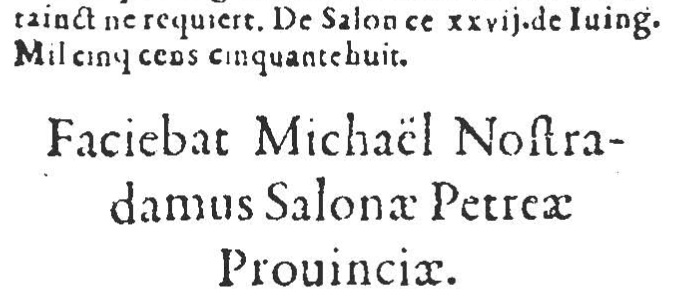
This can be read simply as a statement of who published the letter, as translated to state: Written by Michel Nostradamus in Salon Rock Provence. However, nothing written by Nostradamus, related to his work The Prophecies, should ever be taken simply or as if there was no meaning or significance intended. This is no exception.
First of all, the size of the font is screaming for attention. The size of the lettering is as large as the first line of the introductory section of the letter, which is also presented in centered text, producing a triangular shape. Only the first line of the Old French introduction has letters the size of these in the conclusion, while all of these in Latin are the same larger size.
Secondly, the use of Latin, as a mirror image of the Old French introduction, implies this is actually not a conclusion, but an introduction for the Latin text of the letter (after all the Latin is removed as its own statement of explanation). This corresponds to the significance of only one quatrain being totally written in Latin, numbered as 100 in Centurie Sixth, which has five lines of text (thus not a true quatrain), with the first line of VI-100 presented in a larger font than that the four following lines. That one quatrain then acts as the “Foreword” to the remainder of the quatrains, such that this salutation acts as the introduction to the Latin of this letter, as a stand-alone explanation within an explanatory letter.
Third, while the triangular effect can be seen as justification for the name “Nostradamus” being hyphenated and divided onto two lines, the true intent is to draw attention to the name being two words joined together, where the Latinized Old French says “Nostre-dame,” meaning “Our-lady,” and alluding to the Virgin Mary, the patron saint of the Roman Catholic Church. The Latin, in effect says the same, with “damus” derived from “dominus,” as a Latin reference to a “woman of the house.” The Virgin Mary is the lady of the house of Jesus Christ.
Fourth, whenever Nostradamus used Latin, it was with the intention that it be read on a higher level, such that Latin is the official language of the Vatican and all Holy Bibles of that time were printed in Latin text (except the earliest Lutheran translations). Thus, Latin acts more as an aside directly from Christ, such that quotes from the Holy Bible are found in both of Nostradamus’ letters associated with The Prophecies. Thus, all Latin needs to be seen in a spiritual light.
Finally, when one realizes the importance of reading each word of Nostradamus as singularly important, before it depends on the connection to other words, this “simple” concluding statement can be found explaining:
He made
“Who is like God”
Ours –
the lady of the house
Reception room
Stones
Command
This meaning comes from accepted translations (of a literal nature, not syntactical) of each word written. Without detailing all translation possibilities (a wonderful exercise for honor students of Nostradamus), these are my selections as the one meaning for each “word,” which then best exposes the truth behind the words. This introduction says that the letter (and The Prophecies) was produced by the hand of God, through the human being named Michel, who acted as the angel Michael, fulfilling the truth behind the meaning of the name, as one “Who is like God.” This God is ours as Christians, as the God of Nostradamus, the God of Henry II, and the God of France. This God was justification why Henry ruled, but it recognized how his power was upheld through the support of the Church of Rome, who reveres Our Lady, as the woman of that house of God and the Henry’s House of Valois.
The salon, or reception room of that house of God, should then be read as more than a room in a brick and mortar building. Instead, the reception room or large hall represents the heart within each Christian, where true Apostles of Christ receive the Holy Spirit within. The plural number of “stones” or “rocks” then reflects the stone Tablets of Moses, upon which God wrote the Ten Commandments. Those were two in numbers, identifying with the rocks of King and Church, as well as the anchors reflecting the Blood and Body of Christ. Thus, each Christian has a duty and a command, as a defender of Christianity and as a spreader of the Gospels, ensuring that all Christians connect with God, through Christ, receiving the Holy Spirit. The ultimate purpose of The Prophecies (as stated by the spiritually uplifted Latin) is then to save humanity from understanding where it has gone wrong, rather than simply project its self-inflicted demise without anyone knowing why.
Thus, as a heading for a letter explaining The Prophecies, the Latin is introducing it as being from God, with Nostradamus having the assistance of the Holy Spirit. Because it was written under this influence, it likewise requires the same assistance from those rocks of God to understand. One does not accurately understand the whole of The Prophecies, explaining it all so it means what one wants, without making oneself out to be a fool. One can only realize the beauty of the complexity comes amazingly clear when one follows a higher command towards understanding, through faith in the source being God. To see Nostradamus as one man who produced this work alone is to miss the point, at a time when it has come to open one’s eyes and see the truth.


 Nostradamus Blog