These quatrains listed as “Naval Battle” are all linked to one suprise attack on a U.S. fleet in the Persian Gulf. I posted an article in 2016 about this still unfulfilled future event, due to tensions rising there then. Certainly, now that 2025 has brought the United States a step closer to this deadly battle, I feel it is time to review those quatrains again. Now, I am listing them individually, to make them more readable to the illiterate smartphone addicts with the attention span of a gnat.
—–
With quatrain X-02 and IX-100 shown to be telling the same story, with separate details making the story gain depth of field and yield a specific prophecy that has yet to occur, let me add another quatrain to consider. That quatrain is numbered VII-37 and states:
VII-37
Dix envoyés, chef de nef mettre à mort,
D’un adverty, en classe guerre ouverte:
Confusion, chef, l’un se picque & mord,
Leryn, stecades nefz, cap dedans la nerte.
Again, before I present one viable translation, look and see how the capitalized “Dix,” meaning “Ten,” is repeated. It is in the main theme line, along with the word “nef,” meaning “ship.” In line four, we find “nefz,” which is the plural of “nef.” In the use of “classe,” especially in a quatrain where sailing vessels are mentioned, and with the word “guerre” following the use of “classe,” the translation is commonly said to be “fleet.” We found “classe” also in the secondary theme line of quatrain X-02. Such links act to bond this quatrains to the other two.
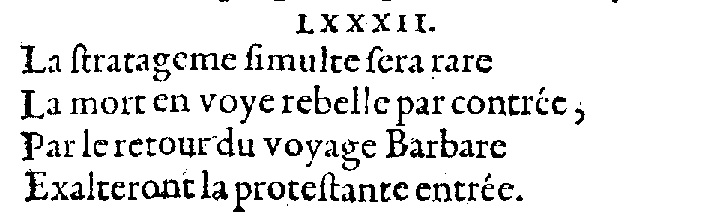
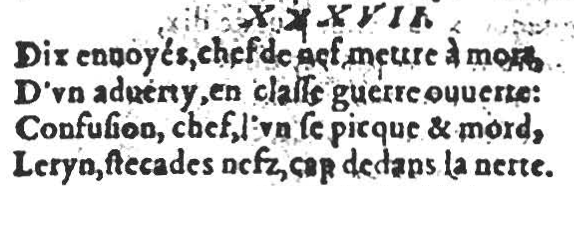
For the translation of this quatrain, I will present a copy of the print, as shown in the 1568 Lyon edition.
Looking above, you can see how page bleed has made it difficult to read some words. The second word is possible to be read as “ennoyés” or as “envoyés,” as the type for a “v” is the same as that for a “u” (as seen in “advert” and “ouverte”). In the Old French dictionary from 1611, an unaccented “envoye” refers one to look up “ennoye” (again unaccented). When the use of a “y” is seen as acceptable to switch with an “i,” the spelling as “ennoie” becomes a third person singular (simple and subjunctive tenses) for “ennoyer,” which means “to flood” or “to inundate.” The past participle of “ennoyer” is “ennoyé.”Another way to state things that are “inundated” is “they are underwater.” That would be an important clue as to the stealth abilities of “Ten ships.” However, the 1566 Lyon edition clearly shows the word to be “envoyés”
By my pointing this out, I hope the student can see how there is never just one translation to consider. There are many errors in the 1566 Lyon edition, which caused a need for a revision in 1568. It may be the correct word set in type was “ennoyés” so that must be considered in translation. However, based on using “envoyés,” one translation of quatrain VII-37 can now be shown so it states:
……….Ten sent unto ones, principle commander to ship to place with murdered,
……….Of one informed, into fleet warfare apparent:
……….Confusion, paramount, the one itself this thrust into & bites,
……….It nothing, places of combat ships, promontory within there not a place that stands high.
This quatrain begins with a capitalized “Ten,” meaning this number is of significant importance. It matches the capitalized “Ten” of quatrain X-02. Erika Cheetham and others have failed to see how the repeating of this number links these two together, more so because this quatrain references “ships,” just as quatrain X-02 added supporting details to the main theme of a “Veiled galley,” stating “Ten ships.”
In the quatrains of The Prophecies, the word “dix” is presented seven times. Three times it is capitalized, with the other four in the lower case. In quatrain VIII-69, the importance of “Ten” is related to “years,” and not “ships.” While there can be a way to link “Ten years” to “Ten ships” and “Ten envoys,” because the 1991 sale of Soviet attack class submarines to Iran was protested in the U.N. and the delivery of the weapons was agreed to be “Ten years.” Still, I am not going to interpret quatrain VIII-69 here and now; but know that two of the three capitalized presentations of “Dix” link those quatrains together.
When one sees the possibility of “ennoyés” being intended to be read (in addition to “envoyés”), “Ten underwater ones” makes the connection stronger. Still, when “envoyé” is seen as meaning (as a noun), “A special messenger sent by a Prince from foreign country,” and as the past participle of the verb “envoyer,” “Sent; delegated; addressed or directed unto; also to cast or thrust out,” these definitions can all be applied to a military presence. “Ten ships” (at least) would be the important number “sent” by Russia to Iran. Those “Ten” would then be awaiting the arrival of an “envoy” of “ships” – a “great fleet” – “sent” to deliver an important message to Iran.
These first two words of line one are then separated from the remainder of the main theme by a comma. This statement is then directly relative to the sending of warships to the Persian Gulf – warships intending to deliver a powerful message – warships that will send ships “underwater” by ships already stationed there. The direction is because a “head” person – a leader of merit – wanted a “ship” in “place,” where “death” had already occurred and was planned to take place again. This makes the main theme relate to the sending of warships by the command of the President of Russia, the receipt of those warships by the President of Iran, and the order of the President of the United States to “address” a murderous act committed by Iran (military or terrorist actions), as a declaration of war.
Following a comma at the end of the main theme, the secondary theme is set up to be separate in time and/or space, while relative to this sending of “Ten” to a “place with death.” The capitalized first word is a combination word, “D’un,” where the capitalization of the preposition “de” is one with the word “un,” making the result be to place focus on a most important “One.” The importance of the directional preposition is all directions are importantly part of this “One.” We have to consider “To one, From one, Of one” and perhaps most importantly “With one.”
In quatrain IX-100, I brought out the importance of “Le” being read as a powerful “It.” The implication was that “It” was a most powerful weapon, as would be a nuclear bomb. When reading “D’un” as an important possession of “One,” as “With one,” it becomes easy to see how “It” can be related to Iran’s quest to develop a nuclear bomb. Should Iran successfully test such a bomb, it certainly would cause a reaction by the Americans, such that a show of strength could be the order given in response to such a test. This would then begin the “To-From” of “sending messengers” by “leaders.”
The use of “adverty,” which means, “advertised, informed, certified, warned, admonished, advised; signified unto; and giving notice or intelligence of,” this means the important “One” is too big to keep secret. When Pakistan first developed their nuclear bomb and successfully tested “It,” the nation cheered wildly, making Abdul Qadeer (A.Q) Khan a national hero. I would imagine Iran would celebrate in a similar manner, making American satellite surveillance simply a matter of confirming what would probably be broadcast internationally through the news media. Thus, the secondary them is initiating a focus on important publicity “Of one” being “With one.”
As was with the main theme statement, where a comma separated it into two fragments, a comma is placed in line two similarly. This creates a separation from the intelligence obtained “Of one,” so the flow following expands on that new information. That expansion states, “in fleet warfare evident” or “apparent, open, overt.” Certainly, this says the “intelligence gathered” shows a “weapon of warfare” is relative “To one,” with the results of a successful application of that technology being “clear” and “plain” to see. The aspect of “classe” as “fleet” could mean the launching of a warhead from a ship at sea (the Indian Ocean or Arabian Sea); but it could also mean the significance “Of one” comes from placing “It” “in a class” of “war” tools that is greater than lesser bombs. In this regard, “fleet” could mean that many “Of one” have been produced.
The secondary theme then is explaining why “messengers” have been sent, because the only purpose of a nuclear bomb is “death,” which is such a weapon in the hands of “inferior” nations makes the world unstable, with “war” a threat more openly communicated. The world has seen this with Kim Jong-un, who readily tests missiles and threatens the West and America with use of his bomb. Recent reports say Jung-un is working with Iran to develop their bomb. Therefore, line two ends with a colon, making line three clarify this aspect of the “open” threat of “war.”
That which is “open warfare” or “evident contention” or an “apparent debate” (from “guerre ouverte”) is clarified as a most high degree (capitalization) of “Confusion, Disorder, Chaos,” or something “Confounding.” This state of “Confusion” could be due to Iran making its nuclear capability come about much faster than expected. In respect to the recent agreement struck by the Obama Administration, overseen by Secretary of State John Kerry (January 2016), the White House reasoned it would be “Ten years” (quatrain VIII-69) before Iran would have enough uranium-235 to make “One” bomb. A major state of “Confusion,” setting off a “Hurly-burly” (busy, boisterous activity – tumult and uproar) of officials scrambling to see why their intelligence did not forewarn them of this progress, is not only clarifying an “overt” activity of warfare” weaponry, it is supporting the main theme of “Ten messengers” being ordered into harm’s way.
While there may be those who reckon that such an unexpected test would be from not developing their own nuclear weapons, but from having purchased some on the international “black market,” the comma following “Confusion” says that a subsequent clarification of that which has “apparently” taken place is of “paramount” importance. The word “chef” is repeated as this next step, but instead of being a word stating (as a noun), “chief, general, head, or principal commander,” it reads as an adjective, denoting the highest degree of importance, with “paramount” being a call for the one with the highest degree of authority to bring calm to the din. Still, because of this great level of importance, a secondary meaning for “chef” can be read, as “the end of a place, time, or business.” That would mean this situation was “paramount” because of the threat to the world’s continued stability – the End Times.
Following another comma, the colon’s list of clarifications of “chiefly” (adverb usage) comes “the one itself this thrust into.” As a clarification for line two beginning with “Of one” (or “To one, With one, From one”), we now see this is “the one,” where a combined article and noun is written (“l’un”). The “Confusion” that becomes “paramount” is related to it being “obvious” that “one” has been witnessed. The statement “the one” then precedes the word “se,” which is a personal pronoun relative to people or numbers, as a reflexive pronoun. This means “the one” is “oneself” or “itself” (as an inanimate object), which is then described as “picque.”
The word “picque” appears six times in quatrains, one of which (obviously) is in quatrain VII-37. This word’s spelling is found in the 1611 Old French dictionary of Randle Cotgrave stating the meaning to be, “A spade at cards,” which is not the intent in any of the six uses of “picque” in the quatrains of The Prophecies. However, Randle Cotgrave added to his definition, “also, as pique.”
The word “pique” is then defined to mean, “A pike [A long spear formerly used by infantry]; also a pikeman [a soldier who holds a spear]; also, A pike [a stab or piercing], debate, quarrel, or grudge.” In this regard, where a “spear” is being stated as relative to “the one itself,” it is then worthwhile to know that Nostradamus wrote the word “pique” in two other quatrains, with the plural spelling (“piques”) in two more. In the quatrain that follows VII-38, Nostradamus began the secondary theme line with the capitalized “Picquer,” which is to be defined as the infinitive form of the verb “piquer,” without the “c.”
Before I interpret this use in quatrain VII-37, I would like to address this “extra c” that appears in many Old French words, where by 1611 it was common to refer one to look up a spelling without the “c.” One can see this as Nostradamus having been hung up – “Confused” – about which spelling he should use, adding it some places and leaving it out in others. That can lead one to see Nostradamus as the author and imagine his mind a whir, trying to figure this future prophecy out. That should not be seen as the case, as Nostradamus explained his source was God, with him simply letting the mind of Christ move his hand, while it held a quill to paper. Therefore, the presence of, as well as the absence of a “c” has meaning.
That meaning is as an simple anagram where the “c” needs to be removed from the middle of the word and attached at the beginning, as “c’pique.” This then acts as an abbreviation of the French word “ce,” this means “this.” You may have noted that my translation shows “this thrust into.” The translation is from “c’piqué,” where the past participle form of “piquer” is read [adding an accent mark is allowed … remember].
Remembering that line three is offing a list of clarifications to the “overt” display of “warfare,” which would be a test of new weaponry, the result has been major “Confusion,” followed by this new state of being be seen as of “paramount” importance, with an enemy having reached unwanted heights of technology, the next statement is telling us why this is “paramount.” It is because “the one itself” placed on display is “this spear,” or “this thrust into” an enemy. A “spear” alone can only do damage to one at a time, but when “the one” of concern is seen as the evil weapon alone, by “itself,” that evil then being “this thrust into” by means of a “spear,” becomes an explanation of a nuclear warhead on a guided missile. Once that is “thrust into” an enemy, many are wounded by one strike.
Once that meaning has been derived, line three reaches an ampersand, the mark that denotes an important statement to follow, while additionally [how to see “and” implied] showing a difference – similarity duality, and adding information as a conjunction run-on. The important statement is then “mord,” which is the third person simple form of the verb “mordre.” This then means, “[he, she, it] bites.”
The complete defined use of “mordre” was stated to be, “To bite, or set the teeth in; to gnaw, chomp, nibble; to pinch, nip, snip or snap with the teeth; also to sting; also to smell; also to conceive, apprehend, understand.” Each of these meaning can now be placed into that third person simple form, where the ampersand now says this tested weapon is “the one” that is designed to be “thrust into” an enemy, so that “it bites, it gnaws, it snaps, it stings, it smells, it understands.” Relative to a statement listing a series of clarifications as to how one would react to an “evident” test of a forbidden “warfare” tool, those who were initially quite “Confused” will finally come to “understand” this new reality. That will be what “bites,” what “gnaws” at them, what “snaps” like a rabid dog at them, what “stings” the ego, what “smells” like a conspiracy. Most of all, it is what one finally “understands.”
Following a comma at the end of line three, one comes to a reflection of the “Confusion” that began line three. Line four contains three quite confusing words: “Leryn, stecades,” and “nerte.” These words have been translated by others as indicating “Lérins Islands”[two islands near Nice] and “Îles d’Hyères” (Islands of Hyères) [four islands near Marseille], which are also called the Stoechades, because they are known for their lavender. The Latin word for lavender is “stoechas.” As for “nerte,” Erika Cheetham footnoted it, saying it was either Old French for “black,” or from the Greek word “nerthe,” meaning “underneath.” All footnoted words are words of uncertainty, as the Old French word for “black” was [and still is for French today] “noir.”
Because the word “nerte” is found in the 1611 Old French dictionary, not meaning “black,” but meaning “A myrtle shrub” [the same meaning today], it becomes a word like “picque,” which was defined as meaning “A spade at cards.” When the word does not fit the flow of context, then an alternate view is required (such as seeing “picque” as “c’pique”).
The words “Leryn” and “stecades” do nothing to establish a setting because islands off the coast of southern France are not focal points for nuclear tests. In what unfolds later in the epic story told by the quatrains of The Prophecies, one could see how seeing those specific islands act as a premonition of what will come, as far as “open warfare,” but as supporting evidence for the secondary theme statement (what all fourth lines present) coastal France can only be misleading as a primary view.
As for “stecades,” the 1611 Old French dictionary shows the word “steccades,” with an extra “c” (remember the extra “c” in “picque”?). The word “steccade” is defined as meaning, “A place vailed in for combat or lists.” A “list” was a jousting contest, meaning a “steccade” was a place set aside for such trials of combat. This is a perfect definition in the context of weaponry testing. A “steccade” is a place set aside for practicing use of “spears” (also known as lances) or “piques.”
As for the capitalized mystery word “Leryn,” it should be seen that a capitalized “L” is representative of a capitalized “La” (in quatrain X-02) and a capitalized “Le” (in quatrain IX-100), when seen as an abbreviated form in a compound word. This means “L’” would sonnect to the front of a simple anagram consisting of the letters “eryn,” where “y” can be exchanged for “i.” This means the word “rien” is a possibility.
The French word “rien” means, “a matter, thing, something, anything.” To attach a capitalized “L” to this “thing” or “matter,” is to indicate a most important “One thing,” as “A thing,” or “The matter.” When one sees how this reflects “l’un se,” or “the one itself, this is then the “One thing” from which all things of matter come – “The atom.” As such, the French use of “rien,” when combined in a statement with a negative (“ne”), the word transforms from “something” to “nothing.” This transformation capability of the word “rien” is then the transformation capabilities of an atom that is split, causing “nothing” be the sudden release of energy from mass (“matter”).
Seeing this possibility of translation, line four ends with an important statement about “it bites,” while also meaning “he understands,” such that the understanding is who has possession of such “A thing” that is an “evident” tool for “warfare,” especially “the one” who “oneself” had raced to have more of “the one itself,” than the other. All of those had been mounted atop “spears” or “lances,” in places set aside for practicing “warfare.” This could point to the realization that Iran was only acting like it was going to produce its own nuclear capabilities, when it had already secretly bought them from the Soviets years before. This then means that sending a fleet of ships into a place set aside for jousting, where one’s lance wins when it “pricks” an opponent off its horse, is the “Confusion” of practicing a showdown or really having a showdown involving “ships” (“nefz”).
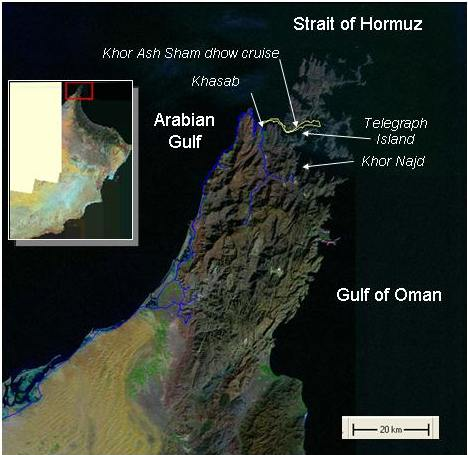
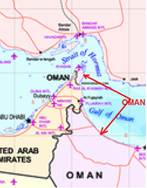
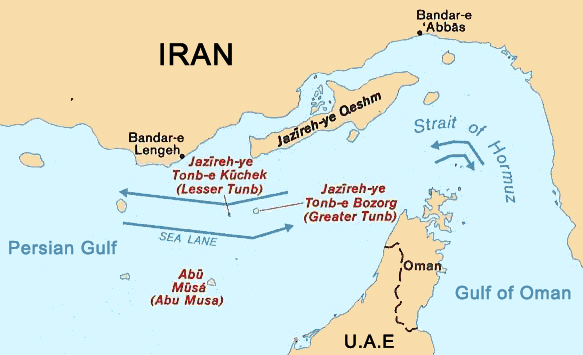
This then refers to a “cape,” where “cap” is defined as, “A promontory, cape, hill, or nook of land outstretched into the sea; a head of land lying out into the sea.” Whereas there are several small capes that stretch out into the Mediterranean coast of southern France, consider this “promontory” of Oman:
This picture grasps how this promontory is possessed by Oman, while being separated from the greater land of Oman, by the land named United Arab Emirates.
This graphic then shows how narrow the Strait of Hormuz is around this “cape.”
From seeing this geography, line four then states how this “cape” forces one to travel “within” a narrow strait, in order to get to and from “there,” where the Ten envoys” lie in waiting for a naval “fleet.” This leaves the word “nerte” to be translated; and if Erika Cheetham is correct that it meant “black” in ancient French, then “black” is a symbolic term used by Nostradamus to indicate Islam. That would place “there” in the land of Muslims. Still, since I cannot confirm this, and although a Greek root, meaning “underneath” also confirms “Ten underwater” (from “ennoyes”), there needs to be a clear understanding of the word “nerte.”
That comes from seeing the word as “nerte,” where it too becomes a compound word, with a negative attached as a prefix to the word “erte.” The word “erte” means, “A place that stands high, or is somewhat high to look at.” The promontory of Oman [Musandam Peninsula] looks like this:
Thus, Randle Cotgrave further defined “erte” to mean, “a steep or craggy ascent; a watch tower.” This perfectly fits the description of the “cape” of Oman, across from the Iranian side of the Strait of Hormuz. Still, when the negative is attached, the meaning becomes the opposite, as “not a steep promontory” or “not a watch tower.” This would be understood as the watching eye was coming from beneath the water, and not from land overlooking it.
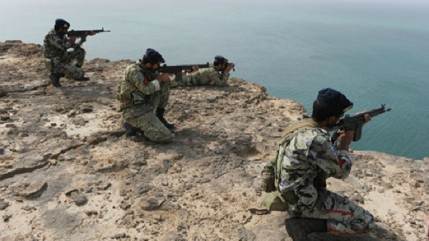
Here is a 2011 picture of Iranian soldiers in a military exercise, supposedly to guard their coast at the Strait of Hormuz:
Certainly, the focus that I have put on Iran and a trap set for the U.S. Navy in the Persian Gulf is not directly supported in the three quatrains that have stated “Ten” and “ships.” One has to realize that Nostradamus explained in his letters how the future would involve Christians versus Muslims, where those two religions were symbolized by the colors “white” (Christianity) and “black” (Islam). Still, there are more quatrains that fall into this series that tells of a most significant event in the coming history of the world. It is already planned, but the timing has not yet been right. That means there is still hope to avert this story and change the heading of the world towards a renewed faith in God and truly Christian oversight. However, this event will always be waiting for the time when that faith has completely been lost.




 Nostradamus Blog