Category Archives: Nostradamus

Astrological Terms in The Prophecies of Nostradamus


As an astrologer, I was interested in The Prophecies of Nostradamus because he wrote astrological terms.  Between 1976 and September 11, 2001, I could not make any of the astrological references I saw have any significant meaning.  After the events of September 11, 2001, I began to look deeper at how the astrology he wrote could be timing events in the future.  I poured over an ephemeris and lo and behold, I saw a repetitiveness in those planetary combinations, which was placing everything into rapid series of timings that made 2003 and 2006 very important.

I wrote a book that had a title like Nostradamus’ Timing of the Future, which I never published.  I did run off five copies (this was like 250 pages per manuscript) at Kinkos [ask your parents children].  I was invited to speak to a local astrological group [something most locals do not have] and was well received.  I sold all five manuscripts at a little above cost.

Well, none of what I wrote was correct, as far as using the astrological text as a secret code to unravel.  My work between the years 2003 and 2006 brought me a deeper understanding of what I was being led to learn, a little bit at a time.  I had to learn the valuable lesson that astrology is a language.

Around 2011, I came up with a presentation that I entitled The Astrology of Nostradamus.  I contacted three different astrological groups, and each welcomed me to come to make a presentation.  I adjusted the slideshow after each presentation, based on where the audience (mostly novices interested in astrology, with no deep understanding) seemed to struggle.  The final presentation seemed to be the best received, with one woman posting a review that said, “I wish we could have had another two hours.”  I believe she sincerely meant that.

The point I wanted to make is plain and simple: Astrology is a language.  It is like any other language, in it requires fluency to properly understand.  To read astrological names of planets, signs, and aspects is much more than what is read on the surface.  One needs to have a fluency that begins an in-depth conversation that ponders, “You said this.  Do you mean this, or are you meaning that?”  Without that, one becomes like I was, a fan of astrology and wanting to think I knew what Nostradamus meant by using the language of astrology.  It is the lesson of the question: Do you know what happens when you assume? [Email me if you do not know the answer.]

I have made a list of the terms written in the quatrains that can be seen as astrological.  Here is a list of words and the number of times found in verses:

Aries – 4…………………………………………………………………………Libra – 3

Taurus – 3………………………………………………………………………Scorpio – 1

Gemini – 0……………………………………………………………………..Sagittarius – 3 (all symbolically as l’Arq)

Cancer – 7……………………………………………………………………..Capricorn – 1 (plus 2 cap. abb. possible, Cap. & Caper.)

Leo – 6 (27 more if Lyon as French form Latin)………Aquarius – 4 (all symbolically as l’Urn)

Virgo – 7 (+4 others as Vesta or vestal-vestales)……Pisces – 1 (in lower-case)

———-

Mercury – 11……………………………………………………….Moon – 10 (+3 forms of lunaire, &5 var. of Artimide &Latona)

Venus – 16…………………………………………………………..Sun – 14 (as Soleil, plus 24 as Sol)

Mars – 40…………………………………………………………….Pluto – 0

Jupiter – 7……………………………………………………………Neptune – 6 (plus 2 as l’Ocean)

Saturn – 21 (plus 2 abbreviated)…………………….Uranus – 0

With that found in the quatrains, this is what is found in the two letters Nostradamus published with those poems (the Preface and the Epistle to Henry II)

Aquarius – 4 (in both letters)……………………………………………Scorpio – 1 (Henry)

Cancer – 1 (Preface)………………………………………………………….Neptune – 1 (Henry)

Capricorn – 2 (both Henry)……………………………………………..Pisces – 2 (both Henry)

Libra – 1 (Henry)

———-

Jupiter – 6 (all Henry)……………………………………………………….Saturn – 6 (both letters)

Moon (as Lune) – 4 (in both letters)………………………………Sun (as Soleil) – 5 (both letters)Scorpio

Mercury – 4 (all Henry)……………………………………………………..Venus – 2 (both Henry)

Mars – 8 (both letters)

It is important to realize that the solar system (in 1555-1558) consisted of five planets and the Sun and Moon (seven orbs total).  The twelve signs of the zodiac were astrologically calculated, meaning it was tropical, not sidereal.  The lack of mention for Uranus and Pluto can easily be explained as they were ‘outer planets,’ which were detected many years after Nostradamus died, using a telescope.  That means the references to Neptune (or the Ocean, as the Titan Oceanus) could have had no astrological application; and that is important to realize.

The most frequently written astrological term was Mars (48, including quatrains and letters), which was the name of the god of War.  This makes “War” be the often-written word, metaphorically as Mars.  The second most frequent word is Saturn, which was written 27 times (21 quatrains, 6 letters).  The Sun seems to be next, but when Sol is seen as a French word meaning “Soil, Ground, Land, Foundation, or the Bottom of a place,” the Sun’s 14 times (as Soleil) equates to that many references to the Moon, when all the metaphor leading to that is added together.

As for Venus, which appears 16 times in the quatrains and 2 more in the Epistle to Henry, this word is the plural past participle of the verb Venir, which can be read importantly (capitalization) as “Came ones.”  Thus, when the language of astrology is seen as using verbiage that will make people think one way, when the truth is the other way, a purposefully confusing use of verbiage is meant to have people try and figure out a brain teaser, lasting centuries.

In this regard, Nostradamus wrote (page 8 of the Henry letter):

Mais l’injure du temps ô serenissime Roy requiert que telz secretz evenemens ne soyent manifestez, que par ænigmatique sentence, n’ayant que un seul sens, & unique intelligence, sans y avoir rien mis d’ambigue ne emphibologique calculation 

This translates to state :

But the injury to the times oh most-serene King required that such ones secrets not having manifested ones, that by reason of enigmatic sentence, not having that one alone understanding, & unique intelligence, without here to have anything put with ambiguous not amphibologic calculation :

That sums up what the language of astrology is, while also explaining the whole of The Prophecies is “enigmatic sentence,” with multiple possible meaning (all valid), which importantly demands one be divinely possessed (with the soul of Jesus) so “unique intelligence” allows “understanding.”  Without that divine guidance, everything will seem “ambiguous” and intentionally written to lead to wrong conclusions (“amphibological calculation”).

With this understanding, let me conclude by displaying what I believe was exciting to those who attended my presentations.  It involves what Nostradamus wrote in his Preface.

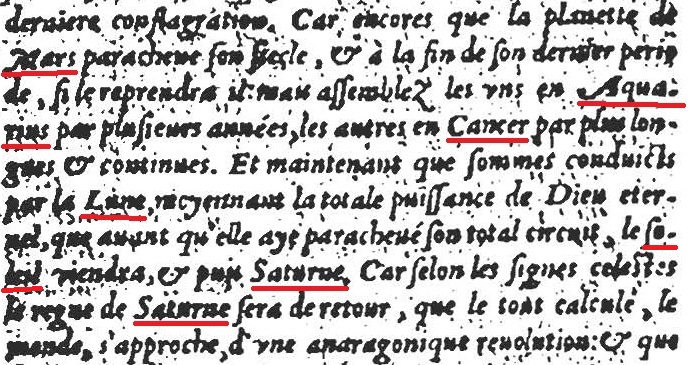
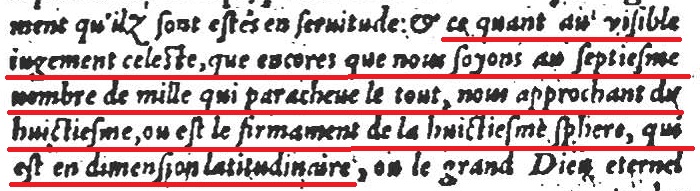
Page 10 of the Preface (1568 edition)
Upper section of page 10
Lower section page 10

The underlined text states (separated by marks of punctuation and symbols) states this in English:

& this in as much as with the evident understanding celestial,

that yet ones who us should be at the seventh number of a thousand which concluded the whole,

we approaching to the eighth,

where is the firmament of the eighth sphere,

that is in measuring latitudinary,

laditudinarian” (Word Origin 1697) – synonymous with:  free-thinking, undogmatic, undogmatical (Princeton University, Farlex Inc.)

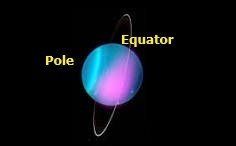
This is a prediction of the discovery of the planet Uranus, where the known solar system of Nostradamus (thus astrology) had seven spheres (Sun, Moon, Mercury, Venus, Mars, Jupiter, and Saturn). AND it is prophesying that Uranus (well after discovery) will not rotate like all the other planets in the solar system.

Uranus was discovered by Herschel on March 13, 1781

When NASA’s Voyager 2 spacecraft flew by Uranus in 1986, it provided scientists’ first — and, so far, only — close glimpse of this strange, sideways-rotating outer planet. Alongside the discovery of new moons and rings, baffling new mysteries confronted scientists. (Google Ai Overview)

As such, its north and south poles lie where most other planets have their equators [Wikipedia] – Latitudinal axis, as “north and south” is the same (top/bottom) for all planets.

Leave a comment

Filed under Nostradamus

Quatrain I-46


Fire in the sky?

The French for Nostradamus quatrain with the ‘part number’ I-46 is this:

Tout aupres d’Aux, de Lestore & Mirande,

Grand feu du ciel en trois nuicts tumbera:

Cause adviendra bien stupende & mirande,

Bien peu apres la terre tremblera.

This can viably translate as this:

Everything in it nearby from With them, of Him built & Prodigious,

Mighty death to it sky upon three darknesses will tumble down:

Matter will come to pass quite senseless & observation,

Benefit little following there country will shiver.

This is what Crystal Links shows as an English translation for this quatrain:

Very near Auch, Lectoure and Mirande
a great fire will fall from the sky for three nights.
The cause will appear both stupefying and marvelous;
shortly afterwards there will be an earthquake.

Okay, to read Aux as Auch makes that only be of secondary intent, but meant to make that mistake. To read Lestore as Lectoure is seeing shapes in clouds. It must primarily be read as L’estore; but as secondary intent, it fits the scenery. To read the capitalized Mirande as a commune that has grown from 1,655 people (in 1793) to a whopping 3,468 (in 2017) [Wikipedia stats] does not justify that place as important enough to be capitalized. Still, on a secondary intent level, all three places are in southwestern France, to the west of the big city Toulouse.


This is where it is important to merge the secondary intent to see who will play a role in the primary intent. That tells of rockets fired from an invading force (from the sea) will cause “dead” (feu means “light” and “fire,” but also “dead’ deceased, departed”) via the “sky.

I had written more, but I guess I did not click the save button. What I had saved is that above. Oh well. Here is what I wrote in 2011:

This theme is stated in the second line of the quatrain, which makes it a secondary theme statement for the quatrain itself, as well as restating an important theme for the future that still awaits us.  This theme is important to understand clearly, because it is something that will affect us all, if we do not wake up and realize we can prevent it from happening.

Before I get into explaining the “fire from the sky” theme of line two, let me first state that there is another theme in this quatrain.  That theme appears in the first line, which is the main theme for the quatrain.  While the statement in line one is specific to the elements of this specific quatrain, a specific place is mentioned, which becomes important as a theme, when multiple quatrains also tell of specific places in the same general area, even repeating the same places in multiple quatrains.  The first line of quatrain I-46 (remember this numbering has nothing to do with the real order of story) states, “Tout aupres d’Aux, de Lestore & Mirande,” which can translate to say, “Everything close to With them, from the Erected & Mirande”.  Mirande is a commune in southwestern France.  

Of course, let me be the one to point out that you will not find anyone other than myself coming up with that translation.  That is because people have seen the capitalized form of “d’Aux” as a Provencal form of Old French, meaning “Auch”.  Auch is a commune in southwest France, in the Gers Department, not far from Mirande, also in the Gers department, which means it can be easy to see that fit.  While the French word “aux” is a routine preposition-article contraction in the plural (as “à les”), which can translate as, “with them,” and while I could find nothing that historically supported the notion that “Aux” was an accepted form of “Auch”, it does seem to fit.  It actually fits quite well.  I mean, they are phonetically similar, and geographically close together (throw a hat over them), it makes sense to make for an easy mistake to be made, one of taking a secondary meaning and replacing that for the primary meaning, so the true meaning of the statement is lost.  Or, at least confused.

The other like mistake that others let their eyes see in the main theme of quatrain I-46, is in the capitalized word, “Lestore”.  Nostradamus regularly did not use punctuation where punctuation is now standard, specifically in words that have a preceding article (“le”) attached in the abbreviated form (“l’ ”).  In instances where the “l” is capitalized, it can actually transfer the capitalization to the second letter, such that “Lestore” can easily become, “l’Estore”.  Such a realization of possibility means that “Lestore” can translate to mean, “the Built”, or “the Erected”.  However, most others in the past have seen the secondary translation as the primary translation, turning “Lestore” into the place Lectoure.

This, again, is not a hard stretch, when one knows that in the Occitan language (one spoken in southwest France) the French spelling of “Lectoure” is “Leitora”.  That is just a hop and a skip, or an “i” substituting for an “s”, and an “e” substituting for an “a”, away from being spot on.  Minimally, the Occitan version erases the “u” entirely, and it is very hard explaining how extra letters get thrown away.  Some sense of logical reason must always apply to these changes being made.  Nevertheless, this leap from “Lestore” to “Lectoure” is further assisted by the fact that Lectoure is another commune in the Gers Department, very close to Auch and Mirande.  That seals the deal, and makes the repeating theme of southwestern France stand boldly out, more than just naming one commune there.

While there is reason to see those three communes appear, although not how they are commonly spelled (with the exception of Mirande), one has to look at the overall theme presented by those translations.  With those liberal translations allowed, they cause the first line to appear to state, “Everything close to Auch, with Lectoure & Mirande”.  As a main theme statement, that makes the main theme of the quatrain be about “Everything in one relatively small area of the Gers Department in France.”  Everything that follows in the quatrain is then to be expected to dangle from that initial lead-in, adding depth of understanding to that statement.  

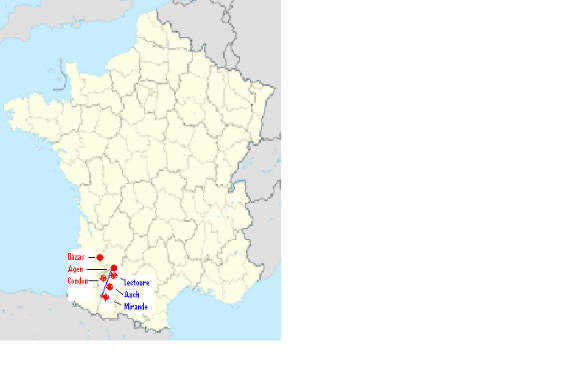
Seeing it as that way, look up those three communes on a map of southern France.  You will find that these three communes make (roughly) a straight line, pointing north south, with about 35 miles separating the northernmost from the southernmost.  The only problem that arises, relative to a statement making a main theme, and as far as the main theme being of primary necessity for solving a word puzzle is concerned, something is lacking.  The theme of southwest France is certainly found repeated in other quatrains, but what makes this three-commune segment of southwest France special?  A statement of three specific communes says nothing more than, “Everything close to” them.  What does that mean for one to see into that clue?

That is why I say that the first line of quatrain I-46 says more, based on the spelling being NOT what others have seen, while intentionally meant to elicit those exact thoughts, for secondary purposes.  What has to be seen is exactly what is there, but ignored, having everyone refuse to acknowledge what it really says.  Line one actually says, “Everything close to With them, the Erected & Mirande”.  That is a main theme that says much more than the names of three nearby communes in southwest France.  It requires one to slow down and read each word for mportance, so that when one reaches “d’Aux”, and “l’Estore”, one can understand how those capitalized descriptions fit into a theme.

That statement beings with, “Tout”, which is “Everything”, or “All”, or the “Whole sum” of that which leads to Mirande.  That, by itself, includes the communes of Auch and Lectoure, making actually stating them needless.  They would specifically be included as places covered by the next word, “aupres”, which means, “close”, or “next”, or “compared”, to Mirande.  Still, this important (as shown by capitalization) “All” is “close” by being people supporting Mirande, as those importantly “With them”, or “To them”, or “In them”, or “At them”, as “d’Aux” states.  For those having reached that point, or those three places in southwest France, we find something has happened there.  “Everything” has led to “the Erected”, or “them Built”, which is a statement that “Everything” had the purpose of “Building up” from the point of Mirande, the commune furthest south.  In a story of war, where “Everything” is on the line, where “All” allies must be “With them”, the ones protecting France, at the southern front battle line, from Lectoure, to Auch, to Mirande, along the Gers River, the tributary to the Garonne River, what must be “Built” is a wall of defense.  Line one in quatrain 1-46 is about this defensive wall.  

Now, what I want to point out about this main theme statement, as a repeated theme, is that this is not the only quatrain that states those three places, either correctly spelled, or misspelled as words that appear to be those places, in a secondary sense.  For instance, quatrain I-76 (remember this is I-46) states in its main theme, “Bazas, Lestore, Condon, Ausch, Agine”, where (long story short) “Lestore” has again been seen as “Lectoure”, and “Ausch” is now a new spelling for “Auch.  

Then, in quatrain IV-72 (not even in the same Centurie as those holding I-46 and I-76), the main theme tells of “Agen & l’Estore”, which is that pesky “Lestore” actually turned into “l’Estore” by Nostradamus.  Still, everyone has seen this, every way, as Lectoure.  If you did not notice, the “Agine” of quatrain I-76 is seen as the “Agen” of quatrain IV-72, and “Agen” is just north of “Lectoure”, although in the Lot-et-Garonne department.  Again, another commune is added to the line created by Mirande, Auch, and Lectoure, with Condom (spelled as Condon) just behind that line, to the west, and Bazas further to the northwest, well behind that line. All of these places are in southwest France, meaning the theme of southwest France is repeated in both of these additional quatrains.  But wait, that is not all.

In quatrain VIII-02 (okay, now we have the theme of the quatrains not in the right order, with two in Centurie 1, one in Centurie 4, and another in Centurie 8, and all related), the main theme states, “Condon & Aux & autour de Mirande”.  Here, we see Condon again, along with “Aux” once more seen as “Auch”, while being spelled the same as in quatrain I-46.  We also find another word that signifies “close to”, in “autour,” which means, “around”, or “surrounding”, which parallels the use of “aupres” in quatrain I-46.  Further, the end of the line’s focus is Mirande, the same as quatrain I-46.  Finally, if that is not quite enough proof of a repeating theme, take a peek at line two in quatrain VIII-02.  There, one will see it says, “du ciel feu”, which is the reverse of what quatrain I-46 states, in “feud u ciel”.  Instead of “fire from the sky”, we have now, “from the sky fire”.  That is undoubtedly a bonafied (Latin: bona fied, meaning, “in good faith”, synonymous with “sincere, authentic, and genuine”) theme; and it brings us back to my original point. “Fire from the sky” is an important theme to understand.  

To understand the importance of this repeated theme, one has to stretch a few brain cells.  By this, I mean one has to understand a little history, as boring as history is to learn.  Regardless of the difficulty, one has to realize that in 1555-1566, the times of which Nostradamus wrote The Prophecies, and the times until his death, the only fire one saw in the sky was when lightning struck, when some invader was hurling fireballs at a castle from a catapult, or when some meteorite or space dust entered the earth’s atmosphere.  Other than lightning, it was not normal to see fire come from the sky; and even with lightning, it was certainly not an everyday occurrence.  Due to this relative rarity, and due to the logic that says one cannot expect a true prophecy to be about ordinary stuff, like regular lightning, or typical meteorite showers, one has to deduce that for Nostradamus to state, “fire from the sky”, he was not talking about ordinary 16th century “fire”.  That means “fire from the sky” is about an abnormal, or purely futuristic, form of powerful destruction.

Certainly, the aspect of catapulted fireballs has to be viewed as typical of the latest (as far as Medieval times was concerned) weapons technology.  All times have their latest, greatest weapons of most massive destruction, with “massive” being ever expanding by definition, always adjusting to fit the needs relative to the effects of the latest creations.  As such, World War II had the German V-2 rockets, which were the first examples of long-distance military fireballs catapulted towards an enemy, with the fire being its method of propulsion.  Today we have rockets that roar and fizzle across the sky, over very great distances, with the tail end of each rocket generating a blaze of fire and a trail of smoke.  All in all, this is not too different from a quickly hurled hay-rock ball, covered in pitch, and set afire.  Despite major differences is the impact results, both weapons can be imagined to have the same effect of eliciting fear among those to whom the “fire from the sky” is directed.  

Keep in mind that famous quatrain, which (if one reads it the right way) predicted the events of September 11, 2001, stating in line two, “Du ciel viendra un grand Roy d’effraieur”, or, “From the sky will come one great King to terrorist”.  That clearly shows how regular passenger air flight occurs, such that standard jumbo airplanes would come “from the sky.”  Without explaining that quatrain, and its themes (I already have in other places), the point is to see that Nostradamus saw objects that normally flew about the skies, which were obviously too heavy to fly without some form of power (fire) causing that flight.  That was not the norm in his day and age; but Leonardo da Vinci had already produced his concepts of man being capable of flight. Leonardo was at his peak prior to Nostradamus’ birth, but did not die until after Nostradamus was born.  

With the mind-expanding realization, one has to be able to see that “fire from the sky” is relative to what has become a modern standard form of warfare.  Leonardo da Vinci played his role as a military technology inventor, in the times leading into the 16th century.  Today, nations commonly fly fighter planes, and launch missiles, as intentional military bombardments, by rocket-propelled devices (remember Kosovo, Serbia, the first Gulf War, all Israeli-Hamas encounters, the Iran War, the Afghan War, etc.). There can be no doubt that Nostradamus was allowed to see these times, complete with all the “firepower” modern science has made possible.  All that remains to be asked is, “What type of warheads might be on Nostradamus’ fire from the sky?”  To answer this question, one needs to look at the clues in the quatrain stating “fire from the sky”, and see if Nostradamus made such a distinction.      

Lines three and four, of quatrain I-46, give a good idea of the nature of those warheads.  One needs to address each line separately, with each word also understood for its whole scope of possible meaning.  One must also be aware that the order of lines is essential to realize, as the supporting details of the main theme (line 1) are found in the third line, while the supporting details for the secondary theme (line 2) are found in the fourth line.

Line three states, “Cause adviendra bien stupende & mirande”.  Most basically, this translates to say, “Occasion will happen quite astounding & extraordinary to view”.  I say most basically because the word “Cause” is capitalized, showing importance, meaning a very significant “Cause”, “Occasion”, or “Reason” is following (from the secondary theme, in line two), “Great fire from the sky upon three nights will fall”.  The place of that impact of “fire from the sky” is Mirande, and it will fall on the important people gathered there, the capitalized Great allies of France.  This fire will be falling upon the three places, the ones intentionally meant to be read secondarily as Auch, Lectoure, and Mirande.  Presumably, the Great will number three, representing the allies, France, Great Britain, and the United States, who will have secured the battle line at those three places.  Also presumably, those three will be bringing in their own fighter jets, stationed in the Atlantic Ocean, to produce fire from the sky on the enemy, on the other side of that battle line.  This will then begin a Great battle that will last three nights, before the line will fall.

We can understand that the future tense verb, “will fall down”, is being explained in line three’s important word, “Cause”, due to the colon designating line three to give an example, or clarification, of that falling down, tumbling down, or falling into.  While fire from the sky certainly does fall (the laws of gravity dictate that), what is more important that will fall down, is that line of defense.  The important Cause to save France, the important Reason three allies are there to fight for southwest France, the important Occasion that will occur is the collapse of Everything, or All, that important word that began the quatrain, and line one.

This important Occasion is then explained, such that it will happen, or will befall, or will come to pass, because something will take place in the battle that will be quite astounding.  The word written by Nostradamus at this point, “stupende”, is not French.  It is Latin, rooted in the word stupere, which is the root of the English word, “stupendous.”  That word is defined as, “Of astounding force, volume, degree, or excellence; marvelous; amazingly large or great; huge; synonymous with enormous.”   To sum this description up in one word, as Nostradamus does following an ampersand, the signal that something important follows, he wrote the word, “mirande”.

If you caught that right away, good for you.  If not, I will explain.  The word mirande is an exact replication of the word ending line one, Mirande, as a rhyme using the same word.  The lower case mirande is spelled the exact same as the capitalized version. The only difference is the capitalization, which shows the importance of a proper noun, versus an adjective.  The lower case spelling becomes the meaning of the word that is at the root of the name.  According to a French travel agency, the word mirande means, “which is pleasant to look at”.  As a one-word summation of a fallen battle line, due to a force that has astonished, it is perhaps best to see that the root of mirande, the source of that travel agent’s defining words, is the Latin word mirus.  That word can mean, “wonderful,” or it can mean, “astonishing,” but it is best stated as, “extraordinary.”  What is quite astounding is something not ordinary.  It is extraordinary to see.  

What is so poetic in the use of mirande, as the rhyme to Mirande, is the name of a place has been itself reduced.  It too has fallen.  The place Mirande, which the travel agent furthered her definition to add, “a much justified name as the setting in this part of the Midi Pyrenees is lovely” , has come, in the prophecy of quatrain I-46, to become the place that in the future will be nothing more than where an Occasion happened, where Reason came to pass, that Caused the use of astonishing force, which will leave a beautiful commune in southwest France little more than a bit of trivia.  Mirande will be where an extraordinary sight will take place.  

If that does not make one consider the possibility of a nuclear weapon being on the warhead of those missiles falling from the sky, then look at one other option as the translation of line three.  That translation, granted it is one on a secondary level, can be stated as, “Matter will fall out substance amazed by degree & astonishing to observe”.  If you are old enough to remember the “duck and cover” training of grade school, during the beginnings of the Cold War, you will remember the yellow and black “Fallout Shelter” signs.  Nuclear bombs create fall out substance, and the U.S. military took lots of movies of their tests, so we can all be amazed at what a nuclear bomb going off can do, including its astonishing blast force, and its radioactive fallout.  That helps explain how an entire line of defense will fall after three nights of battle.  

With that awakening, let us look now to line four, the last line, and the line that adds details to the secondary theme of the fall of a Great line of defense.  In that line, Nostradamus wrote, “Bien peu après la terre tremblera.”  Generally, this says, “Rightly few after there land will tremble.”  In this statement, it can be misleading to see the capitalization of Bien, as it importantly being Right, or Good, that a fall will have taken place, especially when it is with such astonishing force, and so extraordinary, or beyond the norm.  Perhaps its use can be understood when remembering the last time such astonishing force was used in war, as Nagasaki and Hiroshima.  The Reason was, “We thought it would save the lives of many thousands of American boys, not to mention those of countless Japanese.”  In other words, there was a Good 
Reason to use the weapon that caused such horrible immediate damage, with terrible lingering fears to follow.   

Still, when Bien is translated as Aptly, or As it should be, it becomes less a judgment of right or wrong, or good versus bad, and more of a statement of important justice being carried out.  Perhaps God will see it as Apt for those who Possessed (an alternate translation possibility) the bomb, who fought long and hard to keep others from obtaining it, that it should be used against them.  It would be an important lesson, As it should be learned, what goes around comes around.  If ones plays with fire from the sky, one is going to get burned.

Yet, what may Well (Bien) be the Case (Cause), is that few will live to suffer from this bomb’s blast.  The following word, peu, means it will be Right that almost nobody will be left.  The result will be Quite scarce, with little remaining as it was before.  The reduction, the fall, will have scant (peu) Benefit (Bien) for those left.  The result is what comes after this extraordinary sight.  It will be what will be left there, after the bomb goes off.  Not only will the land of southwest France tremble (terre tremblera), but the whole nation (terre) of France will shake.  So too will the countries (Great Britain and the U.S.A.) of the Great shiver.  More importantly, the world (terre) will quake from knowing that time has finally come, the time everyone has feared since 1945.  The earth will tremble because fire from the sky will have fallen in southwestern France.

That sums up quatrain I-46.  As you can see, to explain four lines of Nostradamus requires many pages of writing.  There are 948 quatrains, all of which can be explained just as lucidly as I have explained this one.  While this one quatrain stands alone as a single prophecy, it stands together with other individual prophecies, all of which join to tell one greater prophetic story.  There is not one quatrain that cannot be examined, just as I have examined this one.  All can be understood, if one understands how to read the signs of Nostradamus’ writing.  All can be expected to come true exactly as prophesied, if nothing is done to change the direction in which the world is headed.  

As a single quatrain, the conclusion in I-46 says the earth will tremble.  This too is a repeated theme.  The fire from the sky is in other quatrains, falling in other places.  The world will shake all over; but one cannot see those separate events as unique from the event of quatrain I-46.  When this begins, many places will simultaneously be struck by fire from the sky.  What is good about knowing this now is it does not have to happen in our lifetimes.  We can act to save ourselves, and with God’s help, through a world that turns to God for help through prayer, we can be led to change Everything.  We do not need to be hoping someone will help us, allowing us to stop worrying about what little we can do, on an individual level.  Your soul is your responsibility, yours alone, and you have to act to save yourself first.  All of us have to see what this future brings, so we can find the inner motivation to change ourselves.  If we cannot do that collectively, then this future will happen.  You can count on that.

If you still need proof that Nostradamus was a prophet of Jesus Christ, taking down a message from God, designed to be hidden until needed (break glass in time of emergency), then look at what has already come true 100%.  There are many, many quatrains that prove The Prophecies are anything but random chance occurrences, due to vague words that can have any meaning.  Whoever says those things are not facing the facts.  It is okay to argue against blind faith belief, but to argue logically, on any topic, one has to address what the facts are, and come to some point of agreement.  If someone says, “It is all just a trick,” then I say, “Okay.  Show me where you see a trick.”  One cannot simply use ignorant opinion as logical reason.  It does not hold water.

As always, I welcome your opinions and questions.  I will do what I can to assist anyone who asks to see that Nostradamus was divinely inspired.  I have already seen this.  The point is not to have anyone begin believing in me, or believing in Nostradamus, without seeing for him or herself what there is to see.  The proof is there to see with your own eyes.  If one takes the time to actually look and ponder, the clutter will dissipate, and the clear picture will emerge.  That clarity is also divinely assisted, and it is an amazing feeling to behold.  I want everyone to feel that power, and know that comfort of allowing God to lead one, rather than always trying vainly to control everything in one’s surroundings.  It only requires a leap of faith.  


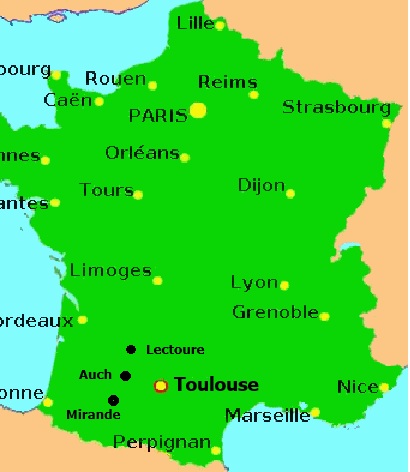
I created this map to help get a picture of the line Lectoure, Auch, and Mirande make.

Note that Agen is along the same line, only a little further north.  Condom is in the same Gers department, just behind that line.

Bazas is north, along the flow of the Garonne River.  Just to the northwest of Bazas is the huge mouth of the Garonne, which is where Bordeaux is a major seaport.  Bordeaux will be the point of entry for the allied forces.

Nostradamus mentions a “wall falling” and he mentions a “wall will fall in the Garonne”

Leave a comment

Filed under Nostradamus

Quatrain I-35


I am reposting an article originally posted around 2011-2013, which was motivated by watching a cable program that parroted the routinely repeated conclusion that reason to believe Nostradamus had some magical-mystical-secret talent to know the future was he foresaw the jousting death of his king. This is relative to one quatrain, with nothing stated in either the Preface or the Epistle to Henry II that supports that conclusion, as Nostradamus writing, “Oh and look for where Henry dies in a greusome accident.”

Nostradamus did not foresee his king’s death. As a devoted subject and a Christian, if Nostradamus had been shown that tragic event it would have been for the purpose of sending urgent word to Herny not to joust. Nostradamus did not warn Henry in the letter he sent to him explaining the meaning of the poems, of which the one numbered 35, in Centurie Premiere (the “First” group of “One hundred”) was one. It was after Henry II’s death that his wife, then Queen Regent Catherine de Medici read that quatrain and (in hindsight) gave Nostradamus credit for having predicted the event. It is unknown how Nostradamus reacted to such recognition, but I imagine him saying something like (while bowing), “Your majesty speaks too kindly to your humble servant.”

One needs to see that this hindisghted way of plucking one small piece of the whole out, looking at it, and then making it project something completely irrelevant to the whole. It is like looking at one puzzle piece out of a box of 1,000 pieces (without looking at the cover picture as a guide) and pretending to know what that one little piece means.

Quatrain I-35! And the envelope says, “Predicting the past.”

In 2003, I knew very little of the depth contained in The Prophecies of Nostradamus, but I was driven by an inner voice to let the world know the truth I had been led to see. Without any fluency in French (or Latin) and going solely by the English translations of an author whose book I had purchased over 35 years prior, I stood in front of a group of card-carrying Skeptics, telling them my opinion about the accuracy of Nostradamus. Their summation of my presentation (in the group’s monthly online newsletter) was headed “Predicting the Past.” For all I presented about what Nostradamus perfectly predicted, which had come true (quatrain I-35 was not one of those five I discussed), to know what happened, after the fact, is useless information. Skeptics want a prediction that can be tested for accuracy, by knowing when and what something will happen.

When the group’s leader told me he wanted to know future predictions of things to come, which could be tested, I explained the astrology of Nostradamus could indicate a major earthquake in Turkey, in May sometime soon. He reported in the newsletter that an earthquake did in fact occur in Turkey, but it was only a 4.5, while pointing out that region of the world is prone for earthquakes. I learned from that experience; and when I published my first book, I used the subtitle: Volume 1: Predicting the Past.

This means knowing the past is vital, in order to realize when one is slap-dab in the middle of a major warning from Yahweh (THE Prophecies). Nostradamus wrote a beginning, middle, and end to the epic poem Yahweh, through Jesus within his soul, led him to write. Knowing a past that is relative to the now and projecting realistically into the future is important to know. However, to think people today need to think Nostradamus predicted the death of a king of France in 1559 … how would that have any meaning in a world that no longer adores kings and rulers no longer ride horses carrying long wooden poles?

With this said, let me repeat what I posted before (with some edits), as the same conclusion applies. Quatrain I-35 has to do with our future that is still ahead. It has nothing to do with a long forgotten past. It served Yahweh by being popularized as myth, which was part of His plan to keep The Prophecies relevant in 2025.

—–

Article posted on Pearls of Nostradamus blog at blogspot.com (a revival of a deleted Yahoo blog post) Nostradamus & the History Channel

(Subtitle: Interpretation of quatrain I-35)

I watched an episode of the History Channel’s series Decoding the Past today, this one focusing on Edgar Cayce. In the first 15 minutes of a 60 minute show, Cayce was not mentioned. They used that time to set up the theme of how so many different people had come up with prophecies about the end of the world (the names used were the Mayan Calendar; the Hopi Indians foretelling of the coming of a 5th world – the end of the 4th; Mother Shipton in England – contemporary to Nostradamus but the two did not know one another; and the old standby himself – Nostradamus). This was the lead up to Edgar Cayce, although he did not (according to the show) predict much more than some earth changes, where parts of the East Coast would be submerged, with increased volcanic and hurricane activity between 1958 and 1998. That fell short of end of world stuff.

Let me clear up a couple of things for anyone who watched the same show (it is a repeat) and thinks a History Channel show represents absolute truth. It does not.

First of all, this show identified Nostradamus as the “court astrologer and magician”. Nostradamus was not a magician. He might have been an alchemist [Sir Isaac Newton was such], in the truest form of the word (not someone who tried to change lead into gold, but someone who understood the philosopher stone as something grasped from within), but there is absolutely no proof that he was anything more than a botanist-apothecary and astrologer. He knew how to make potions and salves, lozenges for sore throats, etc. There is absolutely no proof that he practiced some form of sleight of hand, with something up his sleeve, which is what magicians do. There is no real magic, despite how hard Harry Potter fans wish for it to be so.

This false claim led to them falsely claiming that “Nostradamus’ most famous work, Les Propheties, was produced by astrological calculations and magic.” That is so absurd, it is ridiculous. Nostradamus claimed he wrote from an ecstatic state, where the ecstasy was due to a divine presence. How wonderful a tie-in that truth would be to a show about Edgar Cayce, who fell asleep and was overcome by the divine, which talked through Cayce’s mouth, while Cayce slept. The same thing happened to Nostradamus, only he was conscious while the spirit moved his hand and pen.

Second, they had John Hogue acting as “Prophecy Expert”, who giddily proclaimed how great Nostradamus was by reminding the viewers that Nostradamus predicted the jousting death of King Henry II, with the announcer adding, “four years before his (Henry’s) death.” Hogue then read to an audience that quatrain, leading one to think he knew what he was talking about. He would read something written by Nostradamus, then recite some known history of Henry’s death, as one is led to believe the two parts (Nostradamus & History) connect. They do not. That quatrain is not about the death of Henry.

This is true history. Catherine de Medici, Henry’s wife (queen) and mother of his heirs to the throne, loved Nostradamus and believed in his abilities as an astrologer. She summoned him to Paris on a few occasions, particularly about her seven sons. Nostradamus was made her court’s Physician in Ordinary, in 1564, when Catherine was Queen Regent, after Henry’s death. That was his only official title to the throne. It was, in fact, Catherine that began the rumor that one quatrain perfectly fit Henry’s tragic accident.

Now with that relationship, would it not be strange that Nostradamus wrote about Henry’s death in a quatrain, knew it to be that, but would later say to Catherine after Henry’s death, “Darn Your Majesty. I was so sure you would figure out that one, before the King’s horrible death.” It would be strange, if not treasonous! But, it was not the truth, because Nostradamus did not know about Henry’s coming death, or he would have told them to beware. That quatrain has nothing to do with Henry.

The quatrain in question is in Century 1, number 35. It goes like this:

Le lyon jeune le vieux surmontera,

En champ bellique par singulier duelle:

Dans caige d’or les yeulx luy crevera,

Deux classes une, puis mourir, mort cruelle.

This can translate in English as this:

Him courage youthful it ancient will overcome,
Upon army lodged warlike for singular dual:
Inwardly crate with gold them eyes he will break asunder,
Two orders one, able to perish, death unmerciful.

Guess what a “lion” is. I’ll tell you. Metaphorically, it is someone from England, who is different from someone of Scotland (then a very separate country – and wanting to be again now). Henry was wounded by a French nobleman, Gabriel de Montgomery, who was a captain in Henry’s Scots Guard. The word used to state, “will surpass” or “will vanquish” is surmontera, which also means, “top, surmount”, and “overcome”. Montgomery was 29 when the accident took place, and he did not have reason to “vanquish” Henry. He gained nothing from it, and the Scots Guard tried for a long time to suppress the connection to them and the death of a king. Montgomery was so distraught he left France.

The accident took place on a jousting field, with stands for spectators, not a “field warlike” (bellique). There is a difference; but there was a duel (special or singular) between two warriors, one old, one young. The word duelle is the feminine spelling for duel, which states a “duality,” as “dual.” While an English “duel” is recognized as an argument of “dual” opinions, to be settled by weaponry, the word must be read as “dual,” as a “duality.”

A helmet is not a cage. A cage is more like a place where two men cannot get out – like a cage fight. The word caige refers more to a “crate,” such that birds would be caught in such a “cage,” as a wooden trap. “Of gold” means there will be wagers over the outcome, but some form of gold jewelry could be used to gouge eyes blind. “Two ranks one” means only one will stand in the end. One will die.

While it is true this quatrain could easily be mistaken for the history of the death of Henry II, more is needed to support that theory. Where else did Nostradamus tell that he foretold of the death of his king? There is nothing in the Preface or the letter he sent to Henry II. He said he wrote The Prophecies of a future long away from his times, after his own death, which was after Henry’s death. An event in 1559 does not fit that information. This quatrain has nothing to support that as its event in history. Thus, the quatrain is telling of something still to come.

I think it is important to get the facts straight. The History Channel is more about sensationalism, and those guys tend to bend the truth.

—–

Let me now add an interpretation that takes this puzzle piece and places it snugly between many other arranged puzzle pieces, which show a picture of a coming End Times war.

Le is a capitalized pronoun (not an article) meaning an important “Him” is the initial focus.

The use of lion becomes metaphor for the astrological sign Leo (Latin meaning “Lion”), where that projects “courage, heart, and strong ego.” This means “He” is “courageous.”

The words jeune, followed by le vieux, becomes a statement that “He” shows “courage” to those “young,” who are then filled with “it ancient,” which is both a desire for “old” ways to return and demonic possession by “him ancient,” who is Satan.

This drive “will overcome” one’s basic nature, such that line one (the main theme statement for this quatrain) speaks of a leader (“Him”) who will incite “courage” in “young” soldiers, who “will be overcome” by “him ancient,” as the spirit that motivates all warriors.

This is then conformed in the secondary theme statement (line two), where this spirit will come “Upon” those who are an “army lodged” (a meaning of champ) for “warfare” purposes. They will have been prepared for a “singular” suprise attack, where there will be “dual” agents in this “army lodged.” The “singular dual” is then Muslims added with Eastern European Communists. Those “youths” “will be overcome” with rage to do “battle.”

The “Inwardly” felt motivations for Eastern Europeans will be the promise of a “crate of gold,” where Western Europeans represent the land of plenty, which is theirs for the taking. This lure of “gold” (as wealth and property) will fill their “eyes,” making them ready to “break asunder” and “cleave” to their imaginary enemies, seeking what they do not have.

This will then be “Two” separate militaries that “Both” will be “orders” and “ranks” of soldiers, each with its own “fleets” (Latin translation of classes) to invade “one” target (Western Europe – Christianity – Capitalism). In Italy, there will be “Two” separate invasion “fleets” that will target that “one” country. They will be “able” (puis as a form of pouvoir) to cause unexpecting Western Europeans “to die” in these attacks. The unprepared Western European militaries will run for their lives, but they will be pursued until “dead without mercy.”

As you can see, this future event makes the capitalization of Les Propheties be important, as a warning to all who claim to be Christian. Those will have turned away from Jesus and God and allowed the enemy (“Him”) to be filled with the “courage” of a “lion.” One can then take this future event prophesied and place it over a very old prediction (in hindsight) of a king dying in a jousting accident. It is a story remiscent of the story of Arthur, when he lost his “courage” and sword, allowing the kingdom to be “overcome” by evil. That is why this quatrain is important to understand.

Leave a comment

Filed under Nostradamus

Quatrain II-40 – Naval Battle 6


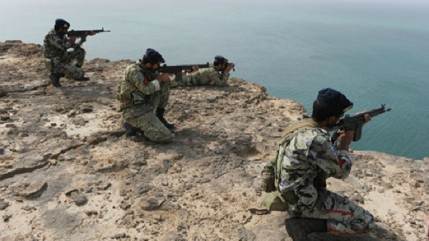
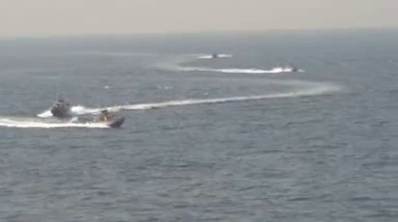
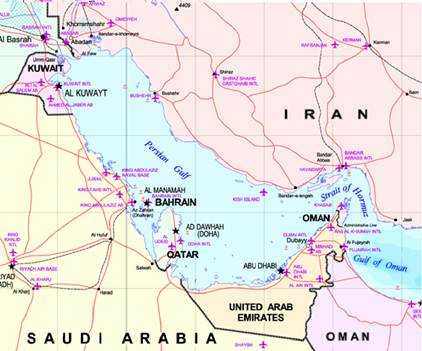
These quatrains listed as “Naval Battle” are all linked to one suprise attack on a U.S. fleet in the Persian Gulf. I posted an article in 2016 about this still unfulfilled future event, due to tensions rising there then. Certainly, now that 2025 has brought the United States a step closer to this deadly battle, I feel it is time to review those quatrains again. Now, I am listing them individually, to make them more readable to the illiterate smartphone addicts with the attention span of a gnat.

—–

Still one more quatrain to consider (as far as making my point about a story of a great naval defeat still to come) is II-40.  The Old French verbiage of it states:

Un peu apres non point longue intervalle,

Par mer & terre sera faict grand tumulte:

Beaucoup plus grande sera pugne navalle,

Feus, animaux, qui plus feront d’insulte.

The Crystal Links website shows this translating as:

Shortly afterwards, without a very long interval,
By sea and land a great uproar will be raised:
Naval battle will be very much greater,
Fires, animals, those who will cause greater insult.

Notice how the use of an ampersand has been transformed into the word “and.” The usage of ampersands is divine and not a statement about a conjunction. There are 682 ampersands placed in 950 quatrains. In addition to that, there are ninety (90) times the word Et is written, with every one of those beginning a line of verse. Neither should be read as “and” or “And.” It is a sign or signal that preceeds importance that must be seen to follow, with a capitalized Et being a statement that the whole line to follow is most important to discern. Thus the ampersand here separates the important statement that can be read to say, “By reason of deep emotions” (Par mer) from that which follows, importantly stating “country will rise made substantial sedition:” A “country” (terre) “will stand acted mighty sedition” importantly speaks of civil unrest and revolution.

Here is a viable translation that maintains word order and punctuation (including ampersand signs).

One few following not moment of time long pause,

By reason of deep emotions & country will rise made sedition:

Very much more mighty will exist fist of the sea,

Deaths, beasts, which added will be forging to triumph over.

In this quatrain, one simply finds “pugne navalle,” where quatrain IX-100 began its main theme by stating, “Navalle pugne.”  In that quatrain we saw “grand” stated, where “grand” (line two)  and “grande” (line three) are found here.  In The Prophecies of Nostradamus, the word grand (in several forms) projects a air of “Christianity,” which is opposed to Communism and Islam, although all major powers are “substantial” as “mighty” opponents. Still, grand must focus one’s eyes on those nations that give credit for their “might, substance, height” of power and influence to their recognition of the “noble” agents of Jesus and God (kings and queens of rule and the Church of Rome).

Finally, line four here begins with a capitalized “Feus,” which tells of tremendous “Fires.”  This matches the use of “fue” in line two of quatrain IX-100. Still, the word Feus is capitalized, making this be an important statement about “Fires” and “Lights,” while the same word (Feu) also means “Dead, Deceased, Departed,” which important follows “fist of the sea” (pugne navalle). That becomes a statement of many “Dead ones.” They will be killed by “beasts” calling themselves human beings. The use of plus says “more” than one enemy will cause so much “Death,” as those “making” this future materialize have “Very much deep emotions” of hatred, seeking to “triumph over” one who praised God for his “country” being “mighty.”

In the news today the “sedition” against Donald Trump is already at hand, where the Communists have been “added” to the Islamic presence (all while millions of killed illegal immigrants are ready and poised to begin a civil war in the United States). When the “battle naval” will be the suprise destruction of a U.S. fleet in the Persian Gulf, it will trigger waves of attackers all around the world in “Christian nations.” This will be when the Iranian nuclear capability had nothing to do with what was just recently bombed (June 2025). The Iranians have “added” already-made nukes by paying their Commie pal Vlad ‘the Beast’ Putin, before the attacks of September 11, 2001. All the news of Iran trying to develop their own nuclear weapon is a red herring. When the Iranian finally make their promise that America will suffer “everlasting consequences” for bombing them, they wanted that excuse and prayed to Allah that Trump and Israel would cross that line. Now they feel nuking the world will be justified by their god.

Still, do not believe me for what I write. You must see for yourself what is written. Can you see the truth? Or, are your eyes and brain too filled with the “Moon” changing your emotional states, blinding you with “rage” or “patriotism”?

This ends this six-quatrain series about Naval Battle.

Leave a comment

Filed under Nostradamus

Quatrain V-35 – Naval Battle 5


These quatrains listed as “Naval Battle” are all linked to one suprise attack on a U.S. fleet in the Persian Gulf. I posted an article in 2016 about this still unfulfilled future event, due to tensions rising there then. Certainly, now that 2025 has brought the United States a step closer to this deadly battle, I feel it is time to review those quatrains again. Now, I am listing them individually, to make them more readable to the illiterate smartphone addicts with the attention span of a gnat.

—–

Another quatrain that adds details to this series is V-35.  The Old French states:

Par cité franche de la grand mer Seline,

Qui porte encores à l’estomach la pierre:

Angloise classe viendra soubz la bruine,

Un rameau prendre du grand ouverte guerre.

Crystal Links translates this as such:

For the free city of the great Crescent sea,
Which still carries the stone in its stomach,
The English fleet will come under the drizzle
To seize a branch, war opened by the great one.

Notice how they take liberties with punctuation and word order. This becomes a paraphrase that generally links “sea” (mer) of the “Moon” (Seline) to an “Englishman” (Angloise) in charge of a “fleet” of “rank” (classe). This is relative to something “underneath” (soubz) that creates a “hot burning mist” (bruine). The last line places focus on “mighty open warfare” (grand ouvert guerre).

The word cité is most frequently read as “city,” which is the noun translation. However, the same spelling is the past participle of the verb citer, meaning “to cite, summon to appear, or warn to appear.” Being “cited” is like a traffic summons that tells one when to show up for court. By seeing this, those who proudly claim to be “free” (franche) will be “summoned to appear,” with them being “mighty” Christians (grand), which is like the “Cross-bearers” of quatrain IX-43. The capitalized use of Seline, where the Greek goddess Selene was representative of the “Moon,” which is a celestial orb that is constantly changing shapes, the “Moon sea” would be a body of water in the Islamic world, like the Persian Gulf. That can be seen as the “stomach” or “womb” of the Middle East. The use of mer, where a “sea” is water, can metaphorically be a statement of the emotions that are relative to the “Moon,” as ever-changing. Thus, a call for help could be seen as an “Islamic anger” (Seline mer) suddenly erupting.

In this quatrain we again see “classe” used [read as Latin], with this time the “fleet” identified as “English,” which is an important word, due to the capitalization.  This also relates to “rank” and “order” (French classe) that is led by an “Englishman” (Angloise is the feminine version of Anglois). This could mean an Admiral of “rank,” who speaks “English.” Thus, this does not necessarily mean Great Britain, but a nation with a “fleet” that speaks “English.”  Language would be very important if one’s intelligence depended on fluency in a foreign language, and Farsi is where American intelligence struggles to find trusted fluency. 

Once again we also find the word “bruine” in a line telling of a “fleet,” with the word “under” or “beneath” linked to this “hot burning mist.  Finally, the last two words in line four are “ouverte guerre,” which represents the same words in the reverse order, as was found in line two of quatrain  VII-37, meaning “evident warfare” here.

Once again, it is not what I see, as my seeing something only affects my faith and Salvation. What do you see? Do you care to see beyond the surface of words, to see what images are flashed into your mind?

Leave a comment

Filed under Nostradamus

Quatrain IX-43 – Naval Battle 4


These quatrains listed as “Naval Battle” are all linked to one suprise attack on a U.S. fleet in the Persian Gulf. I posted an article in 2016 about this still unfulfilled future event, due to tensions rising there then. Certainly, now that 2025 has brought the United States a step closer to this deadly battle, I feel it is time to review those quatrains again. Now, I am listing them individually, to make them more readable to the illiterate smartphone addicts with the attention span of a gnat.

—–

Consider the verbiage of quatrain IX-43, which clearly addresses this issue of religion.  Quatrain IX-43 states in the Old French:

Proche a descendre l’armée Crucigere

Sera guettee par les Ismaëlites

De tous cottez batus par nef Raviere,

Prompt assaillis de dix galeres eslites.

In line one the capitalized word “Crucigere” shows the importance of  “Cross-bearer, where the implication in the 16th and 17th centuries was, “an order of friars who wear crosses on their habits.”  Modify this statement about a Christian sect with “l’armée” – “the armed” or “the army” – and one has just been given a vision of a “Crusader.”  This is then followed, in line two, with “les Ismaëlites,” which literally means, “Those descended from Abraham, through Ishmael” – “Arab Muslims.”

That establishes a history of conflict between the two religions, because “armed Cross-bearers” were invaders of the Middle East, intent on taking land and killing Muslims.  The use of the word “guettee,” in line two, means the watchtowers of the Muslims will have their prey “watched,” which connects synonymously with the use of “erte” in quatrain VII-37.  The use of “nef,” in line three also links this quatrain to the previous three mentioned here; but the presence of “dix galeres eslites” (“ten galleys elite ones”) certifies this match, where Christian and Muslim are identifying the opposing sides in a prepared “List” or “Joust.”  The lack of capitalization of “dix” is then stated as “chosen ones” or “picked out ones,” as the root intent of the English use of “elite.” Where the “superiority” is stated, rather than implied through capitalization.

A couple of notes of interest come from line three’s word “batus” and “Raviere.”  As the past participle of the Old French verb “batre” (now “battre”), “batus” means, “beaten ones, knocked ones, battered ones, and churned ones” (among other choices).  Still, as the noun “batus,” the meaning is stated as, “An order of friars, which in their nightly processions whip their backs extremely.”  The word “raviere” (also spelled “rabiere”) means a “bed of turnips.”  With the word capitalized one is looking for a very important “Bed of turnips,” which on the surface seems quite meaningless.  However, when one remembers the capitalized “Rubriche,” in line three of quatrain IX-100, we found a most important “Marking in red.” 

The aspect of turnips is they are an underground vegetable, meaning they grow under the surface.  A turnip can be mistaken for a radish, because there are bright red turnips.  From seeing this potential, one could see “Raviere” as a “Bunch of red taproots,” being Soviet-made submarines. Still, when the word is read as Ravi, meaning “Ravished, Snatched away hastily, Pulled away violently, Take away forcibly, and Bear away suddenly,” with the -ere suffix being Old French for -er or one who does what it is connected to, the capitalization makes a “Bunch of red taproots” from Soviet-Russia be designed to attack ships. The religious meaning for the root Ravir (as to Rapture) means “Taken away suddenly to heaven.”

For all of this exposure, quatrain IX-43 can present one possible translation as:

……….Close to has to cast down the armed Cross-bearer

……….Will be spied into by them Arab Muslims

……….With all coated ones beaten ones by reason of ship Ravishers,

……….Prepared assaulted ones with ten galleys superior ones.

The use of a capitalized “Proche” matches the description of “Dix naves proches” (“Ten ships close by ones”), found in line two of quatrain X-02.  To read “cast down,” where the implication is to defeat one, the sailing terminology can be also seen, as going fishing, while dropping anchor.  Still, the use of “envoyés” has one recall how “Ten” caused a response of “messengers cast out.”

The secondary theme matches the report in quatrain VII-37, where the “watchtowers” were “not” normal intelligence.  The use of “advert” was also a level of intelligence that allowed “warning,” which could come from spies set within the ranks of their enemies.

When line three uses the term “coated ones” or “coded ones,” it links one’s thoughts back to the “hot mist” that was said to linger after ships had “strangely Turned red.”  Line four repeats the theme of “ten ships,” making quatrain IX-43 easily fit into the story line of a disastrous naval battle in the Persian Gulf.

See if you can add to this. What do you see?

Leave a comment

Filed under Nostradamus

Quatrain VII-37 – Naval Battle 3


These quatrains listed as “Naval Battle” are all linked to one suprise attack on a U.S. fleet in the Persian Gulf. I posted an article in 2016 about this still unfulfilled future event, due to tensions rising there then. Certainly, now that 2025 has brought the United States a step closer to this deadly battle, I feel it is time to review those quatrains again. Now, I am listing them individually, to make them more readable to the illiterate smartphone addicts with the attention span of a gnat.

—–

With quatrain X-02 and IX-100 shown to be telling the same story, with separate details making the story gain depth of field and yield a specific prophecy that has yet to occur, let me add another quatrain to consider.  That quatrain is numbered VII-37 and states:

VII-37

Dix envoyés, chef de nef mettre à mort,

D’un adverty, en classe guerre ouverte:

Confusion, chef, l’un se picque & mord,

Leryn, stecades nefz, cap dedans la nerte.

Again, before I present one viable translation, look and see how the capitalized “Dix,” meaning “Ten,” is repeated.  It is in the main theme line, along with the word “nef,” meaning “ship.”  In line four, we find “nefz,” which is the plural of “nef.”  In the use of “classe,” especially in a quatrain where sailing vessels are mentioned, and with the word “guerre” following the use of “classe,” the translation is commonly said to be “fleet.”  We found “classe” also in the secondary theme line of quatrain X-02.  Such links act to bond this quatrains to the other two.

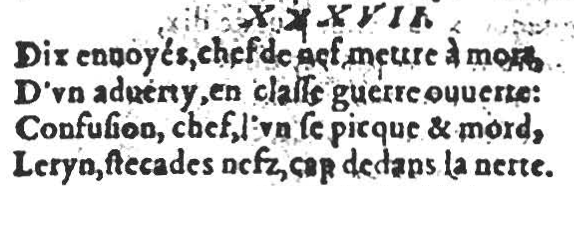
For the translation of this quatrain, I will present a copy of the print, as shown in the 1568 Lyon edition.

Looking above, you can see how page bleed has made it difficult to read some words.  The second word is possible to be read as “ennoyés” or as “envoyés,” as the type for a “v” is the same as that for a “u” (as seen in “advert” and “ouverte”).  In the Old French dictionary from 1611, an unaccented “envoye” refers one to look up “ennoye” (again unaccented).  When the use of a “y” is seen as acceptable to switch with an “i,” the spelling as “ennoie” becomes a third person singular (simple and subjunctive tenses) for “ennoyer,” which means “to flood” or “to inundate.”  The past participle of “ennoyer” is “ennoyé.”Another way to state things that are “inundated” is “they are underwater.” That would be an important clue as to the stealth abilities of “Ten ships.”  However, the 1566 Lyon edition clearly shows the word to be “envoyés

By my pointing this out, I hope the student can see how there is never just one translation to consider.  There are many errors in the 1566 Lyon edition, which caused a need for a revision in 1568.  It may be the correct word set in type was “ennoyés” so that must be considered in translation.  However, based on using “envoyés,” one translation of quatrain VII-37 can now be shown so it states:

……….Ten sent unto ones, principle commander to ship to place with murdered,

……….Of one informed, into fleet warfare apparent:

……….Confusion, paramount, the one itself this thrust into & bites,

……….It nothing, places of combat ships, promontory within there not a place that stands high.

This quatrain begins with a capitalized “Ten,” meaning this number is of significant importance.  It matches the capitalized “Ten” of quatrain X-02.  Erika Cheetham and others have failed to see how the repeating of this number links these two together, more so because this quatrain references “ships,” just as quatrain X-02 added supporting details to the main theme of a “Veiled galley,” stating “Ten ships.”

In the quatrains of The Prophecies, the word “dix” is presented seven times.  Three times it is capitalized, with the other four in the lower case.  In quatrain VIII-69, the importance of “Ten” is related to “years,” and not “ships.”  While there can be a way to link “Ten years” to “Ten ships” and “Ten envoys,” because the 1991 sale of Soviet attack class submarines to Iran was protested in the U.N. and the delivery of the weapons was agreed to be “Ten years.”  Still, I am not going to interpret quatrain VIII-69 here and now; but know that two of the three capitalized presentations of “Dix” link those quatrains together.

When one sees the possibility of “ennoyés” being intended to be read (in addition to “envoyés”), “Ten underwater ones” makes the connection stronger.  Still, when “envoyé” is seen as meaning (as a noun), “A special messenger sent by a Prince from  foreign country,” and as the past participle of the verb “envoyer,” “Sent; delegated; addressed or directed unto;  also to cast or thrust out,” these definitions can all be applied to a military presence.  “Ten ships” (at least) would be the important number “sent” by Russia to Iran.  Those “Ten” would then be awaiting the arrival of an “envoy” of “ships” – a “great fleet” – “sent” to deliver an important message to Iran.

These first two words of line one are then separated from the remainder of the main theme by a comma.  This statement is then directly relative to the sending of warships to the Persian Gulf – warships intending to deliver a powerful message – warships that will send ships “underwater” by ships already stationed there.  The direction is because a “head” person – a leader of merit – wanted a “ship” in “place,” where “death” had already occurred and was planned to take place again.  This makes the main theme relate to the sending of warships by the command of the President of Russia, the receipt of those warships by the President of Iran, and the order of the President of the United States to “address” a murderous act committed by Iran (military or terrorist actions), as a declaration of war.

Following a comma at the end of the main theme, the secondary theme is set up to be separate in time and/or space, while relative to this sending of “Ten” to a “place with death.”  The capitalized first word is a combination word, “D’un,” where the capitalization of the preposition “de” is one with the word “un,” making the result be to place focus on a most important “One.”  The importance of the directional preposition is all directions are importantly part of this “One.”  We have to consider “To one, From one, Of one” and perhaps most importantly “With one.”

In quatrain IX-100, I brought out the importance of “Le” being read as a powerful “It.”  The implication was that “It” was a most powerful weapon, as would be a nuclear bomb.  When reading “D’un” as an important possession of “One,” as “With one,” it becomes easy to see how “It” can be related to Iran’s quest to develop a nuclear bomb.  Should Iran successfully test such a bomb, it certainly would cause a reaction by the Americans, such that a show of strength could be the order given in response to such a test.  This would then begin the “To-From” of “sending messengers” by “leaders.”

The use of “adverty,” which means, “advertised, informed, certified, warned, admonished, advised; signified unto; and giving notice or intelligence of,” this means the important “One” is too big to keep secret.  When Pakistan first developed their nuclear bomb and successfully tested “It,” the nation cheered wildly, making Abdul Qadeer (A.Q) Khan a national hero.  I would imagine Iran would celebrate in a similar manner, making American satellite surveillance simply a matter of confirming what would probably be broadcast internationally through the news media.  Thus, the secondary them is initiating a focus on important publicity “Of one” being “With one.”

As was with the main theme statement, where a comma separated it into two fragments, a comma is placed in line two similarly.  This creates a separation from the intelligence obtained “Of one,” so the flow following expands on that new information.  That expansion states, “in fleet warfare evident” or “apparent, open, overt.”  Certainly, this says the “intelligence gathered” shows a “weapon of warfare” is relative “To one,” with the results of a successful application of that technology being “clear” and “plain” to see.  The aspect of “classe” as “fleet” could mean the launching of a warhead from a ship at sea (the Indian Ocean or Arabian Sea); but it could also mean the significance “Of one” comes from placing “It” “in a class” of “war” tools that is greater than lesser bombs.  In this regard, “fleet” could mean that many “Of one” have been produced.

The secondary theme then is explaining why “messengers” have been sent, because the only purpose of a nuclear bomb is “death,” which is such a weapon in the hands of “inferior” nations makes the world unstable, with “war” a threat more openly communicated.  The world has seen this with Kim Jong-un, who readily tests missiles and threatens the West and America with use of his bomb.  Recent reports say Jung-un is working with Iran to develop their bomb.  Therefore, line two ends with a colon, making line three clarify this aspect of the “open” threat of “war.”

That which is “open warfare” or “evident contention” or an “apparent debate” (from “guerre ouverte”) is clarified as a most high degree (capitalization) of “Confusion, Disorder, Chaos,” or something “Confounding.”  This state of “Confusion” could be due to Iran making its nuclear capability come about much faster than expected.  In respect to the recent agreement struck by the Obama Administration, overseen by Secretary of State John Kerry (January 2016), the White House reasoned it would be “Ten years” (quatrain VIII-69) before Iran would have enough uranium-235 to make “One” bomb.  A major state of “Confusion,” setting off a “Hurly-burly” (busy, boisterous activity – tumult and uproar) of officials scrambling to see why their intelligence did not forewarn them of this progress, is not only clarifying an “overt” activity of warfare” weaponry, it is supporting the main theme of “Ten messengers” being ordered into harm’s way.

While there may be those who reckon that such an unexpected test would be from not developing their own nuclear weapons, but from having purchased some on the international “black market,” the comma following “Confusion” says that a subsequent clarification of that which has “apparently” taken place is of “paramount” importance.  The word “chef” is repeated as this next step, but instead of being a word stating (as a noun), “chief, general, head, or principal commander,” it reads as an adjective, denoting the highest degree of importance, with “paramount” being a call for the one with the highest degree of authority to bring calm to the din.  Still, because of this great level of importance, a secondary meaning for “chef” can be read, as “the end of a place, time, or business.”  That would mean this situation was “paramount” because of the threat to the world’s continued stability – the End Times.

Following another comma, the colon’s list of clarifications of “chiefly” (adverb usage) comes “the one itself this thrust into.”  As a clarification for line two beginning with “Of one” (or “To one, With one, From one”), we now see this is “the one,” where a combined article and noun is written (“l’un”).  The “Confusion” that becomes “paramount” is related to it being “obvious” that “one” has been witnessed.  The statement “the one” then precedes the word “se,” which is a personal pronoun relative to people or numbers, as a reflexive pronoun.  This means “the one” is “oneself” or “itself” (as an inanimate object), which is then described as “picque.”

The word “picque” appears six times in quatrains, one of which (obviously) is in quatrain VII-37.  This word’s spelling is found in the 1611 Old French dictionary of Randle Cotgrave stating the meaning to be, “A spade at cards,” which is not the intent in any of the six uses of “picque” in the quatrains of The Prophecies.  However, Randle Cotgrave added to his definition, “also, as pique.” 

The word “pique” is then defined to mean, “A pike [A long spear formerly used by infantry]; also a pikeman [a soldier who holds a spear]; also, A pike [a stab or piercing], debate, quarrel, or grudge.”  In this regard, where a “spear” is being stated as relative to “the one itself,” it is then worthwhile to know that Nostradamus wrote the word “pique” in two other quatrains, with the plural spelling (“piques”) in two more.  In the quatrain that follows VII-38, Nostradamus began the secondary theme line with the capitalized “Picquer,” which is to be defined as the infinitive form of the verb “piquer,” without the “c.”

Before I interpret this use in quatrain VII-37, I would like to address this “extra c” that appears in many Old French words, where by 1611 it was common to refer one to look up a spelling without the “c.”  One can see this as Nostradamus having been hung up – “Confused” – about which spelling he should use, adding it some places and leaving it out in others.  That can lead one to see Nostradamus as the author and imagine his mind a whir, trying to figure this future prophecy out.  That should not be seen as the case, as Nostradamus explained his source was God, with him simply letting the mind of Christ move his hand, while it held a quill to paper.  Therefore, the presence of, as well as the absence of a “c” has meaning.

That meaning is as an simple anagram where the “c” needs to be removed from the middle of the word and attached at the beginning, as “c’pique.”  This then acts as an abbreviation of the French word “ce,” this means “this.”  You may have noted that my translation shows “this thrust into.”  The translation is from “c’piqué,” where the past participle form of “piquer” is read [adding an accent mark is allowed … remember].

Remembering that line three is offing a list of clarifications to the “overt” display of “warfare,” which would be a test of new weaponry, the result has been major “Confusion,” followed by this new state of being be seen as of “paramount” importance, with an enemy having reached unwanted heights of technology, the next statement is telling us why this is “paramount.”  It is because “the one itself” placed on display is “this spear,” or “this thrust into” an enemy.  A “spear” alone can only do damage to one at a time, but when “the one” of concern is seen as the evil weapon alone, by “itself,” that evil then being “this thrust into” by means of a “spear,” becomes an explanation of a nuclear warhead on a guided missile.  Once that is “thrust into” an enemy, many are wounded by one strike.

Once that meaning has been derived, line three reaches an ampersand, the mark that denotes an important statement to follow, while additionally [how to see “and” implied] showing a difference – similarity duality, and adding information as a conjunction run-on.  The important statement is then “mord,” which is the third person simple form of the verb “mordre.”  This then means, “[he, she, it] bites.”

The complete defined use of “mordre” was stated to be, “To bite, or set the teeth in; to gnaw, chomp, nibble; to pinch, nip, snip or snap with the teeth; also to sting; also to smell; also to conceive, apprehend, understand.”  Each of these meaning can now be placed into that third person simple form, where the ampersand now says this tested weapon is “the one” that is designed to be “thrust into” an enemy, so that “it bites, it gnaws, it snaps, it stings, it smells, it understands.”  Relative to a statement listing a series of clarifications as to how one would react to an “evident” test of a forbidden “warfare” tool, those who were initially quite “Confused” will finally come to “understand” this new reality.  That will be what “bites,” what “gnaws” at them, what “snaps” like a rabid dog at them, what “stings” the ego, what “smells” like a conspiracy.  Most of all, it is what one finally “understands.”

Following a comma at the end of line three, one comes to a reflection of the “Confusion” that began line three.  Line four contains three quite confusing words: “Leryn, stecades,” and “nerte.”  These words have been translated by others as indicating “Lérins Islands”[two islands near Nice] and “Îles d’Hyères” (Islands of Hyères) [four islands near Marseille], which are also called the Stoechades, because they are known for their lavender.  The Latin word for lavender is “stoechas.”  As for “nerte,” Erika Cheetham footnoted it, saying it was either Old French for “black,” or from the Greek word “nerthe,” meaning “underneath.”  All footnoted words are words of uncertainty, as the Old French word for “black” was [and still is for French today] “noir.”

Because the word “nerte” is found in the 1611 Old French dictionary, not meaning “black,” but meaning “A myrtle shrub” [the same meaning today], it becomes a word like “picque,” which was defined as meaning “A spade at cards.”  When the word does not fit the flow of context, then an alternate view is required (such as seeing “picque” as “c’pique”).

The words “Leryn” and “stecades” do nothing to establish a setting because islands off the coast of southern France are not focal points for nuclear tests.  In what unfolds later in the epic story told by the quatrains of The Prophecies, one could see how seeing those specific islands act as a premonition of what will come, as far as “open warfare,” but as supporting evidence for the secondary theme statement (what all fourth lines present) coastal France can only be misleading as a primary view.

As for “stecades,” the 1611 Old French dictionary shows the word “steccades,” with an extra “c” (remember the extra “c” in “picque”?).  The word “steccade” is defined as meaning, “A place vailed in for combat or lists.”  A “list” was a jousting contest, meaning a “steccade” was a place set aside for such trials of combat.  This is a perfect definition in the context of weaponry testing.  A “steccade” is a place set aside for practicing use of “spears” (also known as lances) or “piques.”

As for the capitalized mystery word “Leryn,” it should be seen that a capitalized “L” is representative of a capitalized “La” (in quatrain X-02) and a capitalized “Le” (in quatrain IX-100), when seen as an abbreviated form in a compound word.  This means “L’” would sonnect to the front of a simple anagram consisting of the letters “eryn,” where “y” can be exchanged for “i.”  This means the word “rien” is a possibility.

The French word “rien” means, “a matter, thing, something, anything.”  To attach a capitalized “L” to this “thing” or “matter,” is to indicate a most important “One thing,” as “A thing,” or “The matter.”  When one sees how this reflects “l’un se,” or “the one itself, this is then the “One thing” from which all things of matter come – “The atom.”  As such, the French use of “rien,” when combined in a statement with a negative (“ne”), the word transforms from “something” to “nothing.”  This transformation capability of the word “rien” is then the transformation capabilities of an atom that is split, causing “nothing” be the sudden release of energy from mass (“matter”).

Seeing this possibility of translation, line four ends with an important statement about “it bites,” while also meaning “he understands,” such that the understanding is who has possession of such “A thing” that is an “evident” tool for “warfare,” especially “the one” who “oneself” had raced to have more of “the one itself,” than the other.  All of those had been mounted atop “spears” or “lances,” in places set aside for practicing “warfare.”  This could point to the realization that Iran was only acting like it was going to produce its own nuclear capabilities, when it had already secretly bought them from the Soviets years before.  This then means that sending a fleet of ships into a place set aside for jousting, where one’s lance wins when it “pricks” an opponent off its horse, is the “Confusion” of practicing a showdown or really having a showdown involving “ships” (“nefz”).

This then refers to a “cape,” where “cap” is defined as, “A promontory, cape, hill, or nook of land outstretched into the sea; a head of land lying out into the sea.”  Whereas there are several small capes that stretch out into the Mediterranean coast of southern France, consider this “promontory” of Oman:

This picture grasps how this promontory is possessed by Oman, while being separated from the greater land of Oman, by the land named United Arab Emirates. 

This graphic then shows how narrow the Strait of Hormuz is around this “cape.”

From seeing this geography, line four then states how this “cape” forces one to travel “within” a narrow strait, in order to get to and from “there,” where the Ten envoys” lie in waiting for a naval “fleet.”  This leaves the word “nerte” to be translated; and if Erika Cheetham is correct that it meant “black” in ancient French, then “black” is a symbolic term used by Nostradamus to indicate Islam.  That would place “there” in the land of Muslims.  Still, since I cannot confirm this, and although a Greek root, meaning “underneath” also confirms “Ten underwater” (from “ennoyes”), there needs to be a clear understanding of the word “nerte.”

That comes from seeing the word as “nerte,” where it too becomes a compound word, with a negative attached as a prefix to the word “erte.”  The word “erte” means, “A place that stands high, or is somewhat high to look at.”  The promontory of Oman [Musandam Peninsula] looks like this:

Thus, Randle Cotgrave further defined “erte” to mean, “a steep or craggy ascent; a watch tower.”  This perfectly fits the description of the “cape” of Oman, across from the Iranian side of the Strait of Hormuz.  Still, when the negative is attached, the meaning becomes the opposite, as “not a steep promontory” or “not a watch tower.”  This would be understood as the watching eye was coming from beneath the water, and not from land overlooking it.

Here is a 2011 picture of Iranian soldiers in a military exercise, supposedly to guard their coast at the Strait of Hormuz:

Certainly, the focus that I have put on Iran and a trap set for the U.S. Navy in the Persian Gulf is not directly supported in the three quatrains that have stated “Ten” and “ships.”  One has to realize that Nostradamus explained in his letters how the future would involve Christians versus Muslims, where those two religions were symbolized by the colors “white” (Christianity) and “black” (Islam).  Still, there are more quatrains that fall into this series that tells of a most significant event in the coming history of the world.  It is already planned, but the timing has not yet been right.  That means there is still hope to avert this story and change the heading of the world towards a renewed faith in God and truly Christian oversight.  However, this event will always be waiting for the time when that faith has completely been lost.

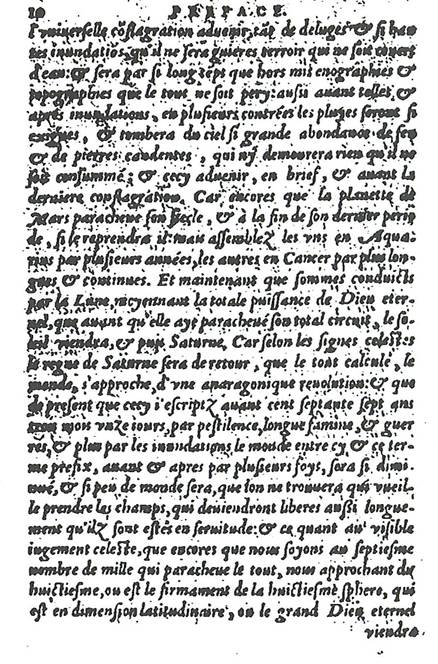
Leave a comment

Filed under Nostradamus

Quatrain IX-100 – Naval Battle 2


These quatrains listed as “Naval Battle” are all linked to one suprise attack on a U.S. fleet in the Persian Gulf. I posted an article in 2016 about this still unfulfilled future event, due to tensions rising there then. Certainly, now that 2025 has brought the United States a step closer to this deadly battle, I feel it is time to review those quatrains again. Now, I am listing them individually, to make them more readable to the illiterate smartphone addicts with the attention span of a gnat.

—–

In Erika Cheetham’s 1973 edition of The Prophecies of Nostradamus, she pointed out that the verbiage of quatrain IX-100 (only two quatrains before quatrain X-02) was similar.  Her notes begin by saying, “There seems possibly to be a connection between this quatrain [X-02] and  IX. 100.”  That connection is more than possible, it is certain. 

Here is what Nostradamus published in 1568 (edited from 1566):

IX-100

Navalle pugne nuit sera superee,

Le feu aux naves a l’Occident ruyne:

Rubriche neufve la grand nef coloree,

Ire a vaincu & victoire en bruyne.

Before I present a translation, look at the word that make the connection Ms. Cheetham referred to.  The capitalized word “Navalle” is the immediate focus of importance.  Line two tells of the “naves,” or “ships,” which is a word repeated in quatrain X-02 [“Dix naves proches”].  We are then shown supporting details to the main theme and clarification to line two through a reference to “grand nef” – “great ship” – where “grande” and “Grande” were in quatrain X-02, while the main theme was about a “nef cachera” – “ship will catch.”  In quatrain X-02, line four began “Great vanquished,” where the feminine spelling of “Grande vaincue” matches line four of quatrain IX-100, which states, “Ire a vaincu” as the masculine form for “vanquished.”  All of this repeating verbiage IS how quatrains link together to tell a story in deep detail.

Knowing that, one translation of quatrain IX-100 then can be:

Naval punch darkness will be vanquished [or overcome, surmounted, surpassed],

It fire [or light; dead, deceased, departed] at them ships has the West ruined:

Marked red strange here great ship colored,

Wrath to vanquished & victory upon hot mist that blasts.

Here, we add the word “pugne,” which is Ancient French, meaning “grip,” but more related to the Latin root, “pugnus,” meaning, “fist.”  One makes a fist while gripping something.  Because the old name for boxers is “pugilists,” where they exchange punches with the fists, the Vocative case spelling.  Still, “pugne” means “a handful” and “a punch,” where it is applied navally and also at “night.”

Something that can enhance an important “Veiled” encounter is “darkness.”  Thus, another meaning for “Ten” can now be applied to the time of day, where 10 PM is after nightfall.  While that would be a secondary application of “Dix,” we are learning from the statement of “nuit” when the sucker-“punch” will  be thrown, and how that strike will make everything go “dark.”  Still, even though this punch “will be” such that the one struck “will be vanquished,” it will not instantly be fatal, in the sense that the strike “will be overcome.”

It is worthwhile noting that the use of “superee” is synonymous with the uses of “vaincu” and “vaincue” inquatrains X-02 and IX-100.  This use here, in the main theme statement of quatrain IX-100 directly links to line four of quatrain X-02, as both line speak of overcoming, surmounting, and vanquishing.  In this way, Nostradamus displayed the multiplicity of word meanings in the use of synonyms.  As such, a search of one word in a concordance for The Prophecies will only show a limited number of choices.  Add in the fact that words like “ruyne“ and “bruyne” are also spelled as “ruine” and “bruine” and an even further limitation is cast.

The secondary theme statement (line two) then ends with a colon.  That mark signifies the statements in line three [each word makes multiple statements] will clarify that theme by example, especially that “ruined,” or make a list or points supporting that already said.

In quatrain X-02, I discussed the capitalization of “La,” stating that an article cannot convey the level of importance that the adverb “” can.  The first word of line two in quatrain IX-100 also begins with what appears to be a capitalized article, in this case “Le.”  There is no need to accent this word (although that is a possibility – “”means “width, strip or length” in paper terms), as “Le” becomes important as a pronoun.  In this case the importance is shown as “It,” which relates with the “pugne” done “Navally.”

Seeing this, “It” creates “light, fire, death, deceased, and departed.”  “It” is what is “from them” who represent the “ships” of the East, which are sent “to them” that are the “ships of the West.”  By this reference, and although we still do not have a specific name for the “Great” of “the West,” the implication can be deduced as the United States.  “It” is, therefore, a weapon that is known to be what “the West has” on their “ships.”  “It” is what makes one “Great.”  However, now “It” will be what “has the West ruined – subverted – destroyed – wrecked – overthrown – and utterly undone.”

If you get the big picture of just how important “It” is, as a weapon of power, you can grasp the next capitalized word – “Rubriche,” which means significantly “Marked in red,” or “Made red.”  Still, as common citizens who are the absolute last to know what the latest in warfare technology has created, there is some doubt that a nuclear bomb would be used where so many “ships” are “nearby” to one another.  when “feu“ is most commonly used to denote “fire,” it is easy to see how “fire” and “red” are somewhat synonymous.  Still, as “fire” creates “light,” the “darkness” can be unveiled.  However, when “feu” has a secondary meaning as “death, deceased, and departed,” the factor of “fire” and “light” can be seen as some form of laser technology having been developed – much like the ray guns of 1950’s science fiction.  It can then be assumed the United States and Russia share this technology, but Iran would be the “least” nation expected to possess “It.”

The importance of something “Marked in red” is then said to be a “new, strange, uncouth, fresh” kind of “red.”  “It” even can be said to be a “Marking” that was (in Nostradamus’ time) “unknown, unused, and unheard of before.”  This could be a “Marked in red” hue that glows, pulses, or glitters, unlike anything Nostradamus had known.  This strange “Red marking” has not only “colored” the “ships of the West,” symbolizing their destruction, but it has “Marked a red-letter” day for those who had previously deemed themselves “great.”

Following the comma at the end of line three, which separates this significant reddening from line four, in time and/or space, we find capitalized the word “Ire,” which means, “Ire, Anger, Fuming, Wrath, Rage and Indignation.”  As line four represents where supporting details can be found directly relating to the secondary theme, it is an important statement about the deep hatred that exists between Americans and Iranians, because the two reflect the long time hostilities between Christians and Muslims.  This act was done out of severe “Anger,” while the act was done because of the extreme “Indignation” America had shown towards Iran, for their support of terrorism.  This “Wrath” unleashed cannot be undone, thus once it takes place the whole world will have been “vanquished” and “destroyed.”  Still, for the moment, the “Anger” shared by Communists and Islamists alike will win the day, and their enemy’s “fleet of ships” will be “overcome.”

In the middle of line four is an ampersand, which is a special mark in all of the quatrains and letters that signifies an important statement will follow.  It also acts to denote where opposites and similarities are divided, before being joined together as one.  This means an ampersand can never simply be read as “and.”  It is a very complex mark.

The important statement that follows concerns this “victory” that was brought about from extreme “Rage.” The use of the word “bruine,” which is spelled with a “y” in three quatrains (including this one) and with an “i” in three others, plus with a “y” in the plural once and as an adjective (“bruyneux”) in yet one more quatrain, means (as a feminine noun), “A hot mist that blasts and burns plants.”  Accented, as a past tense verb, it means “Blasted or burned with mist; hoary, as a thing that is covered in a misty rind.”  Because the color red is part of the determination of meaning, one could eliminate the dew-like image of hoary, unless this was part of a cooling down change.  Most likely, the mixture of “fire” and sea water would create a “hot blast” that would leave a mist; and this would be yet another detail about how this weapon is used.

Leave a comment

Filed under Nostradamus

Quatrain X-02 – Naval Battle 1


Back in 2016, due to aggression in the Persian Gulf by Iran, I posted an article that lists six quatrains Nostradamus wrote, regarding a naval battle. Now, after recent news has reported Iran being bombed by Israel and the United States militaries, Iran just recently retailated by sending a wave of missiles towards the U.S. military facility in Qatar. That addressed U.S. airplanes based there, which is not from from the island nation of Bahrain (just to the north of Qatar), where U.S. naval presence is based.

I will not present each of the six quatrains listed in 2016 and offer views on them individually. Just know they do not stand totally alone. While each is a divine prophecy, they gain greater strength when read as connected, in an epic poem. The epic poem that is The Prophecies of Nostradamus warns of the End Times that will be brought on by faithless human beings following demonically possessed false shepherds. The epic poem tells how to avoid this soul destruction that will bring about the earth no longer being able to sustain life as it has been (a brave new zombie world); but people prefer to skip how to save their individual soul and leap onto the frightening stuff. Onward to the frightening stuff.

Not long ago (a few days now), the news was that four Iranian patrol boats came close to a U.S. navy destroyer in the Persian Gulf, near the Strait of Hormuz.  Later, the news reported that the American ship fired a warning shot (a flare) when two of the Iranian boats came as close as 300 yards to it. 

On the television news recently, a retired U.S. general was interviewed about this incident.  He said the Iranians were testing the response of American ships, which is restricted by directives from the Commander in Chief – Barack Obama.  While the official word from the White House was that the Iranian behavior was unacceptable, the general pointed out that the president has done nothing to establish a position that will keep future tests like this from happening.  The general added that Iran is acting in ways that demonstrate its readiness to take control of the Middle East region, as the supreme power for other Islamic nations to depend on.

Within seconds of the talking head “reporter” agreeing that this is an important development, she said, “Now a look at the stock market.”  This shows that important news is little more than entertainment for an audience that will forever have bad news reported, but never any reports of something being done to stop that flow of bad news.  Therefore, one should expect Iran to keep testing U.S. ships in the Persian Gulf, in the Strait of Hormuz.

Later that day, as I ate lunch and watched the news, I caught the tail end of a report about a Chinese spy that was caught giving China the secret codes for the technology U.S. Navy ships have to instantly communicate with one another.  This seemed to be a problem, simply because the Chinese have since installed a similar program in their fleet communication capabilities.   The viewing audience was told to stay tuned for a prime time series about the spies caught stealing American secrets, which would portray the one who was caught stealing this naval intelligence program.

There was no mention of the possibility that China could sell this technology to other foreign governments, whose militaries would love to “tune in” to the chatter going on between US Navy ships.  That seems like a worse danger to the safety and security of American ships and sailors.

Such news reports as these reassure me that what I have seen from putting multiple quatrains together, about a tragic naval defeat in the Persian Gulf, will come true (if “reassurance” is the right word).   Erika Cheetham saw two of these quatrains linking, and she saw them as possibly about the surprise attack on Pearl Harbor, on December 7, 1941.  President Franklin D. Roosevelt called that “a date that will live in infamy.”  Still, as with every quatrain thought to have already been fulfilled, if it has happened once, then it can happen again.  The two quatrains she noted as about Pearl Harbor (possibly, not certain) are perfect for setting up a scenario that makes the recent news reports of utmost importance … should being forewarned truly mean being forearmed.

The first quatrain I would like to present to you for consideration (as forearming information) is quatrain X-02.  It states (in Old French):

Voille gallere voil de nef cachera,

La grande classe viendra sortir la moindre

Dix naves proches le torneront poulser,

Grande vaincue unies a soy joindre.

One translation (there is always more than one way to put words to a prophecy) says:

[It] Vailed galley willing of ship to catch,

There great fleet will come to issue here inferior

Ten ships close by it turning to violent challenge,

Great vanquished united ones has itself to grapple as enemies.

The main theme statement (line one) begins with the capitalized word “Voille.”  A capitalized word always indicates an important statement, made in one word.  The word “voile” is actually not a word, although it is easily seen as being the same as the word “voile,” so the word is translated according to the primary intent.  Still, “voile” is a simple anagram, where the extra “l” must come out and be attached to the beginning.  Therefore, the true important word stated is “l’Voile,” where the importance of “Veil,” “Sail,” or “Ship” (since a vessel with a sail was a ship in the 16th century) is individualized as “the Veiled.” 

The reason “the Ship” is not the primary intent is the following word “gallere” means “galley,” which was a large sailing ship in the 16th century.  This means the importance of “the Ship” is its ability to be “Veiled,” such that it is a “galley” with the ability to be hidden.  It is like “A Ship behind a curtain.”

This has deeper meaning itself, whereas the people most commonly wearing veils are women in the Middle East, who are Muslim.  Since the Middle East is known for sand and oil, rather than having large sailing ships, the “curtain” that keeps the ship from being seen is one developed by Russians, who were known for the secrecy they demands behind their forceful “veil” of iron – the Iron Curtain.  Therefore, from a perspective of modern historical knowledge, line one is making the statement about a stealth naval vessel, implying it was manufactured in the former Soviet Union, and sold to the Iranians.  This sale was initiated in 1991, soon after the Iron Curtain collapsed.

The word “voil” is an Ancient French form of the verb “volonté,” meaning “wish” or “will,” where a “willingness” or “desire” is the root cause for a cloaked sea vessel being developed, manufactured and sold.  The owner of such a secret ship has only one reason for that possession, which is to use it in an act of revenge, from the element of surprise. 

This willingness is then where one finds the third word in line one that can be translated as “ship.”  The “wish” is to have the capacity “of a ship,” to use “to a ship,” to be freed “from a ship” that is superior to all the other ships one has been known for having.  This means this past history of being weak in naval war capabilities will play a role in drawing in a “ship,” so it can be “caught.”  Thus, the “desire” is to have a “ship” that will act as a trap that will “catch” other ships.

With the main theme focusing on a veiled alliance, where weapons are sold for cash, between two nations with a common enemy (or enemies), line two is separated by a comma at the end of line one.  This separation makes the secondary theme free to associate with that enemy.  Line two then seems to begin with a capitalized article, “La,” but the primary intent of this important word is not as “The,” but as “There,” where “La” is accented as “.”  An accent mark can be added where one is not shown, but one shown can never be erased.

The adverb “la” is then written in two places in line two, one capitalized and one in the lower case.  If multiple translations are possible of a word, then multiple uses should be fitted into the text.  Since “la” can mean, “there, here, or then,” the opposite duality of “Here and there” or “There and here” makes for good application, but “Then” can also can and should be a consideration.

Because the trap is to be set up where least expected, drawing the enemy “There” is most important.  The enemy is identified then as “great,” which is a statement about an individual or collective of individuals seen as one, who are of “great” power, wealth and influence.  This greatness is then modified as being known for its “fleet,” which is rooted in the Latin word “classicus” or “classis,” meaning “the armed forces, especially the fleet.”  The use of a Latin derivative in any quatrain is pointing to an association with Rome.  As an enemy to both Russia and Iran, the common factor is religion, where both have disregard for Christianity.  Therefore, the initial focus in the secondary theme is drawing to “There [Iran, Persian Gulf] the mighty fleet of the keepers of Christianity,” America.  That “fleet will come” into that trap, in order to protect the weak nations that have plenty of oil, who need protection.  The West sees those “inferior” powers as worth protecting, while they see Iran as “lesser” in power than America.  The trap depends on that “great fleet” not expecting an equal or greater power lurking underwater, as “then” and “here” (the Persian Gulf) will be an “inferior” entity.

The news about Iran trying to develop a nuclear device gives the impression that the only way to obtain such weaponry is to make it yourself.  In this sense, even if Iran had processed enough uranium-235 to make one atomic bomb, the number of such weapons held by the United States (not to mention its Western allies) would be far superior.  This means the secondary theme is referencing the attitude, based on intelligence “here” in the United States, as of that time “then,” that it would be okay to send in a “fleet” … “There,” because of that “great” imbalance of power.

Because line two does not end with any punctuation, the statement of line three becomes an immediate flow of thought in reference to a fleet of a powerful nation arriving to present an ultimatum to an inferior power.  Based on the last word of line two being “less, lesser, inferior to” and “least, smallest, most low,” line three then begins with the capitalized word “Dix,” which is the number “Ten.”  The capitalization tells the reader that the “lesser” or “inferior” number is “ten,” but that number if relative to a very powerful “Ten.”

Because line one is the main theme of the “inferior,” as far as the “great fleet” is concerned, with that inferiority based on a single nation’s military might, without consideration to a “Veiled” alliance and purchased “ships” of stealth capabilities, line two is focused on the enemy of that union.  Line three, however, despite being a direct flow of thought about the arrival of American warships into the Persian Gulf, is offering supporting detail to the main theme of an Iranian-Soviet [call it Russian if you want] pact.  “Ten” then becomes the number of “ships” purchased, while “Ten” also represent the level of threat this confrontation will have reached.

According to the Wikipedia article about the U.S. Navy’s Fifth Fleet, it is stated:

“The Fifth Fleet of the United States Navy is responsible for naval forces in the Persian Gulf, Red Sea, Arabian Sea, and parts of the Indian Ocean. It shares a commander and headquarters with U.S. Naval Forces Central Command (NAVCENT) in Bahrain.”

About Bahrain, another Wikipedia article states:

“Bahrain is an island country situated near the western shores of the Persian Gulf in the Middle East. It is a small archipelago centered on Bahrain Island, its largest land mass.”

Google states the report made by the Washington Post that, as of February 23, 2016: “The 5th Fleet is currently deployed in the Persian Gulf, and as of Feb. 23, the naval forces included: two carriers, 20 ships, 103 strike aircraft, approximately 20,000 sailors and marines.”  This is a total of 23 sea vessels, but one would assume not all would ever be in the Persian Gulf at one time, with the Fifth Fleet also patrolling the Arabian Sea and the western fringe of the Indian Ocean.  Another report stated 18 ships were in the Persian Gulf, with five more headed there.  Whatever the number, it is more than the “ten” stated in line three, which are “Ten ships” of significance.

When the next words in line three it stating “close to ones” or “neighboring ones,” this is saying that the “Ten ships” are “ones nearby” to the enemy ships.  This makes the aspect of “Veiled” be closely related to the “Ten,” where for them to be “close to” the enemy “ships,” they would have to either be invisible (not likely) or submerged.  This means American submarines would not be able to detect their presence, nor any sonar readings of surface ships.  I get the impression that the “Ten ships” are stationed on the sea floor.

From that fixed position, we are then told they “will be turning,” as if waiting for the fleet above to pass.  This is probably why Iranian patrol boats have been testing American warships, as a distraction from underwater activities that take place simultaneously.  In this case, the “turning” will be “to violently challenge” the superiority of the larger fleet.  This violence will come as a “pulse,” “to push, thrust; inforce, compel, or violently put on; to drive on or beat in; to jostle or jolt.”  This becomes the moment of action that will have been planned for decades.

Line three then ends with a comma, denoting a separation of time and/or space.  This then leads to the capitalized word “Grand,” which now acts as supporting details for the use of a lower-case “grande” in line two.  It is having large “fleets of ships” that makes America a most powerful “Great” nation.  It has been our willingness to confront evil powers and fight so the weak are protected.  America is “Great” because it has “violently challenged” the likes of Saddam Hussein and Adolph Hitler.  Now, in line four, where the supporting details for the secondary theme of American warfare greatness is found, that “Great” state will suddenly be “vanquished.”  San “inferior” power will “overcome, subdue, foil, surmount and overmaster,” through the elements of equal weaponry and surprise.

In the eyes of America’s enemies, this defeat will be “just,” as the playing field (or battlefield) will have been made “equal.”  Just as America is called the “United” States, and just as America is “united” with Bahrain and Saudi Arabia (et al) in the Middle East, Iran and Russia will have become “united ones” against the “Great” Satan (as Iran has often called America).

Now, as I have made several leaps of assumption by naming Iran, Russia, and the United States, when neither is directly stated, I expect people to challenge what I have stated here, about quatrain X-02.  A brave and courageous individual will raise a voice and question these leaps.  However, a coward will simply disbelieve and walk away silently.  The questions can be answered by seeing how this one quatrain does not stand alone as a single prophecy.  It is one piece of a string of pieces, where the leaps are confirmed in the additional statements made in related prophecies.  When many quatrains of similar verbiage are realized parts of a single story, The Prophecies of Nostradamus become evident as an epic poem, where the random presentation is like a box of puzzle pieces that need to be put together to see the whole picture.

Leave a comment

Filed under Nostradamus

Quatrains that tell of a naval battle


Here are six quatrain that all link together, telling about an important naval battle that is still to come.

Ponder these now and I will offer deeper interpretation individually, later. An article about each quatrain is linked to the ‘part number.’

X-02

Voille gallere voil de nef cachera, it ……………….Veiled galley willing of ship to catch,

La grande classe viendra sortir la moindre …..There great fleet will come to issue here inferior

Dix naves proches le torneront poulser, ………..Ten ships close by it turning to violent challenge,

Grande vaincue unies a soy joindre. ………………Great vanquished united ones has itself to overtake.

IX-100

Navalle pugne nuit sera superee, ……………………Naval punch darkness will be overcome,

Le feu aux naves a l’Occident ruyne: ………………Him fire at them ships with the West destroyed:

Rubriche neufve la grand nef coloree, …………….Made red strange there great ship colored,

Ire a vaincu & victoire en bruyne. ……………………Rage has vanquished & victory upon hot mist that burns.

VII-37

Dix envoyés, chef de nef mettre à mort, …………Ten cast out, general to ship to place with murdered,

D’un adverty, en classe guerre ouverte: ………….From one warned, into fleet warfare evident:

Confusion, chef, l’un se picque & mord, ………….Confusion, chief, he one himself this thrust into & bites,

Leryn, stecades nefz, cap dedans la nerte. ……..The matter, place of combat ships, cape in there low.

II-40

Un peu apres non point longue intervalle, ……..One few after not moment long pause,

Par mer & terre sera faict grand tumulte: ……….By emotions & country will be made substantial sedition:

Beaucoup plus grande sera pugne navalle, ……..Very much more mighty will exist fist of the sea,

Feus, animaux, qui plus feront d’insulte. ………….Deaths, beasts, who added will be forging to outrage.

IX-43

Proche a descendre l’armée Crucigere …………….Nearby in to cast down it army Cross-bearer

Sera guettee par les Ismaëlites ………………………….Will issue from spied through them Arabs

De tous cottez batus par nef Raviere, ………………With everything codes beaten ones for ship Ravager,

Prompt assaillis de dix galeres eslites. ……………..Quick assailed ones to ten warships elite ones.

V-35

Par cité franche de la grand mer Seline, …………..For warned to appear free with there high sea Islam,

Qui porte encores à l’estomach la pierre: …………Which entrance again ones to him womb there rock:

Angloise classe viendra soubz la bruine, …………..English fleet will come beneath here hot mist,

Un rameau prendre du grand ouverte guerre. …One branch to seize from it mighty open warfare.

These can be rearranged so repeating words link up and a story in epic poem style is visible. The translations are multiple. These are just some possible to see.

I would like to make it clear that there are many other quatrains that tell this story, putting it into greater and deper detail. But, given the audience, six is enough to begin with.

Leave a comment

Filed under Nostradamus