
All Material Copyright by Katrina Pearls
Except the Obvious Stolen Stuff
Reproduction by Permission Only
In the year 2007, after I had published my book The Letters of Nostradamus, a member of the church I
had joined wanted to “trade” books. If I would let him have a copy of my book to read (and keep), he
would give (loan, in my mind) me a copy of a book he thought I would like. I believe he thought I would like his book because it was about the Knights Templar, and everything associated with the movie that had come out the year before, The Da Vinci Code (2006). The topic did not excite me, but I made the
exchange, more in hope that he would read my book and realize Nostradamus as a prophet of God.
For most of my life, I have realized things come to me for some purpose. For that reason, I welcome
things that enter my space without me asking. I observe these happenings closely and openly, because I
know they usually (if not always) bring something for me to learn. Sometimes I have had very enlightening experiences, and other times I have scratched my head and asked, “What was that about?” Sometimes, the answer comes to me years later. Because of that experience, I knew I was supposed to read The Templar Revelation: Secret Guardians of the True Identity of Christ (1997), the book that I received in trade.
I say that because I would have never bought that book. I had some serious reservations about it, once I
had it in my hands. The reservations I had from accepting the book were connected to the uneasiness I
felt from the “vibes” emitted by the man who offered the trade. Those vibes were because he was a
Freemason. The man would serve our church as chalice bearer on Sundays. When it was his turn to
serve, I always found my way to the other side of the altar, away from where he serving. This was simply because he held the cup in his hand so that each person taking a sip would stare right into his huge Masonic ring that he wore on his finger. I question the beliefs of Masons, based on my experience as a Rosicrucian and things I have read and heard about that organization. Therefore, I could see his
attraction to the book he was giving me as being less than righteous; and I imagined his interest in
Nostradamus was to inspect him from a Masonic perspective.
Let me say that I read the book he loaned me and found it filled with venom, concerning the nature of
Jesus the man. I had heard how the Roman Catholic Church was protesting the theme of The Da Vinci
Code, and those themes came directly from The Templar Revelation. I wrote a review, which I posted on
Amazon, letting my personal feelings of dislike be known, which was placed more as a warning to other
readers not to take everything in the book as truth and fact. Still, I was supposed to read that book, and
benefited from reading it because of the focus the authors placed on a people I had never heard of
before. Those people lived in southern France, alongside castles built by branches of the Knights
Templar, who lived in that same region. The people were called Cathars.
What is known about the Cathars is pieced together by remnants of history that was not destroyed by the
Roman Catholic Church. To Rome, the Cathars were more frequently referred to as the Albigenses,
because they lived in what is now the Tarn department of southern France, in the ancient Languedoc
region, with Albi a city in that department. The surviving history claims that the people did not call
themselves Cathar, which is a word rooted in the French word “cathare,” taken from the Greek root,
“katharos,” meaning, “pure.” Others saw these people and tagged them with the title of being “Pure
ones.” The Cathars considered themselves to be “Bon Homme,” meaning “Good Men,” but alluding to
“Good Christian.”
The name Albigenses has become a fixture in European history as the Albigensian Crusades, which
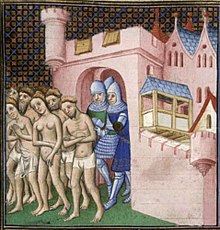
were the first attempts by the Roman Catholic Church to order a genocidal campaign within the realms of Europe. This was new, as it differed from the Church’s repeated attempts to wage genocidal war in the Holy Land. The success of the Albigensian Crusades, which ultimately led to the complete annihilation of the Cathar people and their religious order, was so complete that the Roman Catholic Church felt secure in ordering other crusades in Europe (France and Spain), to focus on the other elements of competition to their monopoly determining which souls went where. In the Albigensian Crusades, the leader Simon de Montfort will forever be remembered for giving the command, “Kill them all. God will recognize his own.” This man was a devout follower of the Dominican Order, which would carry the sword of death to all who followed a religion seen as in competition with the Vatican.
Because of the successful eradication of the Cathars from Christian consciousness, the later
developments of the Reformation, and the rise of the various sects of Christianity (like mushrooms rising over decaying wood in the ground) has split Christianity into many different factions. Those closest to the Roman Catholic–Orthodox Catholic trunk have become set in the dogmatic practices established by those churches, as if Jesus Christ wrote down on paper what rituals he preferred they forever maintain. This dogma has become so overdone (some call it high church versus low church) that all modern churches have turned to a form of idol worship (Jesus on the Cross), more than the original Church of Christ taught. The most ancient practices, those closest to the life of Jesus, have been erased. This erasure has primarily been on order of the Romans, but the Cathars, as recognized Gnostics, were truer to the original dogma established by the first apostles. This did not set well with the Church of Rome.
The information that is now available about the practices of the Cathar people makes them seem like any typical sect of Christian believers, such that from a non-believer point of view all believers are irrational. In that sense, the Cathars act as a good battering ram for non-believers to use against all surviving sects of Christianity. Meanwhile, non-believers find it easy to point at flaws in Cathar beliefs, when their beliefs are really only guesses. Still, from all the smoke screens, a few characteristics remain that would be true reasons why others would look at the Cathar people and call them “Pure.” This is the perspective that one should try to capture for oneself, as that recognizable purity is the true essence of what it means to be Christian. The Cathar people exemplified a Christian lifestyle, where religion was shown through works, rather than a piece of jewelry.
In the book The Templar Revelation, the authors put forth the summary that any of the Cathar people,
primarily known to be common weavers, but presumably also farmers, from the “lowest” of their society to the elders dedicated to maintaining their religious practices, could win any philosophical-religious debate brought on by Rome’s most well-trained orators and scholars of Christianity. Others who have researched the Cathars support this view. This is not a trait common to any other religion, as other religions have a few rams, and a lot of sheep. Sheep do not do well in debates with, let’s say … Wolves.
Also in The Templar Revelation, the authors pointed out a primary point of contention between the
Cathars and Roman Catholics. This was the Cathar failure to recognize the Roman style of baptism as a
rite of church membership. The practice of baptism with water was a Jewish element, associated with the sect of Judaism that was led by people like John the Baptist. John was a Jew who placed importance in this ritual act. Therefore, baptism by water symbolized a Jew’s commitment to following Jewish customs and beliefs. The Cathars believed that Jesus baptized with the Holy Spirit, and only people baptized in that manner were truly Christians, and thus members of that family of “Pure ones.”
In my mind, these two traits (all able to win debates over religious philosophy and being baptized with the Holy Spirit) go hand in hand. The only way one who is common (a simple hard-working farmer-weaver as Cathars were known to have been, or a fisherman, craftsman, etcetera) comes to defeat one educated in debating techniques (the ways of laying traps of logic to ensnare the uneducated) is by being filled with the Holy Spirit. This scenario of the “little man” versus the “big city slicker” is not some comical, made-for-television – Andy of Mayberry sitcom – that plays out in real life. The Cathars did not sway Roman Catholic priests and lords of France to believe their “spin” on religion because they were sly. They did it by letting a higher power do all the talking for them.
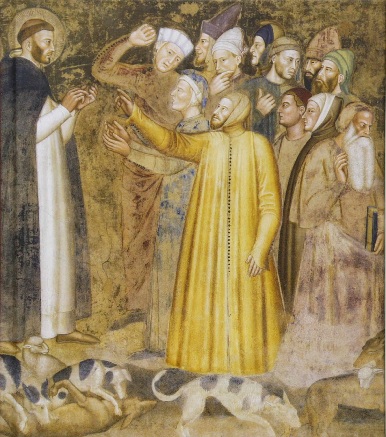
The poor have so regularly suffered at the hands of the rich (a historic serf-lord relationship), to the point that poor commoners would instantly tremble at the thought of having to debate an educated man. It is much easier to surrender to the power, and get the groveling over with, as quickly as possible. The Vatican knew this innate characteristic of the commoners, to the degree that their “internal Crusades” in Europe had long been a matter of seeking this type of auto-capitulation. The Roman Catholic Church has existed as lords over Christendom, reaping all the luxuries of kings over countries. Their power is based on maintaining that “master-servant” order. The Cathars understood that the only “Master-servant” relationship was between each man or woman and God, with Jesus Christ acting as the Holy Spirit within them, guarding them from the birds of prey.
In this regard, it is shown through surviving documents that the Cathars believed in reincarnation. This
belief was different from the Western concept of Eastern religions, who are known to believe in
reincarnation. The Eastern view is to see reincarnation as venerable, as well as to be expected. The
Cathars saw reincarnation as a failure to live life in the manner that Jesus instructed, through the Laws
God passed down to his chosen people. The Cathars believed that reincarnation was like failing a grade
in school, and being forced to repeat that grade. When one is truly filled with the Holy Spirit, one does not capitulate to evil, in any shape or form. Therefore, when the Roman Catholic Church hired the
Dominicans to force capitulation in the face of a sword, the Cathars died for their faith.
In the book The Templar Revelation, the authors recalled stories placed into history by the Templars of
southern France, who themselves had refused to do the Church’s bidding (they were hired Crusaders by
profession, but also a religious sect, per se), because they too saw the Cathars as “Pure ones.” Their
writings told of weary Cathars seeking a safe haven to sleep for a night, approaching a “neutral Templar” castle and being welcomed in to rest. This was a respect given by warriors who honored that Cathar resolve. Then, after resting and re-energizing, the Cathars would go out the next day and fight to the death.
That spirit to fight for what is right does not come from some man (or woman) standing on a stump,
rallying the troops with meaningless words of patriotism, heroism, and by praising sacrifice to some ideal that only benefits a few. To quote a line from the movie Monty Python and the Holy Grail, such coaxing of valor usually results in the order, “Run away! Run away!” The Cathar people displayed a true spirit of faith, which can only come from deep within one’s soul. When one’s heart has filled one’s brain with the knowledge that the only thing keeping one from Heaven is one’s resolve to stand up for what is right and true, one gladly dies fighting for what must be protected at all costs. The early Christians were fed to the lions, to the delight of Romans. Such sacrifice, where believers were willing to die for their faith, rather than sacrifice every principle of truth, was based on the realization that giving up would do nothing more than allow them the right to live under oppression for another 20, 30, 60 years. Then what? Reincarnation, and do it all over again? The Cathars did not die from being sold an ideal. They died because they knew the ultimate reward awaits the truly faithful. They fought against evil, all while feeling the hand of Christ warming their souls. That Cathar dedication speaks volumes about the sincerity of their belief in Christ, and the purity of their way of life.
The point of this exposure to a long departed people is not to place Cathars on a pedestal, nor to
promote Catharism as a new “sect of Christianity.” I doubt the Albigenses people would have seen
themselves as anything other than Christians, and I doubt they would stand at the edge of their territory and cast stones at people who lived differently than they did. The success the Roman Catholic Church had, eliminating through punishment of death those who refused to kneel down and swear worship to the ruler of the Vatican, led the Church to next turn their attention on the Jews of France. The Albigenses lived alongside Templars and Jews, and all had mutual respect for one another, although each maintained their own orders of life disciplines and ritual practices. This speaks volumes for how true Christians (“Pure ones,” “Good Christians”) should live, no matter what time period a Christian is born into.
It must be remembered that the first “Pure ones” were the direct disciples of Jesus, his followers as
believers, and the apostles who went out into the world to tell the “Gospel” (“Good News”) to Jews who had been scattered across the face of the known world. Many of those had found Europe a place to call home. It must also be remembered that the first “Good Christians” were themselves Jews, who believed God had delivered on His promise, to send a Messiah (the Christ) to His chosen servants (priests to the One God, YHWH). In this process of going to locate settlements of Jews, the message was also spread to Gentiles (non-Jews), allowing all people to receive the Holy Spirit into their hearts, instantly becoming members of a church of “Good Christians.” They did not have to pay their way into this “club,” nor did they have to memorize oaths to recite, so all would whisper amongst themselves, “Yes. That is one confessing he, she, or it is a Good Christian. So, it must be so.”
The man named Michel de Nostredame, commonly known by his Latinized name, Nostradamus (a popular trend in the 16th century for college graduates, especially for writers), was born and presumably baptized as a Roman Catholic, to parents confessing to be Roman Catholics. Nostradamus was born in 1506, when all people living in France had to be Roman Catholic, or they were banished by decree, with support from the provincial rulers and parish leaders. Nostradamus’ father was born of a man who had been born Jewish, and practiced Judaism until the French Inquisition placed an ultimatum on him to convert (a direct derivative of the Albigensian Crusades). Nostradamus’ Jewish grandfather converted to Christianity, which needs to be explored further.
Nostradamus’ Jewish grandfather was married at the time of widespread persecution of Jews and Muslims, which was primarily focused on Spain, but southern France was not beyond that reach. The Spanish terms the word “conversos” to explain the many “converts” that chose to remain where they lived, rather than be left losing everything they had worked to build, through conversion to the Roman Catholic Church. This was a willful decision, although there were pressures to make a decision on religious observance. Nostradamus’ grandfather was married to a Jewish woman. The grandfather decided to convert and stay, but his wife refused to convert. The wife had to therefore leave, so an “annulment” was granted, allowing the two to separate. The wife was not the maternal grandmother of Nostradamus. Nostradamus’ grandfather married a Christian woman, and she became the maternal grandmother of Nostradamus. As such, Nostradamus was born Christian, with Jewish lineage.
It must also be recognized that the surname, Nostredame, means, “Our lady.” This is obviously a
statement of name, rather than a family name that existed before the conversion. Everyone had a first
name (a Christian name), but there was no proper surnames in the 15th century. The men were known
by their first names, with that name connected to what those men did that separated them from another man of the same first name. This same practice is seen in the Holy Bible, such that the disciple Thomas was given the name Didymus, which meant that Thomas was known to be a “Twin” to another man who looked just like him, his twin brother. Thus, Nostradamus’ grandfather took on the distinction of being Pierre de Nostredame. This too is significant.
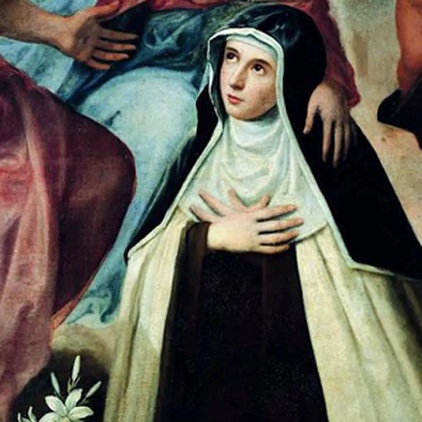
It is easy to think that assuming a surname, which appears to be telling the world, “I am from Notre Dame,” one would be living in the area of Paris, which has long been known for the Cathedral of Notre Dame. This is not the case, because Nostradamus’ family lived in southern France, not the north. The name is a direct statement that Pierre (a name that converts to “Peter,” but in French means, “Stone,” or “Rock”) was descended “from Our lady,” who is understood to be the Virgin Mary. This relationship is then connected to the southern France region where Nostradamus was born, which is called Provence.
Between September and October 2006, my wife and I honeymooned in southern France. We chose that location because of my deep interest in Nostradamus. We visited Lyon (where Nostradamus’ books were published), Avignon (where the Western Papacy was established in the 14th century), Salon-de-Provence (where Nostradamus lived when he wrote The Prophecies), St. Remy (where Nostradamus was born), and Marseilles (the major port city of southern France, at the mouth of the Rhone River, on the Mediterranean Sea, and at the western edge of the Provence region). In my research of the quatrains, I had seen the names of many towns (communes) in Provence; but there are many more names of places listed, which are found to be a little further to the west, in the ancient Languedoc region. That region’s southernmost extension is in the shadow of the Pyrenees Mountains. However, we were unable to visit those regions, although I wished we had the time to do so.
While we were in France, I was awaiting a print-on-demand publisher to have my book, The Letters of
Nostradamus, ready for publication. That completion did not occur until November 2006, and thus I was in France before I had read the book The Templar Revelation. Had I read that book prior to going to
France, I would have made a point of going to the place named Saint Maries of the Sea (Saintes-Maries-
de-la-Mer), which is in the marshes just to the west of Marseilles, at the mouth of the Petite Rhone. While in a museum in Salon-de Provence, we saw a wax depiction of the raft that brought to southern France (the edge of Provence) several figures of New Testament prominence. Those figures were Mary Jacobe (wife of Cleopas), Mary Magdalene, and Mary Salome, with those “Maries” accompanied by Joseph of Arimathea, Lazarus of Bethany, and a baby daughter of the Magdalene, Saint Sarah (Sarah the Black). The museum’s headphones told us the history of them arriving in Europe at Saints Maries of the Sea, on a small raft with no sail.
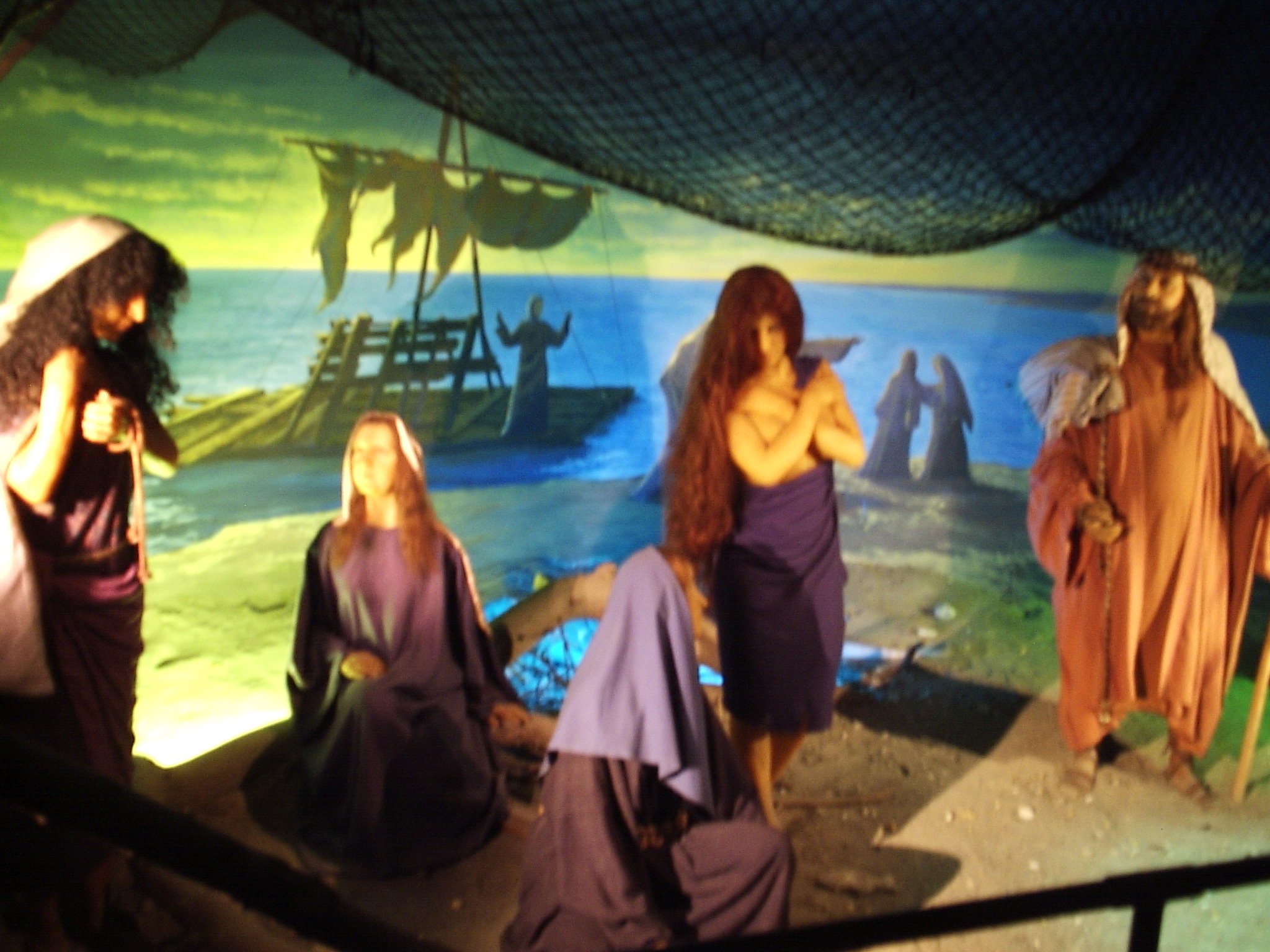
This point of entry was part of the presentation of The Templar Revelation, although it placed more focus on the Saint Sarah, than the other raft occupants. The focus made by the authors of that book presented Saint Sarah as the offspring of Jesus, with the mother being Mary Magdalene. This presentation was the focus of Dan Brown’s mega-hit, The Da Vinci Code, such that Saint Sarah represented the Holy Grail, as the bloodline of Christ. This presence in southern France, presumed to have been around the year 42 A.D., became the seed in Europe that would ultimately become the royal lineages of France and England, spread to all of Europe. However, the possibility remains to have had other impacts.
The presence of such close Gnostic followers of Jesus Christ, would have an effect on those locals in that region, thus spreading Christianity to the pagans they encountered there in France (Gaul). It would also become a welcoming environment for Jews spread into Europe, as a place where they would be valued as human beings, devout followers of the One God, although not believing Jesus was the Messiah. This presence would then make southern France an attraction to Eastern Gnostic Christians, who would venture from the remnants of the Orthodox Church realm (Romania) to southern France (the Cathars believed origin). It would also be why a Jew (one believing in Jesus as the Christ) would convert to Roman Catholicism (technically converting to “Christianity” from Judaism), and assume the name, “of Our lady.” The “lady” would not so much be the Roman Catholic Virgin (although it would be her DNA in Jesus), as much as it would be the “lady” known as Saint Sarah (the DNA of Jesus combined with that of Mary Magdalene). This would mean that the name Nostredame was recognition of being descended from the royal blood of Christ, only possible through a Jewish lineage.
To connect the grandfather of Nostradamus to the Cathar presence in southern France, it is known that
the spread of Catharism extended beyond the region of Languedoc. The Albigensian Crusades focused
on those Cathars of that region. Still, one must keep in mind how the Cathar people did not go around
calling themselves Cathars. The name was a distinction of those who had been filled with the Holy Spirit, and from that presence within they were able to live together, openly expressing their beliefs to all who questioned. The fact remains that other “Good Christians,” also anointed through baptism of the Holy Spirit, lived in more scattered traces throughout Europe. Being more dispersed, these “Good Christians” would have been unable to recognize the temple practices, where en masse they would have the luxury of separating into the hierarchal designations of “temple priests” and “regular priests.”
I believe – now, after contemplation on the subject – that Nostradamus’ grandfather was the equivalent of a Cathar, without the luxury of having to openly confront the Roman Catholic Church, through the safety of numbers. To Nostradamus’ grandfather, conversion was done for preserving the bloodline of those descended with a natural ability to receive the Holy Spirit, more than a reversal of beliefs. Nostradamus’ grandfather could openly call himself a Christian because it was the truth. In private, however, he could continue the Jewish practices that all Jews must maintain; and it is believed by many that Nostradamus received lessons in the Talmud from his grandfather (and father), which aided his knowledge of astrology.
Certainly, none of this can be proved today. Still, the evidence is there to see from the side.
Nostradamus was most certainly home schooled, up to the age that he was sent to the university in
Avignon, where he received his baccalaureate. He then went on to study to become a doctor. Prior to
that education, Nostradamus was already knowledgeable in the “art” of herbal medicine, as an
“apothecary” (not an alchemist). This knowledge is said to be what the University of Montpellier expelled him for, before he could complete a degree. There is also some evidence that Nostradamus argued with his professors about their errors of medical logic. Between his temper and the stigma of experience as an apothecary (frowned on greatly back then, by the book educated) that was plenty enough to put him on a list of students not getting ‘with the program’.
Before Nostradamus was expelled, he served an internship (as did all medical students at the university)
by being of service to the people during a new series of outbreaks of the plague (albeit much milder than the Black Plague outbreak 100 years before). Nostradamus went west to Agen, France, the hometown of his first wife and children. He served the people who were suffering there. Nostradamus promoted cleanliness (rather than the technique of bleeding) as well as taking a “rose pill” he created (high in Vitamin C), which saved several people in several towns. He picked up the reputation of being a healer, but after his wife and children died of the plague, that reputation took a turn for the worse. Still, Nostradamus continued to work to assist in plague-stricken areas of Provence, having success until he eventually settled down in Salon-de-Provence.
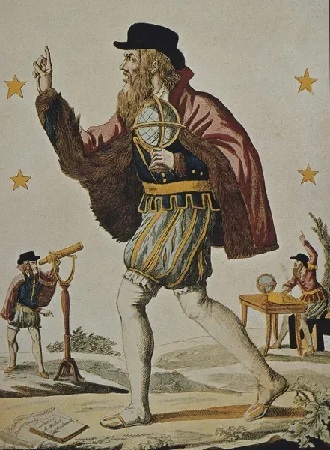
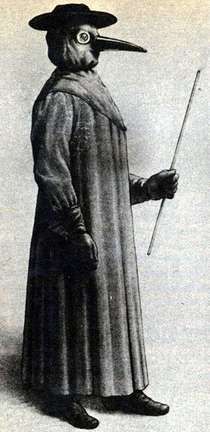
< Religion versus science >
The point of this exercise is to show how Nostradamus had already displayed elements of having received the Holy Spirit, such that this “Advocate” is said to come with the ability to use one’s hands to heal others, as well as to prophesy. The tool of astrology is said by Nostradamus (in his letter to Henry II) to be a gift bestowed by God upon Abraham. This shows how Abraham was also filled with the Holy Spirit, and all of the true children of Isaac, through Jacob (Israel), were true priests of the One God, by having received the Spirit and becoming the keepers of the holy practices that had been gifts of God to his children. Nostradamus also explained in his preface that the ability to know astrology (something that had become commonly known by many in the 16th century) was not a guarantee of prophetic insight. Astrology is only prophetic as a tool for the gifted – those possessing the Holy Spirit within. Thus, through demonstrated history (including the lore surrounding Nostradamus), Nostradamus was a “Pure one,” a “Good Christian,” and a “Cathar,” by his miraculous acts. Those “works” make statements about his beliefs; and he did those works while also going by the name, “the one of Our lady.”
Seeing this connection, I strongly believe, gives a deeper reason to believe that The Prophecies are
indeed from the Spirit of Christ, as explained by Nostradamus in both of his letters connected with his
most famous work. It is a work that can only be seen by other “Cathars,” who are also truly “Good
Christians” that believe the Lord will not allow mankind to walk blindly to its execution. Jesus sits at the
right hand of God as the way to God. God acts upon those truly seeking to be home in Heaven, and one
with God, by believing in Jesus as the Christ, and then becoming the replication of Christ (the return of
Christ) themselves, by having received the Advocate (the Holy Spirit, sent by Christ) that whispers, “Step aside, and I’ll do the thinning around here (Baba Louie).” “Good Christians” step aside and let Christ act through them, appearing to others as one acting as a “Pure one.” From that level of purity, one can read The Prophecies and see the truth, but then go out (as an apostolate) and pass this Gospel on to others, so they too can see for themselves the truth. The truth says: Christ has died. Christ has risen. And, Christ has come again.





 Nostradamus Blog