
This is a rather well-known quatrain, in the fact that it has made the rounds as one of the hits of Nostradamus (hit meaning he got one right). Let me introduce you to that one.
Quatrain VIII-01 states in French:
………………..PAU, NAY, LORON plus feu qu’a sang sera,
………………..Laude nager, fuir grand aux surres,
………………..Les agassas entree refusera,
………………..Pamplon, Durance les tiendra enserres.
Crystal Links shows this:
………………..Pau, Nay, Loron will be more of fire than blood,
………………..to swim in praise, the great one to flee to the confluence (of rivers).
………………..He will refuse entry to the magpies
………………..Pampon and the Durance will keep them confined.
Erika Cheetham (1973) had the opinion that the all-cap words were more sensational when the comma marks are tossed out and the letters made to say NAPOLEON ROY. That would require reading the “au” of PAU as “o.” She did admit that the three all-cap words are small communes in western France.
John Hogue (1997) agrees with Cheetham, calling the rearrangements cryptograms, with Corsican spelling making an anagram possible, while throwing in one rearranged set of words (roy being one) says Destroyer King. He then mentioned that the Amazing Randi (a debunker of magicians, having been one and knowing everything is a trick) listed this quatrain being said to be about Napoleon I his seventh greatest charade in his debunking history. Hogue then argued with Randi’s inability to see the insignificance of three small communes as reason to leap onto the Napoleon assessment.
This is a translation that would make dead Randi remove this quatrain of Nostradamus as one he debunked. And … by the way … Randi never debunked Nostradamus. He debunked those making things up and using Nostradamus’ name. Nostradamus wrote what he wrote (as published in 1568). This is that:
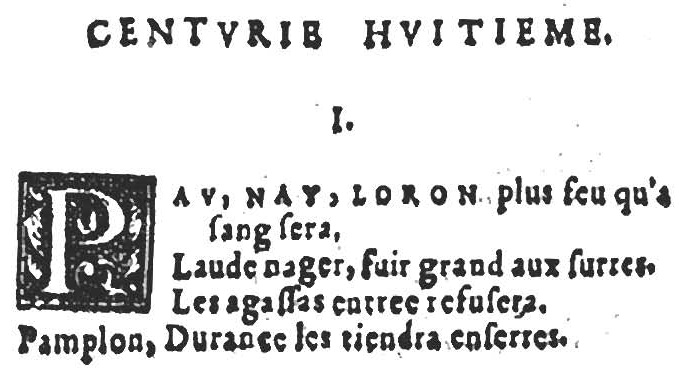
Here is a logical translation of this French into English, maintaining the all-caps, capitalized words and marks of punctuation:
………………..STAKE, SHIP, HIM GOLD SOME added dead that in lineage will issue from,
………………..Praise to float, to escape mighty to them cork ones [or over is],
………………..They cried out access will cast off,
………………..By reason of ample one, Duration [or A long life] them will hold restrained ones.
As you can see, there is nothing about Napoleon. People that want to see Napoleon get all hot and bothered because Nostradamus wrote L’antechrist trois in quatrain VIII-77 and the Hollywood production with obese Orson Welles read lines that made it appear Nostradamus predicted “three Antichrists.” That then made Hitler one and the one to come the second; so, … hmmmmm … I know, make Napoleon the third one! That is wrong on all counts.
The world has been filled with antichrists since Jesus lived on earth; and the Apostle John wrote about plural antichrists in his letters. Napoleon is actually a folk hero to the French, as he represents their last time as a world power (they should not have cut the heads off of innocent royals). So, quatrain VIII-01 is not about Napoleon.
An all-caps word is like a capitalized Et being like a most important ampersand. A capitalized word is one of importance. A word written in all-caps is most important to grasp. The main theme here begins with a crop cap P, with the letters AU connecting to that. Again, all ten of the first quatrains in a Centurie have a drop cap and a word in all-caps (one exception being quatrain X-01, where the letter A is in drop cap, followed by a separate word that begins with a capitalized L (L’ennemy). That makes A be the all-important word to grasp. Here, the main theme statement begins with two all-important one-word statement, which are PAU followed by NAY.
The word PAU is listed in Cotgrave’s dictionary, where he simply defined it as meaning “A STAKE.” Dropping the article, the importance here is “STAKE,” which is a wooden rod hammered into the ground (a PAL or “POLE”). It us used to mark boundaries, while also being used in acts of punishment, where some people were burned at the “STAKE.” That then leads to NAY, which is read as NAI, meaning “SHIP,” with Cotgrave referring the reader to see it as synonymous with NEF, which adds the meaning of “VESSEL OF THE SEA, SAIL; or the “NAVE” of a church” (which is made to resemble a bark or barque). When a “STAKE” is read as the boundary of Heaven, as marking the conditions of entry, to follow this with an all-important “SHIP,” which is the Roman Catholic Church, that most importantly says they are responsible for making that “STAKE” be known by all Roman Catholics. Thus, the reason the Church is known as the “BARK” of Saint Peter is it is a “SHIP” that fished for men’s souls; but when “STAKE” is seen as threatening, the “SAIL” of the Church must always be turning into the wind (as zigzaging to keep from being blown off course), following the divine insight of Jesus.
With this in view, the comma mark that sets NAY as a one-word statement of much importance then pauses for reflection on that, before leading to the all-caps LORON. To read this as the small commune Oloron-Sainte-Marie is quite a stretch, by having to add a capitalized O to make it become that. The etymology of that name is said by some to come from the Basque word olore, meaning “fragrance” or “scent.” Still, that requires a non-existant O. This means the simple solution is to divide the word into L‘OR ON, where the contracted L’ becomes the masculine pronoun “HIM,” attached to “GOLD.” This is what distracts “ONE” or “SOME” from steering the “SHIP” towards the “STAKE” of Heaven. This then implies strongly that the popes of Rome must find Yahweh as the “STAKE” that the voice of Jesus within lead “HIM” to steer the “BARK” of Saint Peter to, with Jesus within being “HIM GOLD” that divinely possesses “SOME,” with the pope being “ONE.”
This then ends the three all-caps words, taking one to a statement that “HIM GOLD ONE” must be “added,” making a pope become “more” than simply a man, as he it then led by an inner “fire” or “light” that sets the “SAIL” towards the “STAKE.” However, if one does not become “more” than just a man, that means the man pretending to be a holy leader will be “dead,” as the soul of Jesus will be “departed” from that man’s soul. This places a pope in the same category of all lost souls in bodies of flesh as being “deceased,” alive only as long as the flesh allows.
This option of “light” and “dead” then points to “that in” or “that with,” where “that” choice of “light” or “dead” is up “to” the soul-body. This means one’s “lineage, kindred, parentage” is either holy and divine or ordinary and worldly. The meaning of “blood” is then the metaphor of Jesus being that everlasting waters of Salvation. Still, when the saying is “blood” is thicker than water, this becomes the difficulty of committing solely to Yahweh and being reborn as His Son (His holy “blood” or sang rael, poured out from the Holy Grail or San Greal). This decision made by a soul is then what “will be, exist, stand, rise,” or “issue from” within that soul-body. Thus, the main theme statement has zero to do with Napoleon and everything to do with knowing the “STAKE” that sets the boundaries of Heaven and being a “SHIP” that sets “SAIL” to that goal. It can only be obtained by joining with “HIM GOLD ONE,” becoming the Son reborn, related through “blood.”
After the separation of a comma mark ending the main theme line, the secondary theme statement begins with a capitalized Laude, which becomes the Ablative form of the Latin word Laus, meaning “Praise, Glory, Honor, Merit, Value,” and “Esteem.” Latin should be seen as a hint towards Roman Catholicism, as it is the official language of Vatican City. This makes the “blood” be dependent on who one gives “Priase” to (Satan is the “ONE” offering “HIM GOLD” of the material kind). This “Honor” will cause a soul in its body “to float” the turbulent winds and seas, without the threat of sinking. When demonic possession is the spirit one finds “Value” from, they will be able “to swim” after the “SHIP” sinks.
An internal comma mark then pauses this view, where the objective is “to escape” and “flee” from the “mighty, substantial, high,” and “lofty” demands of human life. The word grand always must be read in context with nations and peoples who give credit to Jesus and God for being “great,” in comparison to others with lesser worldly blessings. This is also a statement of the “noble” ones who have power and influence over many, such as royalty and popes. This is to find Jesus as the “great” one “in them” who believe and give him credit and “Praise.”
This then leads to the word surres, where surre is the name of an acorn from a cork-producing oak tree. This is then “with them acorns” that become the fruit of the tree. When cork is read, this become a method “to float.” Still, because Cotgrave did not list this word in his dictionary, it can be divided into sur res, which states “over are again.” This use of res (as the second-person present Indicative of rêtre) says of each of “them with” Jesus, then he is “over you,” as “you are reborn” from “above.”
With the secondary theme statement placing focus on how a “SHIP” navigates the turbulent water of worldly existence, the comma mark ending line two separates that line of thought from line three. Following the plural pronoun “them” of aux, line three begins by importantly highlighting “Them” that are not those divinely possessed, but the “dead who at lineage will be,” who cause turbulence that attempts to sink the “SHIP” before it can reach the “STAKE.” Thus, “They cried out” (from agassas being the second-person past simple form of agasser) as “Them annoyed, urged, incensed,” and “provoked” (from agassas being agaça-s, the plural number to the past simple form of agaçer). This says “They” will be “urged ones,” where an inner demon is given a mission that says “entrance” to Heaven, via compliance to the “STAKE,” “will be refused, rejected, repelled, denied, renounced, cast off,” and “foresaken.” That makes “Them” be agents of evil.
Again with a comma mark ending line three, that line of thought that focuses on the influencers that sink the “SHIP” for the fishermen of souls, line four begins a new line of thought. This appears to be one Spaish city and a French river, which certainly adds nothing of value to this quatrain’s flow of words. The first word is made into an important one-word statement by an internal comma mark, where Pamplon must mean more than Pamplona, Spain. That meaning comes from reading this as P’amplō-n, where the contracted P’ represents Par, meaning “By reason of” ot “Through.” The word amplō is the a return to Latin, with that being the Ablative and Dative form of the word amplus, meaning “ample, wide, extensive,” and “important.” The suffix -n is the adding “one” to is “By reason of ample.” This then relates to an ability to ignore “Them” who seek to block one’s “entrance” into the divine realm, as those able “to escape” such diversions because of “noble” Jesus “in them as the “blood over the reborn.”
Seeing that importance in Pamplo, the word following the comma mark is a capitalized Durance. While this is perfectly spelled to reflect the name of the river that flows from the southwestern Alps, across southeastern France, until it meets the Rhone River, near Avignon. That becomes meaningless; but the word Durance means “Durability, Duration,” and by extension a “Long life.” This says that a soul given “ample” protection by the presence of Jesus’ soul, as one’s Lord within, then that soul-body is filled importantly with the “Durability” to resist all temptations and tricks of Satan, in order to have a “Long life” that equates to eternal Salvation. Rather than succumbing to the calls to rejoin the “dead” of soul, the “light” within keeps them focused on the “STAKE” of Yahweh. This is then a result that has “them” who Jesus “will hold” and “keep” safe, as “they will enjoy” being so “restrained, enclosed” and “held hard ones.”
Hopeully, this quatrain can be seen as one that most importantly tells one how to become Saved, which cannot come from a pope or a king. Each individual must realize that self-will always fails eventually; and Satan will never tire of tempting one’s beliefs that stand apart from Yahweh and Jesus. Only with Jesus as one’s Advocate, sent by the Father to grant and maintain eternal life for one’s soul, can one resist those who are “annoyed” one has inner calm, causing them to “cry out” as distractions meant to divert one’s course. There is nothing about Napoleon in this quatrain; but Napoleon could see both the Church and State of his time were corruptions that should be led, not followed. One must have that attitude when seeking Yahweh as the only goal that is worthwile.


 Nostradamus Blog