
The Preface: Reigns, Sects, & Religions (Part II)
After Nostradamus made the one-word statement “religion,” he proceeded to write another segment, again set off by the comma ampersand combination, before concluding this line of thought with a period mark. This stream of thoughts leads to a connecting but separate stream that ends with another period mark. This second two-segment flow of words ends with four series of words written in Latin, making a Biblical quote attributed to Jesus. That quote acts to show how one can connect Biblical prophecy to The Prophecies of Nostradamus, and the prophecy of “reigns, sects, & religions.”
This section states, “foy trouveroient si mal accordant à leur fantasie auriculaire, qu’ilz viendroient à damner ce que par les siecles advenir on cognoistra estre veu & apperceu. Considerant aussi la sentence du vray Savueur: Nolite sanctum dare canibus, nec mittaris margaritas ante porcos, ne conculcent pedibus & conversi dirumpant vos.”
This Old French translates to state, “faith (or trust, belief in, loyalty, fee simple) could be finding as evil agreeable (or well-fitting, consenting with) their judgment (or opinion, imagination, image of things conceived in the mind) auricular [of the ear – sense of hearing and the perception of what is heard; but also ear-shaped, and of the auricle of the heart], that they could be coming at to condemn (or to damn, to give judgment against – to death) this which through them centuries to happen one will know to be perceived (or beheld, seen, viewed, heeded, regarded ) & discerned (or perceived, marked, noted, heeded). Considering (or weighing in the mind, pondering, thinking upon) also there sentence (or saying, decree,
judgment, advice given in a matter) from the true (or truth) Savior:
The Latin literally can state, “Refuse holy doing dogs, nor give up pearls before swine, indeed will trample under feet & turn around again they destroying you [pl.].”
To place all of this in a poetic presentation for easier comprehension, the entire section reads:
faith could be finding as evil consenting with their image of things conceived in the mind the perception of what is heard,
that they would be coming in to condemn to death this which through them centuries to happen one will know to be heeded,
& discerned.
Weighing in the mind eve as there advice given from him truth Savior:
Refuse sacred doing dogs,
nor give up pearls before swine,
indeed will trample under feet
& turn around again they destroying you.
Relative to the Latin, the words written by Nostradamus are very similar to the quote Jesus made, as found in the Book of Matthew, in chapter 7, verse 6. The Latin Vulgate translation of the original Greek is said to be, “nolite dare sanctum canibus neque mittaris margaritas vestras ante porcos ne forte conculcent eas pedibus suis et conversi disrumpant vos.” The exact matches to what Nostradamus wrote are found in the bold type. Obviously, this is not the same wording, and the inclusion of punctuation makes it have a somewhat different meaning, while clearly intended to highlight that quote from Jesus Christ.
Beginning with the series of words that immediately follows the section referencing “reigns, sects, & religions,” one must understand what was written leading up to that Biblical “paraphrase.” In a rather lengthy series, Nostradamus wrote, “faith could be finding as evil consenting with their image of things conceived in the mind the perception of what is heard,” where the first word directly points back to the last word of the previous section, meaning “faith” is the core element of “religion.”
The second word of this series, “trouveroient,” is the Old French spelling of the third person plural form of the conditional present, now spelled “trouveraient.” The third person plural indicates a general grouping of “many,” a non-specific number of multiplicity, with the conditional present making a statement about what should, would, or could occur to “them.” This is then applied to the root infinitive, “trouver,” which means, “to find; invent, contrive, devise; light on, meet with, take in the manner; and also to obtain, get, and/or procure.”
This means that the matter of “faith would be contriving,” as much as it means, “faith will be meeting with,” and “faith will be obtaining.” This is then known to be relative to all who fall under the category of “faith,” which means those who claim a particularity of “religion.”
When this is then related back to the plural number word last introduced, “ceux,” meaning “those of reign,” one sees how this is an important separate series (set off by a comma ampersand combination). This “stutter” is placing focus on the misuse of “religion,” such that the ones in power will claim to be a mirror of the “religion” the people respect, as if chosen by God to “govern.” From a sense of “loyalty” to their “religion,” the people will put their “faith, and trust” in “those” common men. However, “those” people seeking the power of “rule” will have “faith” that “would be contriving,” to get the people’s (“those being ruled”) “confidence.” After gaining that “trust,” the people “could (and should) be finding” (from the obvious results caused by “those with government”) it all to be a misuse of “faith.”
The words that follow in the series states what “those findings will be,” as they are said to be “so evil,” “as bad,” and/or as a conditional “if so be that sick (harmed, pained, hurtful),” then the cause is “agreeable” or “well fitting unto.” This is then stating the “mal” (the word has many translation possibilities, all “bad”) condition that would, could, or should be is based on how willing one is to let go of their (plural) “faith” in God and Christ, and turn it over to a “faith” in man. It says that the degree of “evil” that will set upon the world “would be” equal to the degree that “evil” is “consented with,” or “acceptable.”
Nostradamus then wrote that this acceptance, or “accordance,” will be made easier “with their fantasy.” Here, the plural word “their” appears to support the plural conditional present, as an explanation that the “contriving” will be through “their imagination,” “their affection,” “their judgment,” and/or “their representation of things conceived in the mind.” This is then stating how “faith” will be gained through imaginative ways “so wrong” (from “si mal”), or so far from the truth, based on the “Philosophies” of men’s minds (“representations of things conceived in the mind”). It is a statement that it will be “so sick” that people will fall for such “fantasies,” such as the right of commoners to “govern” themselves without kings or queens. It will be “so evil” to see them as possessing the right to separate “religion” from the everyday affairs of the people. It also will be “as harmful” to see the illusion of equality being a right that allows everyone the luxury of achieving to the height of “rule.” Additionally, it says it “would be found so shrewd” how “those” seeking the right to replace the “Kingdoms” and “Church” “would find” the right of freedom, at all costs, to be the most lasting selling point.
The last word in this series then states “auriculaire,” which in general means, “of the ear,” as the equivalent to the English word “auricular.” This gives the word a meaning that represents a sense of hearing, and thus it tells that “their representation of things conceived in the mind,” which are “as evil,” are not forced upon the people unwillingly. It says that “those with reign” quests will use the art of suggestion and persuasion to woo the public to behead kings and queens, while impoverishing the Church through separation. It even implies how things said to the ear will touch the heart (“auricle”), as increasing a flow of blood to the brain, swelling the head with delusions of grandeur, that “all men are created equal.”
Still, there is a less obvious meaning to “auriculaire,” which relates back to the first word of this series, “faith,” and the last word of the previous section, “religion.” This meaning directly connects this “evil” as attacking the Roman Catholic Church, where an “auriculaire” is a term used to denote a “confessional.” In this sense, it shows a “trust” and “confidence” the people “would be finding so wrong” is one’s adaption to being “agreeable in their representation of things conceived in the mind,” to the point of no longer needing to confess sins. The placement of “auriculaire” means the people of “faith,” in the future presented in The Prophecies, “would be finding” “those of government” as the “counselor, listener, good advisor” (from acceptable translations of the Latin word “auricularius”), instead of the Church.
This use of “auriculaire” is significant in the sense that Nostradamus wrote versions of the word “ogmion” in three quatrains (V-80, VI-42, and VIII-44), after beginning a section in the letter to Henry with the words, “Le Galique ogmium.” The word “ogmios” (as well as “ogmius”) is rooted to the name Ogmios, found in Celtic mythology (also in Irish mythology, as Ogma). Ogmios is said to be similar to the Greek hero Hercules (or Heracles), only older, and much less physically fit. The power of Ogmios comes from his oration skills, and his abilities to persuade men to follow him to the underworld (Hell, or the diametrically opposite direction from Heaven). Depictions of Ogmios show an old man walking, with silver chains attached to his tongue and linking to the ears of those following him. It does not take much imagination to see how political figures are usually the least fit men of older age, while their words send nations to commit deeds of doom. I believe this is how one should read this last series of words, as “faith” in men,
versus “faith” in the Church, or more importantly, in God.
This knowledge allows one to progress to the next series of words, seeing them as addressing this element of “hearing,” while also referring to the plural “they,” or “them.” This combination is found in the first word, “qu’ilz,” which combines two words as one, through abbreviation. This says, “that they,” which is a direct reflection back on “that” just stated, while being a direct indication of the plural number associated with “that.”
This reflection made, the focus is then placed on “what they” (from “que ils”) will cause from “their representation of things conceived in the mind,” by having planted seeds “so evil” into the “ears” of the faithful. Those actions “would be coming, arriving, approaching, or drawing near unto” the point of condemnation. This is stated to be “in to damn,” where the preposition “à” is stating that seed is “in, with, at, and to” the listeners, having “come from” (variation of “viendroient à”) those spreading the seeds by mouth. The word “damner” is the infinitive verb meaning, “to damn, condemn, give judgment against, and adjudge to death,” where “death” is the verdict in all cases.
In essence, those words are making the statement that the most dangerous times told of in The
Prophecies are conditional. It states how this future “would they be coming,” under the condition that “those of rule” should act in ways stated to be “so evil” and the people will lose their “faith” in “religion.” If the people fall for the suggestions of the “new Philosophers” (“their representations of things conceived in their mind”), then at that time the people (in particular those of Christianity) “would be coming with” those bending their ears, as ones “to draw near unto death.” Thus, the condition makes it dependent on that outcome.
On the other hand, “should” it be that after “that bending of the ear they” (the “new Philosophers”) will propose moving away from “religion,” once becoming “those with rule,” the people can postpone the “condemnation to death” by themselves being the plural number “they,” who “would be coming in to damn to death” “those with rule.” This becomes a critical point in the storyline of The Prophecies, as the stories told in the quatrains, and reviewed in the letter to Henry, are based on the former (“to condemn to death” everyone) rather than the later (“to condemn to death” the “new Philosophers with rule”).
With this perspective in mind, Nostradamus then stated, “this” (the “damnation”) will be known to be “that damnation,” where such a distinction is made to show it as one of significance. This is due to the fact that this use of “que” (“which, who, whom; [interrogative] what, how, why; [adverb/conjunction] then, because, unless”) is not referencing some “that” previously stated. Thus, it becomes “that to damn,” and “that” is historically known because the following states, “by them (a reference to the plural number from above) centuries (reference to multiple periods of 100 years) to happen” (or “to come to pass”). This is a reference to the previous section’s use of the same word (“advenir,” “to happen”) telling what is ahead, which has been known for “centuries” to be awaiting humanity.
Due to the length of time known, one can assume (from the previous section ending with the word “religion”) that this “condemnation” is relative to Biblical prophecy of what will “come to pass.” This is then a connection to biblical eschatology and The Prophecies. This links The Prophecies to the same divine source that is recognized as the only source knowing what “will come to pass,” relative to “condemnation.” That source is God, who speaks through Jesus [making one a Christ].
To explain the meaning of what is “to happen,” Nostradamus then wrote that “one will know” (or “will understand, be assured of; be well acquainted with; discern, apprehend, perceive; acknowledge, or avow”) to be seen.” This is an indication that “one” who has the power “to condemn” is an entity who “would be coming at to damn,” being “one” who “will be known,” and “one” who has been “seen” before. However, because the time frame for this “coming” will have been “centuries,” this “one” can “be” none other than Jesus Christ. Jesus has been “seen” as a human, during his time on earth; but Jesus has also been “seen” by John of Patmos (The Revelation), and by Nostradamus (The Prophecies), such that Christians have “known” for “centuries” of the return of Christ. He will return to open the seals and unleash the four
horsemen of the Apocalypse, which along with comes Death.
At this point, Nostradamus placed an ampersand, which acts to signal an important statement is to follow; but, unlike the comma ampersand combination, a lone ampersand has a secondary purpose, which is to act like an ampersand and join with the word before it. This union, as something AND something else, comes after the information following the ampersand is seen in its own light of importance first.
There is only one word that follows the ampersand, before it has another punctuation mark following it. That one word is similar to the word prior (“veu”), as both share some of the same uses as past tense descriptions of what has been looked upon. The word “apperceu” bears the translation possibilities of “perceived, discerned, marked, noted, heeded, and spied.” This means there is a similarity, yet with the intention being to show a level of deeper reflection upon what has been “seen.” From this understanding, one can see a difference in those who have actually laid eyes upon Jesus (the man) or encountered the presence of Jesus as a Holy Spirit.
The difference is to show the importance of those who have “faith” (the first important word of this section) in Jesus, without having ever laid eyes upon him or his spirit. This is not necessarily a belief in Jesus, or a belief in his return, but it is an indication that this is “discerned, marked, and noted” by believers and non-believers alike. Therefore, as a one-word statement, following a word stating “knowledge” that “will be” (“cognoistra”), it speaks of widespread awareness of the End Times having been long projected.
When this stand-alone statement is understood, one can then combine the two words surrounding the ampersand. The words “veu & apperceu” are then stating a combination of similarities of sight. Together, they represent the physical sense of the eyes AND the “sixth sense,” which is most relative to a higher feeling, said to be intuition or psychic knowledge. This is a combination of “religious” dogma “AND” unfounded “faith.” Still, when read as “seen AND heeded,” the statement is relative to the guidance factor of “religions,” and those of “faith.” The return of Christ is “perceived” from the words written into the books of the Holy Bible, but to protect the people the Church has made sure the people “heeded” those words. The words tell what “will be know to come to pass,” should this important (ampersand use)
element of “discernment” not be in place. The removal of “religion” as the core of “faith” means the advent (from “advenir”) of “sects” with “reign” will leave this practice of protecting the people voided. Instead, the “sects” will be “seen” by the common folk as still protecting the masses, “AND” the “sects” will have “noted” how much “faith” the people have in “them,” to do whatever “they” say, to the benefit of “them.”
Following “apperceu,” Nostradamus placed a period mark, which indicates the end of a line of thought. This line of thought has included the theme to The Prophecies (in the first section reviewed). That theme is the changing, in the “times future,” to “diametrically opposite” conditions regarding “reigns, sects, & religions.” In the second section, Nostradamus has addressed how that theme is the same as that found in the Holy Bible. While the theme of “condemnation” and “return” (the End Times), and is consistent with several Biblical books, it makes a significant statement about The Revelation (a mirror book to The Prophecies, thus a mirror theme). There, John is told to write a letter to the seven churches [“religions”] and tell them how they will have bent to the will of the common people, rather than stay true to their
purpose for God and Christ. These are the main points of these two sections.
This line of thought is then relative to the capitalized first word of the next series of words, which begins a new line of though, relative to the line of thought just stated. That capitalized word then states the importance of “Considering.” This is the present participle form of the infinitive verb “considerer,” which means, “to consider, advise upon, think of; examine, ponder, perpend [to consider carefully], revolve [to be held in the mind and considered in turn], or weigh in the mind.” This is then making the important statement about the condition of Christianity having become a major world “religion” without the vast majority having “seen” Jesus Christ, but having “heeded” his teachings, through the “religion” making that its foremost purpose. The spread of Christianity was through “Pondering” the words of Christ, as remembered by those who had firsthand “knowledge” of his life.
As the beginning of a new line of thought, one is then asked to realize the previous line of thought, while also taking the time “to Perpend” what is about to be stated. As such, it is utilizing the future’s penchant for “their representation of things conceived in the mind,” and bringing one’s mind to an important level of thought on this new focus.
This “Considering” should be done along with the realizing of the themes of The Prophecies, as the word attached to “Considerant” is “aussi,” meaning, “also, likewise, as, and/or even as.” This means one should “Ponder” this new line of thought “likewise,” and “as” relevant to the past statements of theme.
The remainder of this series, leading to a colon, says, “here judgment from the truth (or true, unfeigned, right, just, certain, undoubted, sure) Savior.” This translation is based on the word “la” being translated as “là,” meaning, “there, here, or then.” This is a direction of place, where from Nostradamus’ perspective “there” is the “future times,” while “here” is relative to this point in the themes of The Prophecies when it will be most important to be “Considering” this information, making “then” be that same “time” of the “future.” The word translated as “judgment” comes from the French word “sentence,” which can be read as that, but not as a statement of grammar. It is a statement of “judgment,” where a “sentence” is defined as “A penalty meted out.” This “opinion delivered” (viable alternate translation of “sentence”) is then stated to be “of the truth,” as well as “from the true Savior.” The capitalization of the word “Savior” is an importance bestowed on the title known by all Christians to be Jesus Christ.
At the end of this series of words, Nostradamus placed a colon, which means that which follows is an example, or a clarification of the “judgment” that must be “Considered,” as coming from the “Savior,” Jesus Christ. At this time, following the colon, Nostradamus switched languages (as well as the publisher switching fonts to ensure a switch is “seen”). He began writing in Latin, which must be seen as the official language of Rome, specifically the official language of the Roman Catholic Church. As the language of the Church, the use of all instances of Latin in The Prophecies (as indicated by the uses of Latin in the preface) is to show a higher perspective, one relative to “religion,” as of divine origin.
Monthly Archives: June 2025
The Main Theme of the Preface by Nostradamus (Part II)
Filed under Nostradamus
The Main Theme of the Preface by Nostradamus (Part I)
The Preface: Reigns, Sects, & Religions (Part I)
In Nostradamus’ letter of preface, on the second page (275 words in ), he wrote, “, & non tant seulement du temps present, mais aussi de la plus grande part du futeur, de mettre par escrit, pource que les regnes, sectes, & religions feront changes si opposites, voire au respect du present diametralement, que si je venoir à referrer ce que à l’advenir sera, ceux de regne, secte, religion, &”.
That amounts to 52 words.
This literally translates to state, “, & not so much only of the time present, but likewise to there
more great part to the future, with to set through writing, because that them governments,
sects, & religions will be causing changes so opposites, to see in the respect of the present
diametrically, that any I to view in to refer this which at them to happen will be, those to rule,
faction, religion, &”.
To put this in a poetic style for better understanding, it presents in this manner:
& not so much only of the time present,
but likewise to there more great part to the future,
from to set by writing,
because that them governments,
sects,
& religions will be causing changes so opposites,
surely with the comparison to the present diametrically (or oppositely, in opposition to)
that as I arrive at to report this which in them to happen will be,
those with rule,
faction,
religion,
In this manner of presentation, it becomes clearer to see that one word was written as a stand-alone statement at two places. That one word is “secte.” That French word can be translated to mean, “a sect, or faction; a rout or troupe; a company of one opinion (most commonly a bad opinion).” In the 1611 Old English translation dictionary, “rout” and “troupe” are references to “people of the lowest class” rallied together as a force, as “troops,” and as opposed to an orderly militia with a commander of rank and proper upbringing.
From that view of the definition parameters, when placed with the context of “regnes” and “religions” (as it appears both times, once in the plural and once in the singular), the intention of using the word “sect” is to show people of common upbringing, who are equally influential as kings, princes, popes, and bishops. The exception is that one of a “sect” is not directly connected to Jesus Christ, as bloodline descendants (royalty) or body-line descendants (dedicated service to Christ through the Church). This important contextual meaning must be grasped.
From this perspective, one must next look to a deeper level (one degree deeper), where the lack of capitalization bears significance. In the language used by Nostradamus, one must learn to recognize a difference between a “King” and a “king” (“Roy” versus “roy” – Old French spellings for Roi, roi). As such, there would be significance had Nostradamus written the capitalized word “Regnes,” as such recognition (capitalization) would be to place importance on a “Kingdom, Realm, or Sovereign domain” of a born to “rule King.” The quatrains do offer capitalized versions of “Regne” (example quatrain III-49), but both letters only display the word spelled in the lowercase. This level of deeper inspection allows one to see the meaning intended from “regnes” as being away from a royal implication (stemming from “realm”) and towards a more generalized statement of “rule, government, and the continuance of (the hierarchy designed to meet) a manner of government.”
With those observations, one can then see how the “stutter” of a comma being followed immediately by an ampersand (implying, “and and”) is a systemic placement that indicates a separate thought is being made (comma), which is one of special importance (ampersand). The comma-ampersand conjunction is then a “break point” throughout both letters of instruction, as an indicator of significance that is important to the theme within The Prophecies. These themes are stated in the preface and explained further in the letter to Henry II. In the example stated above, the combination of “regnes, sects, and religions” is placed into two important and separate theme statements.
In the first theme statement, the word “religions” is not found. That word is actually the first word of the second separate series, while still linking to the first separate series by the placement of an ampersand. In a secondary sense, an ampersand does imply continuation as an additional (“and”) thought. The comma separates “religions” from “sects.” However, “and”, as implied by the comma’s placement, is importantly added to the next separate statement (as the ampersand’s primary function), by introducing that something of significance is to follow, relative to the precedent. That makes the addition (“and”) that is introduced be an important theme about “religions” (the first word).
Through this deduction, one sees the first theme is about the “sects,” while the second theme is about the “religions.” This means the element of “reigns” is relative to those two “realms” of influence. This is an indirect way of stating that true “kingdoms,” where “Kings rule,” is not a focus of The Prophecies. This can be deduced because this information comes from the preface, which is an overview of what can be found within the text that follows (ten “Centuries” of quatrains).
From this analysis, one can see the series of words between ampersands 1 and 2 shows an importance of theme that states a focus of The Prophecies (“from to set by writing”). This focus has little to do with the “times” of Nostradamus’ “present” (“not so much alone”), as did his yearly Almanacs. The preface is instead focusing on The Prophecies being about “more great part to the future”. This “future” is so important “to put” down “by writing because that (the future)” will be one brought on by “them.” This plural pronoun is then identified as “governments,” specifically those of the “future” set aside as being “governments” by “them,” relative to “sects.”
It is important to maintain a separation of thought that keeps one from drifting into a modern use of “sect,” as a word relative to “religions.” While that is true of the divisions within Christianity that had already begun by 1555 (the Church of England split, as well as the Lutheran split), these are still to be considered the plural of “religions,” not “sects.” The word “secte” has to be seen through the modern definition of “sect.” That states, “A group of people forming a distinct unit within a larger group by virtue of certain refinements or distinctions of belief or practice.” It can thereby also relate to the definition, “A faction united by common interests or beliefs.” The Latin root is then also implied, as “A course; or school of thought.”
The best way to describe a “secte” of the 16th century is as being a group whose influence was granted by either the State or Church, due to need. This then represents groups of people with special talents, such as are known to have been demonstrated by artists like Michelangelo, architects like Brunelleschi, composers like Josquin, inventors like Leonardo da Vinci, philosophers like Machiavelli, physicists-mathematicians-alchemists-scientists like Newton, and astrologers like Nostradamus. These men were directed to produce works for the enjoyment of the people, with the understanding known that their works were expected to meet standards of morality. The State and Church, jointly, oversaw this morality, as recognized agents acting as direct influences for keeping the people connected to God and Christ (“reigns” made possible through the “religion” Christianity). While the individuals represented individual “sects,” all within each “sect” of a common talent were allowed the freedom to interpret sovereign instructions within the parameters of their natural talents.
By the later centuries, and especially by the time the 20th century arrived, the “sects” of influentially talented individuals had grown to replace the need for a royal decree to influence the masses. The advent of revolution had replaced the “Kingdoms” and “Sovereign rulers,” as predetermined by royal birth, with “governments” based on a variety of philosophies. Thus, the influential element named in these segments in the preface, as “sects,” or “factions,” is forecast to become (in “times future”) those who would replace kings and princes as “rulers” over nations.
We know that modern “governments” differ by having focused on being “sects” of philosophies, in particular those that have risen since the overthrow of “Sovereign kingdoms.” Their philosophies of self-government have increasingly promoted some form of “government” that allows the common man to hold the power of “reigns.” These philosophies present this transition of power as a natural evolution of humanity. In a hind sighted historic view of this change, historians have termed this “diametrically opposite” change as the Age of Reason, or the Age of Enlightenment. Such a title signifies a period when humanity began to “think” for itself, and see the “light” of grandiose principles.
This is actually describing an Age of Philosophy, where the Greek root meaning of “philosophos” means, “lover of wisdom.” This change towards “wisdom” ruling is a central theme of The Prophecies. This theme is stated here, in the preface, for the purpose of stating that theme as what is central to The Prophecies.
Along this line of thought, Nostradamus would write later in the preface, “, & from such height (or sublimity, altitude), not least that there natural clarity & according to nature clearness would yield them Philosophers (or Lovers of wisdom) so assured ones, that [the assurance of nature] being the means of them principles (or maxims) to there first reason had attained from more profound chasms with more high doctrines.”
Placed in a poetic style, this more easily reads as:
& of such height (or sublimity, altitude),
not least that there natural clarity
& according to nature clearness would yield them Philosophers (or Lovers of wisdom) so assured ones,
that [the assurance of nature] being the means of them principles (or maxims) to there first reason had
attained from more profound chasms with more high doctrines.
This explains this theme of “sects” by terming the most important influence being (capitalized, to indicate importance) “Philosophers,” who would use “reason” as a way of bringing on the “first” to use the power of thought to take positions of “such height” as is rulership over nations. Their elements of reason will have been nothing new, as their concepts were “first” pondered by the Greeks, who never crossed the “chasms” that separated thinkers from rulers, even though their “profound” thought yielded “more high doctrines” (ethics) than those who would come after Nostradamus’ “times.”
In quatrain III-67, the main theme states, “Une nouvelle secte de Philosophes,” which translates to state, “One unheard of before (or new, strange, rare) sect (or faction) of Philosophers”. This main theme statement of a quatrain is supporting both the segment explaining a theme to be found within the quatrains that is focusing on “sects,” while also supporting the explanation of that theme (in the same preface), where the “sects” are called (capitalized to denote importance) “Philosophers”. The connecting of these elements is not coincidence, as each supports one another as expressing the same central theme.
Seeing this, certainly from a wider “whole view” perspective (having an idea what the quatrains hold, as well as the rest of the preface and other letter), one can then see how the ampersand that signifies importance is directly relative to the word “religions” (in the second segment) while also playing a role in relationship to “sects”. This relativity is not so much the “factions” that would spring up as new “religions” (although that does play a secondary role), but instead to the “separate” (use of a comma before the ampersand) relationship “religions” would play as power brokers in “governments” controlled by “sects,” rather than “reigns.” One must also recognize the study of “religions” falls under the general heading of “Philosophy.”
This relationship seen, one can then focus entirely on the “main theme” of this second segment that states, “religions will be making changes as such opposite ones.” This says that “religions” of “times future” will cease being a, “Belief in and reverence for [God] regarded as creator and governor of the universe; and, A set of beliefs, values, and practices based on the teachings of a spiritual leader (Christ for Christians).” Instead, the presumption is the way “religions” have been allowed to project themselves (especially through “televangelism”) evil money-grubbing corporations. This “change” has led many away from “religions” and towards the teachings of “Philosophers,” who promote a “separation” of Church and State (an “opposite” position), rather than a joint rule, shared by Church and State (the condition in 1555).
This view is expanded in the second series of words, which state, “surely in the comparison to the present diametrically.” The word “dimetralement,” when translated as “diametrically,” bears the definition, “exact opposite; contrary.” This confirms that the “changes as such opposite ones” does not mean a simple shift away from the methods of “religions” in 1555 (“in the present”), but to the “exact opposite” of how “religions” were during the times of Nostradamus.
While the specifics of “religions” could be discerned in a comparison-contrast method, to show the similarities and differences that existed in “religions” of the 16th century, one must realize the importance of the Roman Catholic Church, and the “sects” of that “religion,” versus other “religions” that were not allowed to exist freely in Europe. From this broader perspective, one can then look to the general characteristics of those “religions” of European Christianity that have since become “exactly opposite” from the positions held in “times” past.
This is a confirmation of the “comma ampersand” division, where a “separation” is “emphasized.” This is the separation of Church and State, such that “religions” were seen to play absolutely no role in influencing the people through the “realms” of royal personages. The advent of the “sects,” most importantly those “Philosophers” of “governments” headed by the influential of the commoners (“sects”), would lessen the role of the Church to the point of extinction. By separating the “vine of Christ” from the tree of wealth (the wealth of a nation, through the value of its land and that production, plus the wealth provided by a work force of citizens [slaves to the State]), the vine would eventually wither and die. In the late 20th century, this “diametrically opposite” position was publicly questioned by the New York Times (and later Time magazine), when it boldly asked, “Is God Dead?”
Such a question during Nostradamus’ time would have meant severe punishment to the one feeling strong enough to publish such rubbish. In our times, however, it is common place to see the absurd placed in print, under the protection of the “Philosophers” who demanded not only separation of Church and State, but freedom of the press and the right to publicly speak freely. The right to speak freely is the cornerstone of propaganda, and the way the “Philosophers” influence the masses to think the way they want the people to think.
The Church acted as the moral police in the 16th century, while also working in concert with royals (whose right to “rule” was ordained by God). The Kings were born with the right of “rule” through a royal bloodline (via Christ). The removal of royal heads (via the axe and guillotine) thus freed thrones for common leaders [“sects”], and made it possible to reduce the Church’s influence. People were no longer required to be Christian, as they were “freed” to voluntarily go to Church and pay tithes.
By the time 400 years had passed, so many people had stopped paying tithes to the Church it had become economically bankrupt. This led to a corruption of moral values, where the Church sold its soul for “thirty pieces of silver,” laundering crime money for the ability to stay in business. These generalities have indeed occurred, which proves Nostradamus prophesied that downfall of the Church. This prophecy becomes an important theme of the “times” of the “future,” which the preface introduces as what will be found in The Prophecies.
The next series of words state, “that [a reference back to the diametrical] as I arrive at to report this which in them will happen to be.” This is then a statement about how Nostradamus came to know this element of the future as a certainty. This will need further clarification, because his statements about what “will happen” were unknown at the time. It would take 400 years to fully develop this theme to the level of “surety,” thus this statement is beyond the scope of rational thought to believe he calculated things would be differently, when they had existed similarly for the 1,200 years prior (minimally).
In this translation, the combined form “l’advenir” has been represented as “them to happen,” or alternatively it could be read as, “them to come to pass.” The plural has to be seen in the abbreviated “l’,” because this makes a statement relative to that stated prior, and also that to be stated next, which included those identified as “reigns, sects, and religions.” Still, while collectively they represent the plural “them,” individually each can be seen in the singular, as “it to come to pass.”
This singular number is relative to the individual statements that follow, with the first being, “those of government,” where the plural is indicated as the many who will play roles in the singular sense of “rule.” This then specifically states that The Prophecies indeed tells of “those of government,” who also will “rule” nations “diametrically opposite” in “times future,” than “Kingdoms” were “ruled” in the past. The stories of “those of reigns” (in the lowercase meaning non-royal rulers) will be told through the linking of quatrains together.
At this point, Nostradamus repeated his isolated use of the word “secte,” this second time in the singular number. This stand-alone statement (separated by commas) has been translated as “faction,” instead of “sect.” This is because the prior statement, leading up to this stand-alone statement, tells of “those with government,” such that the reader is next told there will be different forms of “government” over the different nations. When one understands the definition of the word “faction,” such that it means, “A group of persons forming a cohesive, usually contentious minority within a larger group,” one is then being told the nature of the world’s “government” at the “future times” of The Prophecies.
This is a statement of oligarchies foreseen, where the majority of the people are controlled by the minority. This state existed in the times of Nostradamus, but the forms of “rule” were monarchical. It was expected that a minority of the population was of royal birth, and thus predestined by God to be in line to the thrones of Europe. However, these were not “factions,” or “sects.” The advent of the common man to the “height” of “rule” over nations is projected to occur by conscious efforts to manipulate the people to replace monarchies with oligarchies, while being sold a “bill of goods” about the “Philosophy” under which all are to be united.
This means that a “faction” is the oligarchy called Democracy, where one leader comes from one party that is actually a minority of the whole, requiring “independent” voters be swayed to surrender their independence to follow one of a named minority. A “faction” is then, likewise, the form of oligarchy practiced in the Soviet Union, Communist China, and the residual Russian Federation, where the “Philosophy” tells all people they are equal, all while those in power reap tremendous wealth at the expense of the poor who are powerless. Certainly, Europe in the 20th century found a “faction” in the oligarchy that was the Nazi Party, representing a “Philosophy” named Fascism. This is how one must read this one-word presentation of “secte,” because this is the history of the world, once kings began being beheaded, allowing “those” from the common class to rise as the most driven “faction with reign.”
From this one word, “secte,” Nostradamus has detailed much of the first part of The Prophecies. Multiple quatrains separate from the whole, to reconnect together in story fashion, telling of the heads of these “factions” and their deeds. These stories tell of “those” who will come “to reign” brutally upon their own nations, as well as the world. Included in these are some tyrants of World War II (Hitler, Stalin, and Franco), with the establishment of “puppet rulers” in the Middle East and North Africa (Saddam Hussein, Muammar Kaddafi, the Shah of Iran). These are known to have been positioned by those “free” nations of Europe termed “greats,” which are the United States, Great Britain, and France. All of those stories reference the one word stated in this section of the preface, as the actions of “those with government,” who represent minority “factions.”
With that one word making its own statement about “those with government” being “factions,” this element of “faction” is then furthered through the one-word statement “religion.” This is an important statement about how each “faction” will be generally classified, based on its predominant “Philosophy,” as to how each adheres to some form of “religion.” The Western forms of “government” have laws based on the remnants of Christian doctrines, with a majority of their citizens still claiming Christianity as their “religion.” Still, those of the Middle East, as well as across Africa, and in Eastern Europe (closest to Turkey/Greece) are strongly connected to the “religion” of Islam. Those two “religions” have a history of conflict, which includes the small “sect” known as Judaism, which is also a distinct “religion.” To the opposite extreme, the Communist nations of Eastern Europe, the former Soviet Union, and China, adhere to strict principles (“Philosophies”) of atheism, which is a lack of “religion.” This one-word statement is then telling the reader how “religion,” specifically those “diametrically opposite” the others, will play a major role in the “future times” of The Prophecies.
Filed under Nostradamus
Nostradamus and September 11, 2001
I was first called to understand the importance of The Prophecies of Nostradamus a few days after the events of September 11, 2001. Over the years, after a tragedy of major news occurred, I would thumb through the only book I owned that listed his quatrains by Centurie and number, and see if I could find any predictions about those events. I had found none and had no expectations of finding anything about those attacks that stunned the nation and the world.
What I found shocked me. I clearly saw five quatrains that detailed the events of September 11th that year. As I found those five, I saw (the count was later 200) quatrains that indicated a future war between Muslims and Christians. Of course, I knew nothing more than what the author of that book I owned (Erika Cheetham) said the French text translated into English as. I was only beginning a lifelong journey and those five (of 200) was the first step.
After time went on and I found better and better tools to assist my research, I have translated all of the quatrains and both of the letters (Erika Cheetham’s book had no mention of any letters) and have interpreted everything at least once. I never review a quatrain and edited something I have written prior without again translating what Nostradamus wrote; and with each new time I am able to add more to the depth, which I had not seen before.
One thing I have come to realize (divinely inspired to see) is all of the quatrains are out of order, as they have been published (1555, 1557, and 1566/1568). The Epistle to Henry II of France also has been scrambled and needs to be rearranged for it to make perfect sense. A good example of this necessary reordering can be seen in those quatrains that tell of the events of September 11, 2001. Everything involving the quatrains is relative to a lucid epic poem, like those found throughout history, from The Iliad and The Odyssey, Beuwolf, Paradise Lost, and Faust (to name a few).
When the ‘serial numbers’ (the Centurie and number within) for each quatrain is realized to be like a parts inventory number, with that number having nothing to do with where a quatrain fits in the epic poem, the quatrains that tell of September 11, 2001 (and I will list eight, although there are more than that) would appear in epic poem form like this:
Beaucoup avant telles menees,
Ceulx d’orient par la vertu lunaire :
Lan mil sept cens feront grands emmenées,
Subjugant presque le coing Aquilonaire.
Le Roy vouldra dans cité neufve entrer
Par ennemys expuruer lon viendra
Captif libere faulx dire & perpetrer,
Roy dehors estre loin d’ennemys tiendra.
L’an mil neuf cens nonante neuf sept mois
Du ciel viendra un grand Roy deffraieur
Resusciter le grand Roy Dangolmois
Avant après Mars régner par bon heur
Cris, pleus, larmes viendront avec coteaux
Semblant fouyr donront dernier assault
Lentour parques planter profons plateaux,
Vif repoulsez & meurdrys de prinsault.
Subit venu l’effrayeur sera grande,
Dea principaulx de laffaire cachés :
Et dame en braise plus sera en veue.
Ce peu à peu seront les grans faschés.
Mys en planure chaulderons d’infecteurs,
Vin, miel & huyle, & bastis sur forneaulx
Seront plongez sans mal dit malfacteurs
Sept. fum extaint au canon des horneaux.
Triremes pleines tout aage captive,
Temps bon à mal le doulz pour amertume :
Proie à barbares trop tost seront hastifz,
Cupid de veoir plaindre au vent la plume.
Cinq & quarante degrés ciel bruslera,
Feu approcher de la grand cité neufve,
Instant grand flamme esparse sautera,
Quant on voudra des Normans faire preuve.
Each word must be deeply analyzed for meaning, as many words will appear to be one thing that is confusing, when in reality (with some allowed adjusting) it adds strength to the words it is surrounded by. This means one English translation will have some degree of accuracy on the surface, but Nostradamus did not write in English. In fact, he wrote using both French and Latin words, but not using the rules of syntax for either language. That is why the French (who were fluent in Old French and are fluent modern French) cannot claim to know the meaning of his written poetry. With that disclaimer, here is the above Old French presented in an English translation, with the ‘serial numbers’ attached.
I-49 Very much before such ones brought ones,
Those of East by virtue of the moon:
The year millennium September one hundred making great brought unto ones,
Subjugating almost-ones the corner Northerners.
IX-92 The King will want in city new to enter
By enemies to subdue the one will come
Captive freed false to tell & to perpetrate,
King outside to be, far from enemies will hold.
X-72 The year millennium nine almost not before nine September month
From the sky will come one great King terrorist
To revive the great King Of white my ones.
Before after Mars to reign by happiness [notice no period mark ends this flow of thoughts]
X-82 Cries, tears, teardrops coming with knives
Seeming to escape endowing last assault
The circle encloses, to plant high ones flat stones,
Full of life ones repulsed ones & crushed ones of complete leap.
V-65 Sudden came the terrorists will be great,
From principals of the affair hidden ones:
Importantly lady arm-full more not will be regarded.
This little by little being them great ones angry ones.
IX-14 Set in a plain cauldrons with poisoners,
Wine, honey & oil, framed ones over little ovens
Being plunged ones without displeasure said evil-makers
September smoke stretched in the decree of the brothel ones.
X-97 Triremes full ones, all age captive,
Times good to bad, sweet for bitterness:
Prey to Barbarians too much soon to be hasty ones,
Greedy of to see to feel sorry for in the wind the feather.
VI-97 Five & forty degrees the sky will burn,
Fire to approach to the great city new,
Instant great blaze scattered will leap,
When one will want Normans ones to for proof.
Certainly, MUCH MORE could be added to these translations, which would come with pages and pages of explanation. I can see it. I have the utmost faith that this is divine Prophecy. It will do you no good to believe in me and what I write. You must be able to see the truth for yourself, with your own eyes, computed by your own brain, so it is felt in your own heart and soul. I gain nothing by taking the time to post instructional postings like this. I place it here for your benefit; so it is up to you to take advantage of it.
In a work I have yet to publish, I will include a matrix for each quatrain. This lists my English translation alongside the Old [or Middle] French, with each word of French-Latin then listed down a left-hand column, with the multiple translation possibilities for each word listed in separate columns to the right of that text. For example, the word Le (appearing capitalized 277 times in 241 quatrains) would be listed in a matrix as this:
Le Him He It A An The (masc. sing.)
Some word has as many as 10-15 different translations, requiring multiple lines of translation columns.
With the average quatrain containing 24-28 words, each quatrain requires one full matrix page. With there being 950 verses that I recognize, that amounts to a 950-page book, explaining nothing. It simply becomes a reference tool for the depth each quatrain offers in translation.
To go along with that reference tool, I have already published The Systems of Nostradamus and The Concordance to The Prophecies, which assist one interpreting Nostradamus with the divne rules of syntax needed to know and a way to determine how unique or common a word is in the vocabulary he was led to use.
Of course, I have published a book that alerts the world that The Prophecies must be rearranged, entitled The Epic Poem Prophesied by Nostradamus. However, that book is not in the proper order and is missing in-depth interpretations. That will be published in a series of books that will exceed 1800 total pages. In that, the story of September 11, 2001 will be seen as the declaration of war (call it fatwa), with much more intriguing tales told, Everything told in the quatrains matches the outline of expectations in the Preface and the Epistle to Henry II.
Another book I have published is entitles The Letters of Nostradamus, which speaks in the voice of Nostradamus, so those letters yield understanding of their focus. Still, I have reworked those letters into a better format, so the reader can see that understanding themselves, without reading what I say and wondering, “How did you get that from that?”
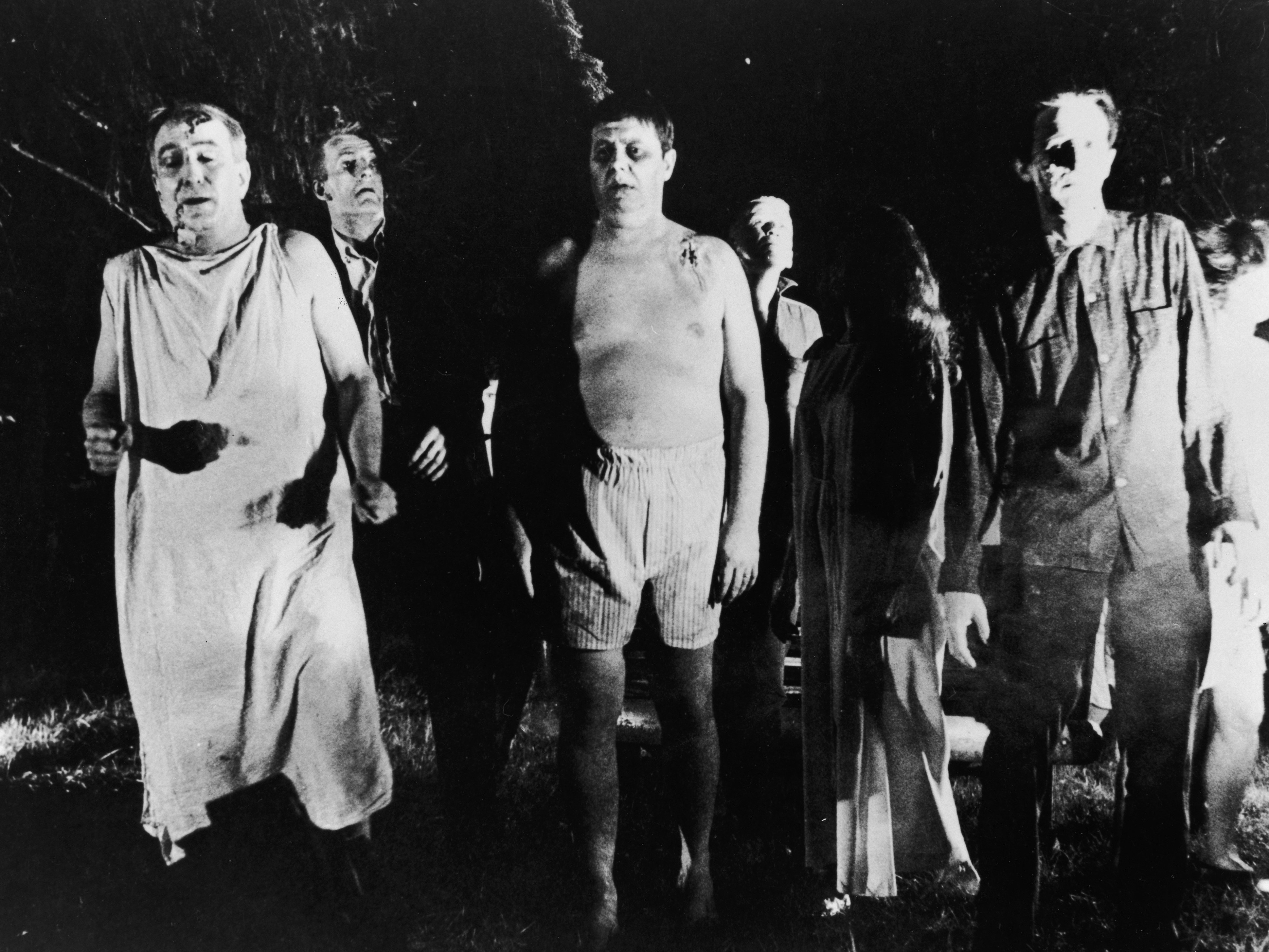
Since the world is beyond the point of change and is headed to this End Times prophesied, there is no hurry for me to publish all this. My ‘elves at the North Pole’ are busily tinkering with the final productions and know if anything happens to me they are free to publish as is. I have so many Russians and Chinese trying to get some inside skinny on what I am doing, which I see as signs of guilt. They know they are at the root of the End Times, but are using the Muslims as their surrogates. Thus, guilt in their black hearts is making them sweat they will be outed. None of that matters, because the End Times will spare nobody. All souls released will be Judged and the guilty will come back into a world incapable of supporting life as it has been known. I see them as zombies; and evil Hollywood loves making money off that future theme.
Filed under Nostradamus
The Epistle to Henry II (Part III)
Then, at the bottom of page 5 is found this:
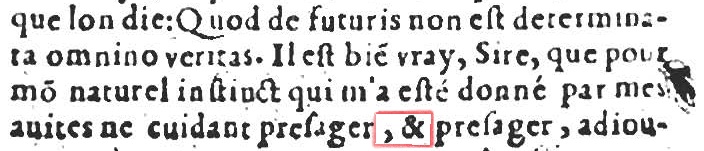
Quod de futuris non est determinate omnino veritas . Il est bien vray , Sire , que pour mon naturel instinct qui m’a esté donné par mes avites ne cuidant presager ,
Notice the combination of a comma followed by an ampersand (, &). If one reads this as a place to divide the letter and rearrange it, see how that links to that found on the top of page 6, with several segments seen as irrelevant to this being stated.
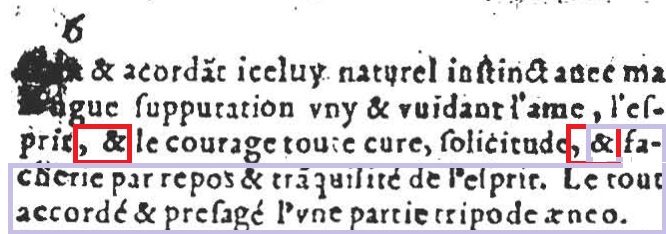
& facherie par repos & tranquilité de l’esprit . Le tout accordé & presagé l’une partie tripode æneo .
Notice another combination of , & that reflects a separate division point, but one that is not part of this red together, which is pieced together from the bottom of page 5, to top of page 6 (as numbered in the 1568 Lyon edition for the letter to Henry). Splicing these two segment lines together, one now sees an English translation that is this (again keeping the segments separate, based on marks used):
Although to course of future not is decided entirely truth .
It is as it should be true ,
Master ,
that for my natural inspiration which myself has been given by bad you warn not knowing to prophesy of things to come ,
& weariness through quiet
& tranquility from him soul .
He everything granted
& prophesied of things to come it one distinguished tripod of bronze.
This reading selection begins with Nostradamus having written in Latin. Latin is the language of the Roman Catholic Church and in the days of Nostrdamus there were no other languages allowed for translating the books of the Holy Bible. This is because Latin is closer to the languages of Hebrew and Greek, where one written work reflects a multiplicity of possible meanings that lesser languages cannot match. Thus, to take a Bible quote and translate it into German (Martin Luther) or English (King James) places a watered down version into the hands of people who are not prepared to understand the truth of Scripture. As such, Nostradamus often paraphrased Scripture in his letters, when he wrote in Latin, giving those word an elevated meaning to grasp.
In this selection, Nostradamus began by writing in Latin “Quod de futuris non est determinate omnino veritas.” Google Translate shows a translation from Latin to English as, “That there is no absolute truth about the future.” That translation follows the normal syntactical rules o such translation; but divine syntax does no allow such paraphrasing to be the primary intent of meaning. All order of words written must remain in place, unchanged. Therefore, a literal translation into English could be this:
“Although future not is determined completely truth”
This becomes an elevated statement that says a divine “future” that is “What, Who, That, So be, Although,” or “In what way” of Yahweh is “completely truth,” which is to be “determined” by “What future” humanity chooses. If humanity chooses to serve Yahweh as His souls in peoples, then a prophesied “future” will “not determine” the fate of their souls. This is why The Prophecies were written as they were, so not to influence those “Who” this “future” would “not be” for them to “determine” as “completely truth” for them to be warned. In essence, this is an important statement that divine Prophecy is not a dog and pony show that is to prove the existence of Yahweh, where idiots will demand someone predict the “future,” based on what Nostradamus wrote, so it can be judged by incompetent souls as “completely truth.”
Can you then see how the Latin “omnino veritas” is matched by the French bien vray, where the Latin translates as “totally truth” and the French as “thoroughly a truth”? The capitalized Il states importantly (through capitalization) “He” and “It” “is,” as a statement of “being,” which is “good, right, aptly, with good reason, and quite” (as an adverb), while also “wealth, substance, possessions, benefit, favor, and a good thing” (as a noun) that is “a truth, true, just, right, sure, certain, undoubted, and natural of itself” Cotgrave, 1611). This becomes a statement about “He” “Who” is one with “Him” (Yahweh and Jesus), so two together (joined as a Trinity) makes one be led the “right” way (righteousness), from the “truth” guiding one from within, spiritually.
When the capitalized Le is read as the masculine pronoun “Him,” this leads to a separated one-word statement (set apart by comma marks, of capitalized importance), where Sire (“Master”) is a statement of Jesus as one’s “Lord” and “King” Spiritually, while giving the impression that Nostradamus was addressing the physical man, Henry II, King of France.
The long series of words that follow include the words mes avites, where the word mes is one of three listings by Cotgrave for that specific word, where he wrote, “In composition is as much as Mal, perverting and turning to ill the sense of the words it proceedeth.” The word it proceeds is avites, which should be read as the second-person plural past simple form of avir (as avîtes), meaning “you warned, advised, or noticed.” This makes for a statement that said Nostradamus was thought to write his works “that” deemed as “quite true” [his Almanachs] that was due to “my natural inspiration,” coming from his knowledge of astrology, where “my with been given” from years of practice. This then infers that it can be seen as “evil” to claim divine insight leads one to cause “you” to be “warned” about the “future,” because people (“you”) have been “advised” that people outside the Church should “not” be “imagining, thinking, or supposing” that Nostradamus has a talent “to prophesy” on mundane issues.
Here, there is a break point that jumps forward to the next page, where three of four segments are begun by an ampersand, making those important to discern.
The first important statement focuses on “anger” (reading facherie as fâcherie, yielding fascherie), which points to a “weariness” that come over Christianity and faith in Yahweh and Jesus, which will come “through” long periods of time when there seems to be “quiet” and “rest.” In 1966 (April 8), Time Magazine published a cover with the question, “Is God Dead?”
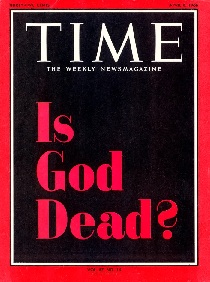
That is the result of “weariness,” even “anger,” especially in Jews, who rejected Jesus as their promised Messiah (Machayach), only to have nearly two thousand year pass, making some think God is at “rest” or in “repose.” The importance of the ampersand then explains a timing element to The Prophecie and why nobody can make sense of the quatrains, because the people in France in the sixteenth century believed and saw God alive and acting in their lives. Thus, it will be different times when the “future prophesied” by Nostradamus will be realized.
The next important statement then points to a state of “tranquility” being present, where tranquilité is closer to an English spelling (“tranquility”) than the proper French spelling of tranquillité (an extra l). Still, both mean “tranquility, stillness, calmness, quietness, peaceableness; a calm; and rest” (Cotgrave, 1611) The ampersand is then denoting the importance of an inner “stillness” that comes “from him” (Jesus) being one with one’s “soul” or “spirit.” This is how one knows Yahweh is alive. It is the true source of faith, where one knows Yahweh is alive, through the Son. Belief is being taught things that over long periods of time not proved, due to one tragic event after another, all blamed on God not helping, lead souls to experience “weariness.” That produced faith that there is nothing beyond death (“repose”), and the “anger” that makes one believe God is dead. This, of course comes from the whispers of Satan; but with Yahweh and Jesus within (Spiritually), one knows “tranquility by reason of” being one with “him spirit” to spirit.
This then follows a period mark that ends that series of line segments, beginning a new series with a capitalized Le, which (as a pronoun) means “Him, He,” or “It.” As the prior word stated “he spirit” or it soul,” the importance of “Him” is Yahweh. As the One God, “everything” and “all” are His creations, including all “souls” sent into human bodies of flesh and the Son Jesus, whose name means “YAH Saves.” For Nostradamus have become one “soul” devoted and committed to serving Yahweh totally, his divine union with Yahweh’s Baptism of Spirit consummated that Spiritual marriage and brought forth the Son into the womb of a wife, which was Nostradamus’ “soul,” making Nostradamus a Saint (or Apostle). This was not because some Roman Catholic priest told Nostradamus to believe in Jesus and be saved, because the only true form of Salvation comes from “Him” knowing a “soul” is His servant, sending “Him” His Son, to protect that wife-soul from “all” and “everything” Satan can present. This is not by human will, but by the gift of Yahweh, where “everything” a Saint will do in the name of Jesus is “granted” by the divine. As far as writing The Prophecies about a very distant “future,” “everything” written was “granted” by the “soul” of Jesus, as Nostradamus’ Lord and Savior.
This then leads to another line segment that begins with an ampersand and ends with a period mark. Here, Nostradamus wrote, “prophesied of things to come it one distinguished tripod of bronze.” This has nothing to do with Nostradamus placing a bowl of water on some “brass” or “copper tripod,” which he would peer into to see the “future” (some mystical art called scrying). This should be read as a statement that “everything granted” by “Him” includes the tales in Greek mythology of the Oracle of Delphi, where Pythia was the high priestess of the Temple of Apollo there. As mythology is metaphor, Pythia reflect upon one who served a god (Apollo), with Apollo being the god of truth (like Jesus is the Light of Truth). The tripod is then the willingness to serve the spirit (the fumes emitted from a crevasse in the rock), so that spirit fills one and “grants” them to speak the truth in “everything” stated. This is Nostradamus explaining that he was seated on the “tripod” when he prophesied the truth of Jesus in The Prophecies.
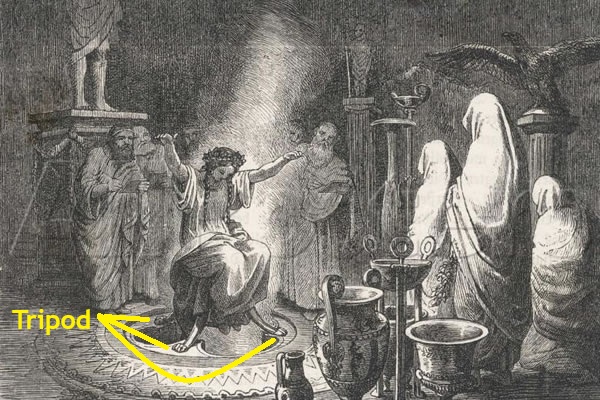
This small amount of words written by Nostradamus yields a vast amount of explanation about the source of The Prophecies. Again, this is not some easy read that can be mastered by some speed reading class. Divine Scripture and this work by Nostradamus comes from the same soure, as for “Him everything is granted.” This includes understanding, because (if one knows the lessons of the stories about the truths told by the Oracle of Delphi) thinking you know what the truth means always leads to failure, with the truth still being as it was told.
P
Filed under Nostradamus
The Epistle to Henry II (Part II)
The Preface to The Prophecies (also called the “Letter to Cesar,” Nostradamus’ newborn son) is 10 pages long (1568 Lyon edition, pages 3 through 12). It is relative easy to read, in the sense that the language made sense, even though what appears to be ‘sentences’ (determined by period marks) seem to go on, taking a long time to end. Comparatively, the Epistle to Henry II is 21 pages in length (1568 Lyon edition, pages 3 through 23 of final three Centuries). This uses much the same, relative to easy to read French and Latin, but because this letter is more deeply explaining what the quatrains reveal, he uses metaphor and symbolism that is difficult to grasp. Add to that confusion the appearance of ramblings (long ‘sentences’ again) that seem to be addressing one lucid point, before suddenly off that point and careening into some wildly new direction; and the Epistle to Henry II sounds like a senile old man writing a letter with no ability to stay focused on why he was writing a letter.
All of this is solved by reorganizing the Epislte to Henry II into a meaningful order. That reconstruction has to follow rules (rather than guesswork); and I have been led to realize the division rules are relative to the use of punctuation marks, such as period marks, colons, ampersands, and the combination of two marks of punctuation together, most commonly being a comma mark followed by an ampersand. According to the syntax of English (as my English teach taught me), both a comma mark and an ampersand are used instead of the written word “and.” To then place the marks “, &” together symbolically stated “and and,” which is bad writing grammar. I see this as where one line segment ends with a comma mark, so it can be joined to another line segment that has verbiage in agreement. The ampersand then breaks off that line segment, to be connected to another line segment that agrees with it.
This is simply how to divide the Epistle to Henry into puzzle pieces (like the quatrains are all puzzle pieces), which needs to be rearranged in an agreeable manner. That then means the words written can be discerned; but those also have rules to follow, in order for them to make sense, as intended. My work (over years) with The Prophecies led me write the book The Systems of Nostradamus: Instructions For Making Sense of The Prophecies, which teaches a divine syntax that must be learned, so fluency can come with understanding The Prophecies. I wrote this book focus on understanding Nostradamus, but the same systems of reading can be applied to Biblical Scripture, so a deeper truth arises from those Holy Scriptures. It is then the first true textbook for understanding Nostradamus and all divine and holy writings.
Relative to understanding those rules of divine syntax, questions about the meaning of The Prophecies can be answered, coming from the explanations given in the Letter to Henry II.
From the bottom of page 3, in the 1568 Lyon edition, for the letter to Henry is found.
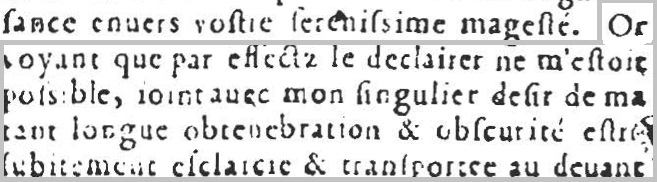
The text to focus on now is placed within a gray outline. That says: Or voyant que par effectz le declairer ne m’estoit possible , joint avec mon singulier desir de ma tant longue obtenebration & obscurité estre subitement esclarcie & transportee au devant
As there is no punctuation ending that page (after devant) this continues onto the top of page 4.
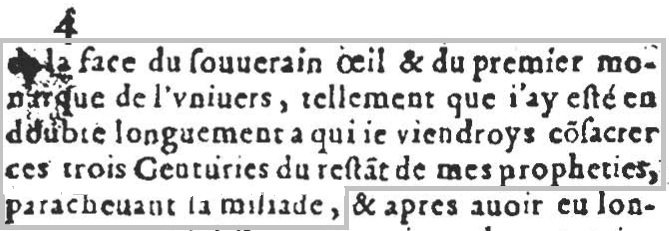
This continues to a focus that ends with the word milade“. The text in this gray outline continues to state: en la face du souverain œil & du premier monarque de l’univers , tellement que j’ay esté en doubte longuement a qui je viendroys consacrer ces trois Centuries du restant de mes propheties , parachevant la miliade ,
By realizing punctuation marks are signals to separate the text into segments of word statements, those segments are not difficult to understand, based on the rules of grammar that apply to French (which can be modified to follow rules that translate into English). This is an example of how line segments are important to read separately from one another, such that lucidity comes when agreeable segments create a flow of intelligible thought. Thus, the above translates into English saying:
Now seeing that through works him to declare not myself been possible ,
joining with my singular desire from my in such manner continual act of obscuring
& hidden meaning in words to be suddenly cleared up
& transported with him in front of upon there face of it sovereign eye
& from the premier monarch to the universe ,
in that fashion that I have been in suspect at length in which I may approach to consecrate unto these three Centuries from the remainder of my prophecies ,
finishing the thousand of ,
—–
Take note that an ampersand introduces three line segments. This seems to be repeating the word “and” excessively, like when one is poorly educated and feels a need to interrupt his train of thoughts with needless words like “you know what I mean?” In the verse of the books of the New Testament (the Greek texts of the Holy Bible) there are a plethora of uses of kai (9039, according to Strong’s). Some are so frequently used in the same chapter that it sounds like Stuttering John of the Howard Stern show trying to spit something out. So many “ands” make you want to scream, “Just say it!” However, kai is like an ampersand in The Prophecies, where there is no word attached to that symbol. It is a statement that says, “Importance to follow this mark. Pay close attention to what is written.” That is a hardfast rule of divine syntax; and it intensifies the meaning one sees, simply from that recognition.
With an ampersand introducing “hidden meaning in words to be suddenly cleared up,” that becomes an important line segment to understand. So, what does it mean where Nostradamus wrote?
“hidden meaning in words”? (obscurité)
“transported with him in front of upon into there face of it sovereign eye”?
(transportee au devant en la face du souverain oeil)
“the premier monarch of him universe”? (du premier monarque de l’univers)
According to Randal Cotgrave and his 1611 dictionary, the French word obscurité translated into English as “obscurity, darkness, dimness, cloudiness, duskiness, an overcasting; closeness, covertness, diffusedness;” and what can be seen as deeply applying here (following an ampersand) “a mystical sense, or hidden meaning in words.” For Nostradamus to explain his writings as “mystical” and “hidden meanings” that are “to be suddenly cleared up” (estre subitement esclarcie), this says understanding was always there, just beyond one’s ability to see that clarity.
This is the importantly stated “to be sudden cleared up” when one’s soul has come (ampersand use) “before” or “transported” or “carried over, removed fom one place to another” spiritually, so one’s soul is “with him “before” or “in front of” the divine presence of Yahweh, as His Son reborn, “with it” Christ Mind then leading one’s intellect. This is a presence “upon” or “into” one’s soul, so one’s soul is “with him” (du = de + le, reading le as a pronoun, rather than a meaningless article) that is Jesus, “removed from a state of physicality to one of spirituality.” This takes one to a union within one’s flesh, as “there” Jesus is king or High Priest of one’s bodily tabernacle. so one’s “face” is then the “representation” of one born again fom above as Jesus returned to human flesh. This is the gift “of he” that is Yahweh, to a committed servant in divine marriage, where Yahweh is the One God with “none superior” and the soul of Jesus is the “prince” of peace, whose kingdom is not of the material world, but the spiritual. This means Jesus becomes one’s “high” connection to the all-seeing “eye” of Yahweh. To discern the truth of The Prophecies, one must be led by Jesus. Nostradamus was so led to write that work; and to understand what he wrote, the same divine presence must leads one’s mind.
This then says that Jesus, like the Father as the Son, is the “first” and only Son, whose soul was created to be joined with all souls that seek Salvation. Jesus is then the “monarch” or “absolute prince” of one’s soul, acting as the Spiritual Lord that commands a soul in its body of flesh to act divinely. This presence makes on a Saint; and, according to the talents listed by the Saint Paul, a Prophet is the product of this divine presence, just as understanding a Prophecy is also. This means a Saint is motivated to act as commanded by the divine Jesus, so one does not put one’s light under a barrel to keep it from others, because Yahweh sends His Son’s soul to be “with” servants that minister in Jesus name, going into “the universal world” with a message of Salvation that is “he universal” to all souls.
Those three important line segments (all introduced by ampersands) tell that understanding The Prophecies demands full and total commitment to Yahweh, so one can be reborn as His Son Jesus “into” one’s soul, with the “face” of Jesus being the halo around Sants depicted in medieval artwork. This helps support that The Prophecies are not predictions, but the “divine utterances of Prophets.”
Continuing on in this from the top of page 5 is Nostradamus then explaining this final edition that was published in 1566. For a letter dated June 27, 1558, that says it was written eight years before it was first printed publicly. That means the Epistle to Henry II (King of France) was meant to be included, like a preface to Centuries 8, 9, and 10. That is stated when he then wrote:
“I may approach to consecrate unto these three Centuries from the remainder of my prophecies”?
(“je viendroys consacrer ces trois Centuries du restant de mes propheties“)
The word consacrer means “to consecrate, hallow, dedicate, or devote unto” (Cotgrave, 1611). That speaks in the voice of Jesus within Nostradamus, where je is not the man Michel de Nostredame but the presence of the soul of Jesus. Only a divine presence, such as the Son of Yahweh, can speak in the first-person, as “I” who is “to consecrate” that contained in this additional imprint. The word viendroys should be read as an Old French variation of viendrais, which is the first-person conditional form of the verb venir, meaing “would come, arrive, approach, draw near unto; proceed, issue, be drived from; spring, prove, grow; and to happen, chance, or fall out” (Cotgrave, 1611). To then state this “dedication” is placed upon “these three Centuries,” the number “three must be read as a statement about a “trinity,” which means the “three Centuries” or “three groups of a Hundred” quatrains all have been infused with the divine presence of Jesus within Nostradamus. When Centuries is read separately, as an important word (due to capitalization) the plural number applies to all of the “Centuries” of The Prophecies, as all are a work of the Trinity. These “three Hundred quatrains” are those “from” the whole that was written before the first edition was published in 1555, such that “these” represent the “remainder of” all produced through the Prophet Nostradamus, where “my” is the possessive pronoun relative to “I” (je), as the “prophecies” of Jesus, written by the hand of Nostradamus.
Nostradamus then ended this set of cohesive line segments with this statement:
“finishing here thousands of” (“parachevant la miliade“)
Here, this makes the statement of completion, as “finishing, consummating, accomplishing, achieving, and making an absolute end of” this work that is The Prophecies. It can equally be a statement that the life of Nostradamus on earth will soon be over, with his work for Yahweh, through Jesus “accomplishing” his ministry in the name of Jesus. The word la cannot ever be read as a meaninglsee feminine article, as “the.” It must always be read as the adverb là, meaning “there” or “here.” As “there was used earlier, “here” becomes supportive that Nostradamus “here” alive in the flesh is in his “finishing” days. The word milade is not a known word, as spelled. It then acts to show how words also must be divided so they make sense, where miliade divides into milia de, where milia is Latin for multiple “thousands” (plural) and de is a preposition meaning “of, to, with,” or “from.” This implies a “thousand” quatrains in ten Centuries, but the word can mean there are “countless” (as metaphor for a large number) examples “of” other divine Prophecies (the books of the Holy Bible certainly includes, but those apocryphal as well) these now “finishing” can be added to.
Filed under Nostradamus
The Epistle to Henry II (Part 1)
This letter is enigmatic and difficult to grasp, but it is that way as an explanation of the ordering of the quatrains. Everything Nostradamus was divinely shown, he wrote down in the logical order that allowed him to understand this future he was shown. Thus, when Nostradamus first published a part of that which he had been divinely inspired to write (nearly a thousand poems), he did so by rearranging the logical order, so the quatrains he published in 1555 gave the appearance of individual predictions, similar to his prior publications of Almanachs.
In 1557, Nostradamus then added more of the verses he had originally written in logical order (perhaps in 1553 or earlier), again selecting random quatrains that did nothing to lead readers to believe he had written an epic poem (similar to The Iliad and The Odyssey by Homer, The Aeneid by Virgil, The Epic of Gilgamesh, and Beowulf; to be followed later by The Divine Comedy by Dante, Paradise Lost by Milton, and Faust by Goethe). It was this random presentation that kept The Prophecies of Nostradamus from being seen in that way. Therefore, before the King of France would give his approval for any new publications of Nostradamus poetry, he demanded Nostradamus appear before him in Paris and explain the meaning of the 353 poems published in 1555, along with the additions in 1557, which ran the total to 642.
Rather than appear before Herny II and be held prisoner, as Jesus would not allow him to expose the truth of his work at that time, Nostradamus was led to write a logical letter of explanation, which he then divided into pieces, tossed in the air, and reassembled into a letter that sounds like it was written by a madman. It was the presentation of the Epistle to Henry II that explained the ordering of the quatrains – everything is out of order, for a reason.
Nostradamus had published Almanachs for several years (1550-1566, including years when The Prophecies were published), which contained far less than hundreds and were understandable (with some usage of metahpor and innuendo) and seen to come true. This accuracy led people to call Nostradamus a prophet, while knowing he utilized his knowledge of celestial alignments (astrology) to calculate his future predictions, one year at a time.
To have 342 quatrains burst into publication in 1555, not called Almanach, but The Prophecies, had people scratching their heads. Then the total ran to 642 in 1557, with none of the first figured out. It must be noted that those who say Old French is not easy to translate, the people of 1550 to 1566 all spoke Old French fluently and the royal family of France was afforded higher education. Because the Old French had figured out metaphor, symbolism, satire, and innuendo, they were not ignorant beasts. They struggled not because of the languages written (French and Latin), but because their ingrained abilities to comprehend writings by learned rules (syntax) of French and Latin did not produce meaning.
Nostradamus would write his Epistle to Henry II, King of France, in 1558. Presumably he mailed it to the king (sent by carrier), from his home in Salon-de-Provence, in southern France. One could then assume that Henry and his most educated advisors read that letter explaining The Prophecies, coming away with doubts about Nostradamus’ sanity. That doubt put a hold on further publications relative to The Prophecies, until Henry died after a jousting accident in 1559.
With his death, having several male heirs but none of whom was old enough to take over the throne of France, his wife, Catherine de Medici, became Queen Regent in Henry’s place. Catherine de Medici was very fond of Nostradamus as an astrologer and sought his readings for the princes. It was with her support that a final edition of The Prophecies would be published in 1566, the year Nostradamus died. There would be no change in anyone being able to understand the meaning of the poems (although Catherine saw one that she said predicted Henry’s death); but Nostradamus’ assistant, Jean de Chavigny, obviously was told of printing errors that needed to be corrected. So, a 1568 reprint was approved.
Simply because a reprint of unintelligible poems was done two years after Nostradamus’ death says it was important those corrections be made, for a future time, when understanding would be possible. The final editions then added a full 300 verses, bringing the total (in ten Centuries or groups of one hundred) to 942, with Centurie Septiesme (“Century Seventh”) still containing only 42 quatrains. The Epistle to Henry II was then published in both the 1566 and 1568 editions (and all subsequent ones), acting as a foreword to those added 300 verses.
The word “foreword” is defined as “a short introduction to a book, typically by a person other than the author” Oxford Languages). This epistle was in addition to the Preface that was published in all editions, placed prior to Centurie Premiere (“Century First”); and a “preface” is defined as “an introduction to a book, typically stating its subject, scope, or aims.” This means the Preface was as it is defined, while the Epistle to Henry was an in-depth explanation (not an introduction) of the “subject, scope, and aims” of The Prophecies. This makes the two letters (Preface and Epistle to Henry) be extremely important to discern, in order to make sense of what the bulk of the work says. They must be understood first, before one can begin attempting to make sense of the verses.
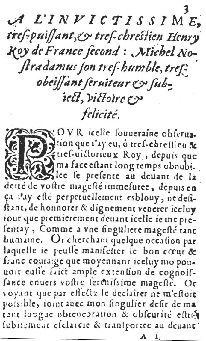
This makes realizing the Epistle to Henry II most important. It must be seen as a mini-puzzle that must be placed together in a logical order, where understanding in-depth explanation of the subject, scope, and aims of The Prophecies is possible. Simply by seeing how to divide the epistle into parts (logically) and reorder into a lucidly clear writing is vital. One must be able to read for instructions in how to discern the poems; but the simple realization that the epistle is like the quatrains and jumbled up on purpose, becomes an unstated in-depth explanation about how to make sense of the quatrains.
Then, between the introductions by the author become the logical way to defend interpretations of everything. The author must state the subject, scope, and aim of those quatrains nobody could grasp in 1555-1558, or it becomes an exercise in illogical (flawed and invalid conclusions) guesswork that is wrong (like Catherine de Medici’s belief that Nostradamus predicted Henry’s death was wrong). Logic says, an interpretation my be fully supported by what Nostradamus said would be found within.
Filed under Nostradamus
Sub-domain to search
All the articles for katrinapearls.wordpress.com have been linked to blog@jean-de-chavigny.com, an ionos web page. I have reverted the primary wordpress link to katrinapearls.wordpress.com for now. Subscribers can bookmark jean-de-chavigny.com and go there, click the “read the blog” link and return to the Word Press Nostradamus Blog website.
Thanks,
Mgmt
Filed under Nostradamus
Quatrain I-94
This was originally written in 2011, as it was relevant to the news at that time. It is about the death prophesied of Osama bin Laden. I welcome readers to ponder what I wrote then and see if the current news (2023 to 2025) is a reflection of the Western world not knowing all it thinks it knows. Send the children away. Let them sink what is left of their puny brains into the addictive electronic gadgets you poison them with. They are beyond understanding or caring what the future holds.

| All Material Copyright of Katrina Pearls apart from the obviously stolen stuff Reproduction by Permission Only |
I want to discuss the Nostradamus quatrain recognized as I-94, or the 94th listed in the initial
“chapter” of The Prophecies, called Centurie Premiere (Century First). As a quatrain from the
first chapter, it has been public since 1555. That was 456 years ago [2011]. However, only recently did
historic events take place that shed light on the true meaning of this quatrain.
The quatrain states in Old French:
Au port Selin le tyran mis à mort,
La liberté non pourtant recouvree:
Le nouveau Mars par vindicte & remort,
Dame par force de frayeur honoree.
Erika Cheetham wrote (1975) that she guessed this quatrain was about the Battle of Lepanto,
which took place in 1571. That was only 16 years after Nostradamus published this quatrain,
but five years after his death. So, Nostradamus could not publicly take credit for seeing that
battle. But then, John Hogue assured us this was not about that battle, pointing out other
possibilities, stating that Edgar Leoni called it a “failed quatrain.” The reality is none of the
above is true, because the event of this quatrain took place well after everyone jumped the gun
on matching it to an historic event (they all interpreted before 1996). The event that matches
this quatrain took place on May 1, 2011.
To help one see this develop, look at this quatrain translated in this way:
With he * bringing * Arabian * him * A ruler who exercises power in a cruel manner * reduced * at * departure out of this life
There * freedom * not * yet for all that * reobtained:
Him * recent * War * by reason of * revenge * & again dying,
Lady * through * violence * of * terror * honored.
Certainly, other words can be substituted for the ones used above. They too can make sense of
the event that recently happened. However, the point of presenting this quatrain in a translation
format where asterisks are inserted is to show where pause for reflection needs to be
observed. One needs to read these words without attempting to form them into one sentence.
Feel the full meaning of each word.
The event is about the killing of Osama bin Laden. Look at how that is stated in the main theme
line (line one). See how the words match the way we learned about that news in the days (and
now weeks) that followed.
The capitalized preposition-article contraction, Au, shows how “one” (the individual focus from
the article “the,”) [versus a plural focus from les, as Aux] was the important (capitalization)
connection “With him” bin Laden. Some messenger he trusted was allowed “In it,” the network related to a compound in Abbottabad, Pakistan, whereby “To him” Osama bin Laden gave updates and messages, letting his whereabouts be known in the outside world. Some Muslim traitor then received new assigned tasks, which the traitor sought to make millions of dollars in reward money (after nearly a decade in hiding) and contacted the American authorities. It was “From him” (someone with bin Laden) “To he”(the traitor Muslim) via a cell phone call he received, from a cell phone known to be related to a bin Laden aide, which signaled American intelligence to follow the courier “To it” the place where bin Laden was hiding. The capitalized first word is thus showing the importance of movements that would
importantly be necessary, to take “he To” the one being sought.
The second word is “port,” which can represent a “harbor.” While this word identifies the use of
Selin as a body of water on which a “port” can be found, the word “port” is a verb of “carriage,
bearing, and bringing.” The aspect of bin Laden’s body being “buried at sea” is a secondary
reading that can come from this word, but its primary meaning is to confirm the meaning of
movement found in Au. Thus, one can see how the “he With” bin Laden will be
“bringing” those watching him to bin Laden, while he will be “carrying” out his duty, “bringing”
information to his boss. As such, the one leading the way would become a “portal” to the
hideout (with the Latin word porta meaning “gate.”)
The third word, Selin, is a capitalized word. As such, it is important to understand. All
capitalized words are important, but “Selin” is a major theme word, making it vital to
understand. It is a major theme word because Nostradamus wrote this “name” in variations
twelve times. He wrote Silene (1), Seline (2), SELIN (all-caps -1), Selin (capitalized – 5), selin
(lowercase – 1), selyn (lowercase, with y = I, – 1), and celin (phonetic c = s, 1). All these references are presented in several Centuries (7), along with common connective words, which act to assure
the observant reader that the variations refer to the same intent and focus.
Let me make it clear that twelve times is making a statement of importance through that number
of repeating appearances. As a repeated term, all twelve quatrains with those variations in
them can be placed together to tell a story about Selin. The variations disappear when a
common translation is found that represents an understanding of Selin. All spelling then
represent that translation. In attempting to determine this translation, it does not take long to
recognize that Selin is not a cleanly spelled word from any known language. In such cases,
rules for determining “misspelled” words apply.
In a phonetic sense, Nostradamus often spelled words that he applied a “French” ending to,
such that a dialectical form of a word ending with a (such as the Catalan word Nissa) would
be written with an e ending (such as Nisse). Of the twelve repeating forms, Silene and
Seline give the indication that the pronunciation is as one would pronounce Celine, or Selene.
If you look up the name Celine, it references a root in Selena, or Selina. In those variations, all
state the etymology to be rooted in the mythological goddess Selene (which is spelled Selen in
French). This goddess was known in Roman mythology as Luna. Thus, Selin represents the
Moon in its meaning.
Since it is impractical to interpret line one in the physical sense, where the theme begins, “With
the Moon,” one must look at the symbolism of the Moon. Symbolically, the Moon is closely
related to Islam. This is evident by the Crescent Moon being present in the flags of many
Islamic nations. Because the goddess Selene represented one figure symbolizing all the
Moon, Selin is one icon that represents all of Islam. Because Mecca holds that symbolism for
Islam, and because Mecca is in Saudi Arabia, those places can be seen as important symbols
reflected by Selin. As an individual representing Islam, as Osama bin Laden was, Selin can
be seen as recognizing him as an “Arabian,” which is the name of the sea his body was “set at
death” into, after being “carried” beyond the “port” of Pakistan, to where an aircraft “carrier”
awaited.
Now, as solid as the phonetic meaning is, one cannot overlook how being one letter off allows
Selin to yield other information. This information would do nothing to cancel the meaning just
discussed, as it would add to the information “Selene” produced. That new meaning comes
from seeing Selin as a combined form word, just as Au combined two words. In that sense,
Selin can turn into S’elin and Se-lin.
In both forms, one word attached to the another is “Se,” which is contracted as “S’.” This is a
pronoun, which means, “oneself, himself, itself, or themselves (pl.).” It thus often acts as a
possessive pronoun, in particular an indication of one possessing the word it attaches to. In the
case of elin, this is ancient French, used between the ninth and fourteenth centuries. It means,
“of noble birth; illustrious; or illuminate.” In this sense, it does identify Osama bin Laden as
being from a Saudi family that made “Oneself illustrious,” from birth into great wealth and
fortune. It also acts to show how the courier would “Himself illuminate” the way to bin Laden.
This brings one to find the word lin is French for “linen, or flaxen,” but in Old French it meant,
“line” or “flax, yarn,” from which “linen” was made. In other words, lin means a “thread” or a
“line.” In that vein of thought, the downfall of Osama bin Laden was the need to have “One’s
line” to the outside world of al-Qaeda. To maintain that “line,” he kept a thin “thread to Himself,”
via a trusted courier. All these meaning apply to the story we have been told, as everyone
involved in this link was “Muslim” (the general meaning of “Selin”).
Now look at the fourth word, which is the simple French “article,” le. This typically translates as
“a, an, or the,” depending on the following “masculine” noun. However, in reading Nostradamus
for understanding of true meaning, such articles only appear at the secondary level of
interpretation. When the word le is read alone, it becomes the pronoun usage, such that it
means, “him.” This reflects on the masculine singular contraction of the first word
(capitalized), Au, which is the combination of À + le. The purpose of this pronoun is to point
to a male that is relative to Selin, portage, and “With him.” This, by itself, is not limited to
one “him,” which is important to keep in mind.
The fifth word in line one is another important word, which is tyran. This word is important
even though it is written in the lower case. Just as was stated prior, about the twelve times
some form of “Selin” appears in The Prophecies, meaning the number of repeated uses
makes it important, with some of those twelve being presented in the lower case (selyn, selin,
and celin). Some form of the word tyran appears in the quatrains seven times, written as
tyran (5), Tyran (capitalized – 1), and tiran (1). These also link the quatrains containing those
repeated terms together to tell a story of a “tyrant,” with common key terms associating all
the uses of that central word. Therefore, that knowledge allows me to make it known to you that
tyran is indeed a significant word to understand. Please, check me on this information.
The French word tyran translates as “A tyrant,” but that can be further described as, “A cruel
king, lord, or ruler; a violent governor.” In the translation I produced originally in this
interpretation, I quoted one of the definitions of the word “tyrant,” as being, “A ruler who
exercises power in a harsh, cruel manner.” Other definitions are: “An absolute ruler who
governs without restrictions,” and “An oppressive, harsh, arbitrary person.” (All definitions are
pulled from the Free Dictionary by Farlex, which uses The American Heritage Dictionary of the
English Language, Fourth Edition.)
The point of using a definition for “tyrant” is to show precisely what the word means, before
wandering into the realm of careless language, where an overstatement could be read,
mistakenly seeing some superfluous meaning. While it is true that the word can be thrown
about to identify individuals who act in ways that can be deemed as characteristic of a “tyrant”
(“tyrannical”), the primary use is to denote one who holds true power over many others. When
one understand this distinction, one can then see how a quatrain referencing Nero (Neron)
is one truly pointing to a “tyrant” (He is said to have used the burning bodies of Christians, hung
from poles, to light his garden path at night), making Neron a personification of a “tyrant,”
indirectly stating “tyrant” as one who will act like Nero.
The presentation of tyran in the lowercase does not diminish the level of power that one holds
as a tyran. One gains this understanding from recognizing how Nostradamus wrote the two
forms of the word roy (modern French roi). He wrote in the lowercase (roy) and in the
uppercase (Roy), and he did so to show two different kinds of “kings.” The lowercase
represents one that is not truly a “king,” but has all the power of a “King.” This is seen in
presidents of nations, and prime ministers of nations. They rule as “Kings,” but without any royal
blood making them gain this title by birthright. They must be elected. A capitalized “King” is
then a distinction of true royalty, either as a “King” of a sovereign nation, or as “Pope” to the
Roman Catholic Church. Thus, a tyran is as powerful as a “king,” but not limited to being
elected by a physical vote.
The use of tyran is then a stand-alone statement of one who abuses “his” (masculine use of
le) powers, as one who acts in “a harsh, cruel manner.” This is then relative to “him Selin,”
which is describing Osama bin Laden, but it is also the “him With” a “port” (where the word
means, the behavior of a man, or the way one carries himself) that “Himself threads” to bin
Laden. In other words, the one tracking down bin Laden is also identified as “him” also being a
significant “tyrant.” It becomes important to see this duality coming from these words.
The word tyran is then followed by the sixth word in line one, which is the preposition à. This
is the second use of that preposition in this line, as the quatrain began with the important
(capitalized) Au (À + le). When one reads the quatrains, it is not uncommon to find some
instances of repeated words, within the four poetic lines, as well as in one individual line. The
most frequently repeated words are prepositions (most commonly de and à). Since these
words have multiple contextual uses, it becomes a rule to seek different contexts as the primary
intent each new time presented, such that one repeated French word results in multiple different
English translations.
For instance, the preposition à means, “at, in, with, to, and from,” depending on the context.
When a little one-letter word is read as a stand-alone statement for meaning, all contexts are
open for analysis and possibility as representing the primary use. When one then sees a
second use in one quatrain, the first use will have previously been established as primarily best
read as “fill in the blank.” Then, the second use would complement that first use, as its primary
intent. Thus, it à were to be seen first as primarily meaning “to,” a second use of à would
compliment “to” by primarily meaning “from” (a to-from relationship). In this quatrain, the
capitalization of Au was seen best presented as “With he,” such that this second use would
eliminate “with” as a repeated primary context, causing one to look for another translation
possibility, bearing more weight. In the translation I originally presented, I chose “at” as the
primary choice.
The English word “at” is primarily defined as meaning, “In or near the area occupied by; in or
near the location of” (Same Free Dictionary by Farlex source.) While that choice is my
personal decision, and all choices will find merit, in the storyline of Osama bin Laden’s death,
we find the important context leading to that death as being relative to “location.” He had to be
located, before he could be killed. To focus on that location, intelligence had to first
make a connection to a significant “one With” information of that location. Therefore, the word
à makes sense as a connection of one “him tyrant” to another “him tyrant,” “at” the place
where an operation would be planned to intercept “him Muslim tyrant.”
The final word of line one is “mort,” which means, “death; bane; a decease or departure out of
this life,” but also bearing the meaning, “dead, deceased, departed; and also killed, murdered,
slain, and/or made away.” (all translations based on an Old English perspective of meaning)
This word is confirming what the plan would be (a kill mission), as well as where “him tyrant”
would be found, to be “killed.” However, when one recalls how the word “tyrant” can
also be representative of “him” who will “govern without restrictions,” and “exercise power in a
harsh, cruel manner,” one can see how the plan drawn up for the location “at” Abbottabad,
Pakistan, “in” a private, “lavish” compound, was completely designed “to murder” (“à mort”).
With all of the building blocks individually understood, one has been taken through the meaning
of this main theme, which governs how one is to read the whole quatrain, so that it matches all
that has been made public about the death of Osama bin Laden. It also brings out the
questions about the mission having committed “murder,” rather than being a “capture and bring
to justice” operational plan. Still, line one can be seen as still telling further of that event, on a
secondary level of wholeness (as a sentence), becoming the later released facts of that mission.
In this sense, the same words of line one can be read to collective say, “With him (meaning
With Osama bin Laden in the hands of U.S. SEALs) carried (the reports of his body being
dragged to an awaiting helicopter, which then went beyond the ports of Pakistan, hundreds of
miles away) Arabian (meaning the proper name of the sea to which Pakistan has ports, as well
as the nationality of bin Laden, as well as Selin representing his Islamic religion, the customs of
which were said to have been followed once on an aircraft carrier) him tyrant (Osama bin
Laden) thrust into (or laid, pitched, reduced, or sent [from the French word mis]) at (another
location of place, or in, to the water of the Arabian Sea) death (optimally meaning buried at sea,
but also meaning the destroying of evidence relating to a murder). This whole view fully
complies with the known history of the killing of Osama bin Laden, while also supporting the
concept of a planned act of ridicule, where the body of a powerful Islamic leader (Selin tyran)
was simply thrown away, after being murdered.
This exposes what has not been made public, although it has been voiced in theory. Such
voices that question the actions of leaders, to prevent one from ever becoming a
tyrannical ruler, have been suppressed, through public ridicule in the media. The event of
Osama bin Laden’s death followed soon after the final submission by Barack Obama, to
answer the question of his legal right to be president of the United States of America. On April
27, 2011 (4 days prior to the Osama bin Laden news), Obama made public his long-form birth
certificate. That act eased questions about his authority, which had been ridiculed by Obama
supporters as the rantings of “birther idiots.” Immediately after people began to question why
Osama bin Laden could not have been captured alive, the questions of murder began being
ridiculed as the rantings of “deather idiots.” It helps us to realize that the purpose of The
Prophecies is to expose the hidden agendas of all tyrants, as they (and their secrets) are why
the world would be put in grave danger. Keeping this “conspiracy theory” exposure theme in
mind will help one to understand the remainder of the quatrain.
I will complete this interpretation in a separate posting. It is important that one be able to see
this meaning, just from the main theme, for him or herself. Look at the Old French words
written. Double check the translation possibilities. See how the translation possibilities are
defined. Make the meanings rise before your own eyes, so it is not me telling you what to
believe. Seeing is believing. I see and I believe. I want you to believe by seeing through your
own eyes. There is no magic involved here. No suggestive language is used, designed to have
one fall for my biased, illogical opinion. Still, you must “receive the spirit” intended by a
higher source.
Once you have looked at this main theme statement, realize that the main theme covers
everything else that is to come in a quatrain. The whole of each quatrain relates to the main
theme that is stated in line one. It is that way for every quatrain. There is order with purpose by
design. Look at the remaining lines of quatrain I-94 and see what they mean to you, before I
present an interpretation that states what they mean to me.
With the main theme statement (line one) of quatrain I-94 understood to be presenting a
multifaceted view of the events that have recently been announced – the killing of Osama bin
Laden, one is now ready to look at how the next parts of the quatrain read. Before jumping
immediately into line two, one must check to see what punctuation signs (if any) are present at
the end of all first lines. These mark direct one in how to approach line two, which is a
secondary theme to the main theme. A secondary theme will always be related to the main
theme, but some are free to take an approach that focuses on another relative element, one
less directly connected to the main theme event. However, some secondary themes are directly
stemming from the main theme event.
I quatrain I-94, line one ends with a comma. That punctuation mark is defined as having the
purpose of being “used to indicate a separation of ideas or of elements within the structure of a
sentence;” and “A pause or separation.” Simply because Nostradamus did not write in
“sentences,” his use of punctuation still follows the intent and purpose of those marks. In that
way punctuation acts as signs instructing the reader to do as the mark instructs. In the case of a comma, it instructs the reader to see a “separation” from the main theme. It also instructs the reader to
expect the separation to allow for a new “idea or element” that is “within the structure” of the
main theme, and the order system present in all quatrains. Thus, line two is related to the death
of Osama bin Laden, but a separate (and probably subsequent) event, directly stemming from
the last idea presented, which was “death” and/or “killed, murdered.”
From that expectation, one sees line two stating, “La * liberté * non * pourtant * recouvrée”. As
originally translated, one English string of words to follow could be, “There * freedom * not * yet
for all that * re-obtained”. This theme should be understood to be a confirmation of the
concepts derived from the main theme, such that the information contained in those five words
will establish another theme that is equally important to follow, by itself, while being reflective of
the main theme of killing those enemies sought after.
The first word following the comma is the capitalized first word, La. This appears to be a
simple article of the feminine gender, simply meaning, “A, An, and The.” This brings out a rule
that is required to know for understanding the whole truth, which is, “If Nostradamus accented
the word, you cannot change it; but if Nostradamus did not accent the word, it can be read as
accented.” In the case of La, it must be read primarily as if it were accented, as Là. This
gives much more meaning to what appears to stand alone in need for the following word to
open its purpose. The word là means, “there, here, and/or then,” depending on the context. A
capitalized version shows the importance of “There,” connecting to the place “at death,” while
also separately becoming a statement of “Here,” where the order was given to “put to death,”
and “Then,” the consequences of that act of “killing.”
With all of those meanings of Là being directly focusing on the aspect of “death,” and in
particular the “death” of Osama bin Laden, the way his “death” was detailed by presidential
announcement, and then amended by subsequent White House briefings and news reports, line
two appears to be primarily focusing on “There,” the United States. While forces of the U.S.
Navy had to go “There,” to make the “kill,” one must look at the capitalization and ask, “Which
“There” is more important, and thus worthy of capitalization?” That is best describing America,
and the use of a comma allows for such a separation from the place of the main theme event
(“at”), to focus on another place related to that event, with more importance (“There”). However,
keep in mind the word “There” is always free to turn its spotlight wherever need be, although the
other directions would seem to be on more secondary levels of interpretation.
Seeing “There” as a primary focus on the United States, which had to use forces in a foreign
land (“There”) to defeat an enemy it had sought for nine-plus years, the second word confirms
that choice of primary meaning. The second word is liberté, which can easily be seen as
representing, “liberty,” as well as “freedom.” If there was any word that best representing the
ideal of the United States of America, both “Here” and all around the globe (“There”), it would
be how America represents “freedom” to the world’s huddled masses. One has the “liberty” to
climb out from the depths of human despair and rise to the heights that a “free” capitalistic
society offers, to everyone. Again, that is the IDEAL that has become the American dream, but
it is undeniable that America and “liberty” (and liberty and justice for all, amen) are connected
as synonymous.
To ensure that the concept of “liberté” was similarly seen in 1555, when this quatrain was first
published, it is important to get the full scope of meaning that comes from a 1611 Old French –
Old English dictionary. The word “liberté” is translated as representing, “liberty, freedom; full
scope, good leave, ample or free choice; an uncontrollable condition; also openness,
plainness, boldness in speech or action.” These possibilities of meaning not only show how
the United States is identified as “There” where the “freedom” bell rings, but it shows that
“There” held all the cards in the matter relative to the “death” of Osama bin Laden.
In this sense, the word liberté states that the operation to take place in Abbottabad, Pakistan
had the “freedom” to move at will, with “liberty” to act in any manner the troops on the ground
saw fit. It also shows how everyone in President Obama’s cabinet sat in the “Situation Room,”
with a “full scope” of what was about to go down, with Obama having the “free choice” to stand
down the troops, or the ability to stop the mission, should it become an “uncontrollable
condition.” Obama also had the ability to order “good leave” to spare the life of Osama bin
Laden, should he be found unarmed and defenseless. All these meanings are known to have
happened, as there have been reports and pictures released making these elements of liberté
publicly known.
When one sees “There” as representative of the place that is “at” the site of “death,” one sees
the importance of capitalization fall upon the nation of Pakistan. As a bought and paid for ally of
the United States, who allows U.S. Troops access to the landlocked Afghanistan, it has been
Pakistan that has given the United States the “liberty” to perform military actions in Pakistan.
These actions have been primarily drone bombings in mountainous regions bordering
Afghanistan, where the Taliban is said to have been finding refuge. Still, Pakistan is accused
(after the main theme event) of having been complicit in allowing Osama bin Laden the
“freedom” to live in that “lavish compound,” where Navy SEAL soldiers “killed” him and his son
(among others).
The other aspects of the meaning associated with liberté, as far as it applies to Pakistan, is
best read into liberté being attached to the next word, the negative non, meaning, “no or
not.” Pakistan has made it public (after the main theme event) that they did “not” allow the
United States the “liberty” to fly into a city where the largest Pakistani military base is located,
and endanger the lives of innocent Pakistanis, in America’s quest “to murder” Osama bin
Laden. They have steadfastly stated they did “not” know Osama bin Laden was “There.” Thus,
the government of Pakistan did “not” grand Osama bin Laden the “freedom” to live comfortably.
As such, they did “not” give the United States a “full scope” to go anywhere, and do anything,
without (“not”) the joint knowledge of the Pakistani government and its military. In essence, the
word “not” represents the denial of the Pakistani government of knowledge about bin Laden’s
whereabouts, as well as the disapproval of the actions of the United States.
When the primary focus of line two is seen as reflecting on “There” as the United States, where
“liberty” reigns supreme, the presence of “not” is making a statement about “liberty” ceasing, as
what was will “not” be. This is a statement about the illusion of “freedom,” when the reality is
(and has always been in a philosophical sense that everyone trapped in an earthbound
existence is never truly free) Americans were “not” allowed the “liberty” to vote on what
President Obama would decide about the fate of Osama bin Laden. That realization reflects
back on the main theme line’s use of the word “tyrant.” When one man has complete control
(“freedom”) over what will take place (by force) at home and abroad, that term shows just how
little “freedom” exists. The people have “no liberty” to control the “uncontrollable conditions”
placed upon them by higher ups. Beyond the “free choice” they voice their choice for supreme
leader (“tyrant“) on election day, most of the people are “not free” to do as they wish or
prefer. They are slaves to a leader and a system subservient to that leader.
The fourth word in the secondary theme is pourtant, which means, “notwithstanding, yet for all
that, and however.” It can also state, “still, though, and nevertheless.” In the cases of
“nevertheless” and “notwithstanding,” they are both defined as meaning “in spite of that,” which
matches the translation “yet for all that.” With this meaning realized, the word is reflecting on
the negative condition of “not.” It is a statement that a lack of true “freedom” will produce a
willingness to proceed into the future (definition parameter of “yet”) thinking actions that
“murder” bad guys are all for ensuring “freedom,” which is “not” real, and certainly “not yet for all
that.” Americans sold on the idea of the “killing” signifies secured “freedom” will find the
opposite true in the future (“yet for all that“). It means, “still” to come, “nevertheless” after “not”
having mean ole Osama bin Laden leading bad guys against America’s “freedom” anymore,
will be some form of retribution that will mean “no liberty” for the weary, especially the troops on
the front lines (defenders of freedom?).
When one sees the phonetic closeness of pourtant to “portend,” such that the Old French word
pourveoir referred the reader to look up prouvoir (a word meaning, “to foresee, forecast,
beware”, as does “portend”), one can get the feel for what is “yet for all that.” When one sees
how the Old French word pourtoir (with a u) referred the reader to look up portoir (without a
u and a word meaning, “to carry,” just as portant means “carrying”) one can see how
pourtant represents a reflection of “bearing” responsibilities for past acts. This makes it be a
subsequent reflection of “port,” found in line one. In this way, dragging the dead body of Osama
bin Laden to an aircraft carrier (“port“) to be dumped into the sea will “yet bear” a vision of pay
back to be expected. The “liberties” taken in the past allow for “liberties” to be taken in
response, in the future.
This brings one to the last word of line two, which is recouvrée. This word means, “recovered,
re-obtained, rescued; also gotten and procured.” As the past tense form of the regular verb
recouvrer, it states a repeating of something, where “again” is seen in the prefix ‘re-.” This
means something that had previously been “covered, obtained, cowered over, sat on,
cherished, bred, hatched, or brought to perfection” (all translations of couver) will “again” be
“hatched.” This can work two ways.
In the vein of retribution, where pourtant recouvrée says the acts of the past will be countered,
in some attack of retribution (as a repeat of something on the level of 9-1-1), forewarned
minimally in this quatrain, but historically proven to be a natural response to all attacks (in one
way or another). The suggestion here is one will be “bearing” the revenge of the “rescued,” in
response again to another death in the name of freedom. However, when line two is viewed as
a theme about the United States, this predicts a plan to take “liberties’ that will further the
actions of the past, “still” to come, which will be attempts to “re-obtain” control of the War on
Terror. Just as the plan “to decease” Osama bin Laden acted to raise Barack Obama’s
popularity in the polls, there will be no letting up in “recovering” those voters who had lost faith in
his promise of “hope.” This can say more violence is planned, to “hatch” support for a
“tyrant.” This, of course, remains to be seen.
In order to get a better feel for this last proposition, one needs to look at the punctuation at the
end of the secondary theme. The primary theme was about the event of Osama bin Laden’s
“death,” while the secondary theme was focused on the argument over one’s right to invade a
foreign nation and the issues of “liberties” to operate “There” “not” being maintained, or “still
recovered.” The question of this act being a political ploy to get reelected needs to be
examined, such that the sign of a colon indicates line three will help explain line two. By
definition, a “colon” acts, “after a word introducing a quotation, an explanation, (or) an example.”
At this point, it is necessary to pause this interpretation once again, so one can reflect on what
has just been presented. It is important to understand the duality of themes, where line one’s
“A” rhyme controls the whole, while allowing line two’s “B” rhyme to offer another important
aspect relative to one main event. One must follow the word flow carefully, leaving nothing to
the side, without consideration. One must see how this style of language is not within the
scope of human creation, as it would have taken Nostradamus all his adult life just to
“manufacture” this depth of meaning in so few words (948 times). One must realize the divinity
of these words. One must pray for guidance in understanding. After one has placed some
effort into this level of understanding, one will receive the spirit of guidance and have one’s eyes
opened to understanding, with the full awareness of just how little we do know without God’s
helping hand.
Filed under Nostradamus
The Philosophy of Occam’s Razor & The Prophecies of Nostradamus
All Material Copyright of Katrina Pearls
(apart from the obviously stolen stuff)
Reproduction by Permission Only
When one realizes that Nostradamus explained The Prophecies was a work written so that
the words have double meanings, it becomes a simple matter of relinquishing all personal
desires to translate in solute oratione solely as “in plain prose”. Doing so rejects the use of
the word amphibologique in explanation, or recognizing it as a word indicating such
multiplicity of meaning. To see translations that are “not amphibological” is to find only
ambiguity.
This means that a review of the complete context surrounding this Latin phrase has to also be
checked for amphibological wording. As such, we find that Nostradamus wrote, in his
preface, “comme plus a plain j’ay redige par escript aux miennes autres propheties qui
sont composes tout au long, in solute oratione, limitant les lieux, temps“. This literally
translates to read, “like more to smooth (or plain) I have reduced by writing (or set down in
writing) with (or of, to, in) them my other ones prophecies which are composed (or done in
verse, or written) ones all in the long (or length, or tedious, or out-stretched), in unrestricted
style [of language or speech] (or in free prose), limiting the places, times”.
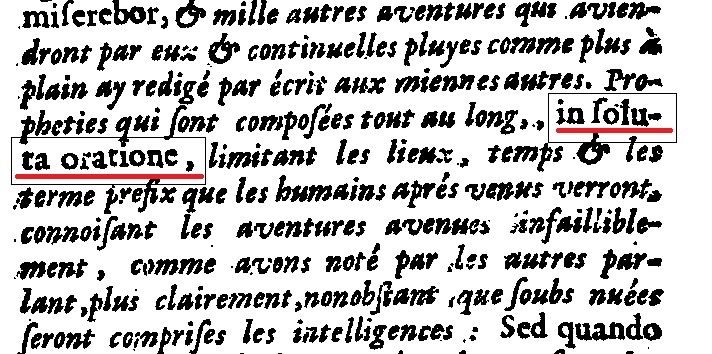
Just from reading through these words, we can see Nostradamus referring to multiple
prophecies. This is based on the plural ending on mienne and autre, which shows another
set of multiple prophecies are known to be from the pen of Nostradamus. This multiplicity is
then the source of the multiple possibilities, as far as in solute oratione is concerned. As a
separated grouping of Latin words, they can be read as a recognized idiom, and they can be
read with the flexibility of each word being free to follow the extent allowed for the meaning of
the individual word. The standard translation would then be a reference to the other
prophecies, like in his Almanacs. They were written in standard understandable language,
much like prose. However, the words of The Prophecies were not designed to be read in
such a standard manner, which causes them to be unintelligible. This means, as a reference
to The Prophecies, and not the Almanacs, Nostradamus is making the statement that they are
written in unrestricted style (of language).
In this series of words, another such idiom is placed, which also follows the same
amphibological way to find whole meaning to the words. This is where Nostradamus penned
the word redige. In modern French, this word is plain and simple, accepted to mean, “written,
or drawn up,” as a written contract. In modern French, the word “reduire” is the verb meaning,
“to reduce,” with the past participle being “reduit.” It is obvious that Nostradamus did not
write “reduit,” which leads one to believe, “j’ay redige par escript” means, “I have drawn up,”
or “I have written,” rather than, “I have reduced.”
Well, in 1611, when a preserved Old French to Old English dictionary was written, the past
participle “redige” was stated to translated as, “reduced, brought back or into; digested,
ordered; urged, or compelled unto.” The same basic translations were also listed for
“reduire,” “reduict,” and “reduit.” In fact, the author of that dictionary, Randal Cotgrave, made
note that the idiom, “redige par escript” (the exact phrase written by Nostradamus) can
translate to mean, “set down in writing”. This would lead one to believe the evolution from two
words having the same multiple meanings, to two words with separate meanings was
beginning, but not yet complete. Therefore, Nostradamus is making the statement, “like more
to smooth I have set down in writing (or drawn up in writing) in my other prophecies [the
Almanacs, etc.] which are composed ones all in the length.” But, he is also stating, “like
[adding] more to [the words] plain [without other words in combination with each] I have
reduced [cut out what standard speech adds in] by writing [The Prophecies] with my other
prophecies [the Almanacs, etc.] which are understandable ones [because] all [of those
quatrains are worded] in the [standard form of prose in] long [form]”.
What this was conveying was nothing new. It was the philosophy made public by William of
Ockham, who was a master of the philosophy of logic, while also being a Franciscan friar, in
the 14th Century (he died 206 years before The Prophecies was first published). William is
perhaps best known for his philosophical argument called Occam’s Razor. A simple
description of this philosophy is, “less is more.” According to Wikipedia’s definition, “The
principle states that the explanation of any phenomenon should make as few assumptions as
possible, eliminating those that make no difference in the observable predictions of the
explanatory hypothesis or theory.” However, the paradox is that the essence of Occam’s
Razor is, “Plurality ought never be posited without necessity.”
For The Prophecies the necessity becomes plurality due to the bare presence of individual
words, which cannot be joined (for conversation understanding) until that plurality is
understood. This means a language without the singular restriction of syntax (not
amphibological) is the only way to the true meaning of The Prophecies, with all ambiguity
removed.
Filed under Nostradamus
Quatrain III-19
In Nostradamus’ 19th quatrain in the chapter named “Centurie Tierce” (in one sense having the meaning, “Group of One Hundred the Third Part”), he wrote (in Old French):
En Luques sang & laict viendra plouvoir,
Un peu devant changement de preteur:
Grand peste & guerre, faim & soif fera voir
Loing ou mourra leur prince recteur.
Now, it is most important to understand that this quatrain cannot be understood by reading it syntactically, meaning one cannot race through these four lines as if it were one sentence, even though there is only one period mark showing. In fact, one cannot run through one line (MUCH LESS combine two lines as one), as if that were one standard sentence. Each word has the potential to translate (into English) as multiple words, such that in French a French fluent person may use the same word in multiple expressions, all with different impact of meaning.
Everything I am about to present, relative to the meaning of this quatrain, is explained in the book I published: The Systems of Nostradamus: Instructions for Making Sense of The Prophecies. This offers guidance to learning and applying special rules that apply to divine texts, as I was led to understand in my work with the works of Nostradamus, relative to that publication. I later realized that becoming fluent in these syntactical systems allowed me to understand divine Scripture found in the books of the Holy Bible. All come from the same source (Yahweh), where a Prophet produces Prophecies, by obeying the inner voice of Jesus, the Son resurrected within a Prophet. As such, every book of the Holy Bible was written by the voice of Jesus, the Son of Yahweh, as his soul resurrected within a soul in a body of flesh. This makes The Prophecies of Nostradmaus be from the same source as guided Genesis, Samuel (1 and II), the Psalms, (of David and Solomon), Daniel, and all the Epistles of the New Testament to be written. Everything comes from Yahweh, through Jesus the Son, by a Prophet.
Returning to the interpretation of Quatrain III-19, see how practicing these systems leads to fluency.
For instance, the common irregular verb, “venir,” as appearing in this quatrain in the third person future tense (“viendra“), would simply be translated as, “will come”; but, based on practical usage, “viendra” can also translate as, “will arrive, will approach, will draw near unto; will proceed from, will issue from, will be derived from; will spring, will prove, will grow; will happen, will chance, and will fall out.” These possibilities of translation come from a 1611 French-English dictionary, making these possibilities most relative to the times of Nostradamus. Therefore, when reading, “laict viendra pluvoir“, one has to be open-minded, and consider ALL of these possibilities of translation, since no one after the fact (i.e., not Nostradamus) knows for certain which use is correct. This is what makes interpreting Nostradamus much more complex than simple syntactical reading can allow, and is why the French have never understood the meaning of Nostradamus’ words, even though they fully understood (for the most part) the words.
Due to constraints in this forum, I will simply present a translation in English, based on the totality of translation possibilities, where although there are other words that could be substituted, these make it clearer how one can begin to interpret this quatrain. That translation, although not the only translation, is as follows:
In the ones of Luke parentage
& milk will issue from to pour down wet,
One small owing
converting to judge:
Great disease
& warfare,
hunger
& thirst will cause to see
Far off where will decay their potentate cleric in charge.
What one has to do at this point is understand that Nostradamus, as a Prophet of Yahweh, through an encounter with the Holy Spirit and the apparition of Jesus, produced The Prophecies as a holy document, from a holy source. With The Prophecies indeed from a divine source of inspiration, it then the equivalent of another book of the Holy Bible. Included in its verses are then predictive quatrains related to this holiness, explaining how the future is allowed to be seen by Yahweh. Knowing that, one can see the following begin to appear in the words of this quatrain:
Luke – an author of one of the books known as the Gospels (Good News), although not one of the known disciples of Jesus. Some state he was born Greek, and became a disciple of Paul. Some believe that Luke, as a Greek physician and historian, wrote the story of Jesus from his mother’s (Mary) perspective, as he was not a first-hand witness to that of which he wrote. This would make line one hint of those who know of Jesus from his mother, the blessed Virgin. The point is not to debate who Luke was, but to see that “the ones of Luke” (Luques, pronounced Lucas*) means Christians, in general, and thus followers of Jesus as those Anointed by his presence, by Yahweh [the word Christos means “Anointed one”].
blood – is a word of huge metaphoric meaning, although it still retains the physical element of the flowing of blood through the veins, assisting life. As such a liquid flow, the ones of Luke share in the belief of Jesus, whose blood was shed for many. Still, Into the ones of Luke means the bloodline of Christians.
& milk – where the ampersand signifies a level of greater importance to what follows, meaning that the simple nourishment of milk is not the only meaning. The production of milk, in all mammals, begins after the delivery of a child, who is the important recipient of important milk. When joined as parentage & milk, one sees a connection of the mother & child.
will issue from – is then the act of childbirth, which makes a mother’s milk drop, in the form of lactation.
to pour down wet – is not only the flow of nourishment to the child, but the rain of blood, as the genetic flow of lineage, which will issue from one mother.
That is the first line, which is the main theme that controls all focus of the remaining lines in this quatrain. It can be summed up as, “In the lineage of the ones found in the book of Luke & milk will nourish a line of offspring.” This, my friends, is a statement confirming a bloodline of Jesus. Line two, the secondary theme, which supports the main theme, but is allowed the freedom to separate and direct the focus to a new line of thought, based on the main theme, then states (looking at each word individually):
One – which, as a capitalized word mean an important One, focuses on the first offspring that relates to the main theme. This is then identifying the secondary theme as relative to the first offspring, which would beget a line of offspring.
small – or perhaps a better choice would be, “slender company”, which indicates the size of a child, or infant, while also indicating the group of the ones of Luke. The size is intimate, rather than a large group of people bring recognition to themselves. This mirrors the nativity of Jesus, as born in meager surroundings, to a small group of persons recognizing the greatness of the affair.
owing – where the present participle of the possessive verb, “devoir” (in Old French debvoir), meaning, “to owe, to have to”, states an obligation born to one so small. It indicates a duty possessed by the bloodline, and the responsibility of those surrounding the one to ensure its protection.
converting – which is a form of “changing,” as the word “changement” initially indicates, but with a quatrain bearing a religious theme, a statement of conversion as being what is owed from the “One”, it shows the entirety of Jewish history, since Jesus, where Jews were faced with the acceptance that Jesus was indeed the promised Messiah. They had to convert to belief in the New Testament. Along with the Jews, Gentiles were also given the opportunity to convert their beliefs (pagan views of polytheism) to those of the One God. This is highly supportive of the main theme the lineage of Jesus all being Anointed with his soul (all Christs), as it indicates the advent of Christianity, as a changing from Judaism (theocracy of priesthood to teach of the One God) to Christianity (theocracy of all being priests, through the Holy Spirit, to teach of the One Christ), for the conversion of all humanity. The same One Son’s soul must be poured out by Yahweh [Divine Baptism by Spirit], so it become eternally One with a Saved soul.
to judge – where the preposition, de, can mean, “to, from, with, or of”, covering all aspects relative to judgment. The element of judgment cannot be overlooked, particularly as the theme of The Prophecies is the proverbial Judgment Day, but each individual has to understand that we all have our own judgment, regardless of when Judgment Day comes. This secondary theme concludes with the statement that it is up to every one of humanity to judge for themselves how to live. Judgment Day comes when the majority of humanity has turned its back on Yahweh. To avoid that judgment, Yahweh sent Jesus, as His Anointed One (the Christ), to be the One small slither of humanity owing its whole living soul in service to Yahweh, for the purpose of changing the views of the world, so the world can judge correctly, and avoid “Doomsday”. This secondary theme then explains the need for a bloodline to Jesus, and those who followed His lead.
: – the second line ends with a colon, which means the third line will clarify the secondary theme’s statement of One small owing conversion to judge. Still, as the third line, it additionally adds supporting details to the main theme of holy blood.
Great – is one of the most repeated words (non-preposition, article) in the quatrains. The capitalization indicates it is more significant than just a simple statement of superlative. In fact, all uses of the word “great”, particularly in the masculine gender (“grand“), is indicative of a nation, including the people within that nation, who have achieved greatness. With the focus of the quatrains being the times of the United States of America’s rise to power, and greatness, the United States is referenced by the one word, great. They are not exclusive in this title, although the USA is undoubtedly the recognized world’s greatest, since the (feigned) collapse of the Soviet Union. The colon is clarifying the need of these Great nations of the world to uphold the values of Christ, in order to save the world from its predicted fate; or else the Great will cause the predicted end, due to their inability to judge how to live in peace.
disease – where the word “peste” can equally also mean, “pestilence, infection, plague, contagion, and death”, states that there is a huge flaw that comes with being Great, regardless of how much good the leading nations can do for the world. The flaw comes from what causes humanity to thrive to achieve greatness, which is far less than altruistic. Man has a strong tendency to strive for personal gain, and for each Great man of this world, hundreds will try to mimic the actions that led to that stature. The disease that humanity suffers is its inherent inability to easily shun the trappings of a material world, for the truly higher rewards of a spiritual home. This disease not only leads to greatness, but it also leads to ruin. Thus, every historic Great nation has risen and fallen, with no exceptions made.
& warfare, – is stating an important aspect of the disease of the Great. What makes nations the most powerful in the world, what makes empires out of nations, what makes one nation rise above all others is a nation’s abilities, and willingness to use those abilities, to fight to the death, until only one sits atop them all. The Soviet Union was a Great from war. The British Empire was Great Britain from war. The United States became Great at the end of World War II. It is the most important obstacle one must face to be Great, but it is a disease to believe that war keeps one Great forever.
Following the word “guerre” is a comma, which means the following words are separate from, while still related to warfare.
hunger – states that the taste for war and the rewards of being Great create a stomach for what it takes to reach ever higher goals. Significantly, nations that are Great finds ways to feed the people of those nations, which increases their satiation point, making them increasingly hungry. Meanwhile, a sign of a nation that is far from a world leader is its inability to feed its people properly. A state of hunger leads to death, or to war.
& thirst – states the need for the most valuable element of life, which is water. Still, the word “soif” can also translate as drought. This means that the same can be said, as for a hunger for greatness, having been Great once before (the Ottoman Empire, the Roman Empire, the Egyptian Empire, etc.), but long since in a “power” drought, gives one a thirst to become Great again.
will cause to see – means that these two desires in the world’s nations, hunger & thirst for power, is enough to allow all who study history to see the repeatability of this course to greatness. Still, seeing is not believing. The word “voir” can equally translate to mean, “to heed,” which takes one’s focus back to the main theme statement of divine prophecy, and the secondary theme of Christianity being due to Yahweh’s owing mankind a chance for survival on earth, and redemption in Heaven (the Spiritual realm). In this sense, Jesus was sent to feed the hunger pangs (“take this bread, it is my body” – the body of the Anointed one – the nourishment of the soul, in how to live, knowing truly what is Great), and to quench the thirst (“drink this wine, it is the blood of the New Covenant” – with Yahweh, where Jesus is the spirit that flows through one, elevating one to being in touch with Yahweh, through the Holy Spirit that is Jesus). The purpose of Jesus being sent in the flesh was to open all eyes; and in the future we will see the true meaning of these words, hopefully enough to heed the advice.
Far off where will decay their potentate cleric in charge – is a statement of the Roman Catholic Church, which will take the idea of the Anointed and, rather than nurture a true bloodline, will make its own quest to become Great. While Nostradamus did not condemn the Church of his day, the schisms of the original Church of Jesus and Mary point to some flaws in the methodology of turning the Great Roman Empire into the Great Church of Rome. The Prophecies were written in an unintelligible style to protect that Church, because, for all its imperfections, symbolic of all humanity having sins, that Church would do work for Yahweh, despite its disease. However, in the future of which Nostradamus wrote, divinely inspired by Yahweh to write, with no knowledge of the future beforehand, that Church will decay, particularly when their potentate (or their prince) cleric in charge (or pope), not Yahweh’s Son Jesus in flesh, will perish. This means both the death of the last pope, having already led the Church to depart this life.
All in all, this quatrain is a general one, one which paints a broad-stroke picture that spans over two thousand years, while still being predictive of things around the corner to come. As all quatrains, it stands solidly alone as one prediction, or prophecy. It bears meaning by itself. Still, like all quatrains, it links to other quatrains that expand on what is said here, specifically the general storyline of the whole of The Prophecies, as far as this quatrain is concerned.
There are other ways to view this quatrain, so that it tells of a specific future event, one involving someone, or someplace named Lucas, and the advent of milky white rain. Certainly, the stories of the quatrains focus deeply on the elements represented by the “Four Horsemen” of The Revelation: Famine, Disease, War, and Death; and all is represented in this quatrain. In such a case, both interpretations would be true; and such is the power of a Divine Prophecy. Yahweh cannot be limited to one explanation.
I hope this gives you an idea how to read Nostradamus. Every quatrain comes alive with deep meaning, by following the same format. You simply have to know what was truly written, and then you must read slowly.
———
* The Italian city Lucca (in the Tuscany region, near the Tyrrhenian coast) is spelled in French, Lucques (notice an extra “c”). The name Luke, as in the Gospel of Luke, is spelled Luc in French. The family name Luques showes it as a variation of Luke and Lucas.
Filed under Nostradamus


 Nostradamus Blog