
Fire in the sky?
The French for Nostradamus quatrain with the ‘part number’ I-46 is this:
Tout aupres d’Aux, de Lestore & Mirande,
Grand feu du ciel en trois nuicts tumbera:
Cause adviendra bien stupende & mirande,
Bien peu apres la terre tremblera.
This can viably translate as this:
Everything in it nearby from With them, of Him built & Prodigious,
Mighty death to it sky upon three darknesses will tumble down:
Matter will come to pass quite senseless & observation,
Benefit little following there country will shiver.
This is what Crystal Links shows as an English translation for this quatrain:
Very near Auch, Lectoure and Mirande
a great fire will fall from the sky for three nights.
The cause will appear both stupefying and marvelous;
shortly afterwards there will be an earthquake.
Okay, to read Aux as Auch makes that only be of secondary intent, but meant to make that mistake. To read Lestore as Lectoure is seeing shapes in clouds. It must primarily be read as L’estore; but as secondary intent, it fits the scenery. To read the capitalized Mirande as a commune that has grown from 1,655 people (in 1793) to a whopping 3,468 (in 2017) [Wikipedia stats] does not justify that place as important enough to be capitalized. Still, on a secondary intent level, all three places are in southwestern France, to the west of the big city Toulouse.
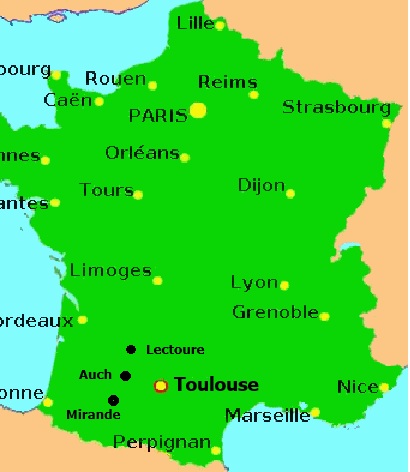
This is where it is important to merge the secondary intent to see who will play a role in the primary intent. That tells of rockets fired from an invading force (from the sea) will cause “dead” (feu means “light” and “fire,” but also “dead’ deceased, departed”) via the “sky.
I had written more, but I guess I did not click the save button. What I had saved is that above. Oh well. Here is what I wrote in 2011:
This theme is stated in the second line of the quatrain, which makes it a secondary theme statement for the quatrain itself, as well as restating an important theme for the future that still awaits us. This theme is important to understand clearly, because it is something that will affect us all, if we do not wake up and realize we can prevent it from happening.
Before I get into explaining the “fire from the sky” theme of line two, let me first state that there is another theme in this quatrain. That theme appears in the first line, which is the main theme for the quatrain. While the statement in line one is specific to the elements of this specific quatrain, a specific place is mentioned, which becomes important as a theme, when multiple quatrains also tell of specific places in the same general area, even repeating the same places in multiple quatrains. The first line of quatrain I-46 (remember this numbering has nothing to do with the real order of story) states, “Tout aupres d’Aux, de Lestore & Mirande,” which can translate to say, “Everything close to With them, from the Erected & Mirande”. Mirande is a commune in southwestern France.
Of course, let me be the one to point out that you will not find anyone other than myself coming up with that translation. That is because people have seen the capitalized form of “d’Aux” as a Provencal form of Old French, meaning “Auch”. Auch is a commune in southwest France, in the Gers Department, not far from Mirande, also in the Gers department, which means it can be easy to see that fit. While the French word “aux” is a routine preposition-article contraction in the plural (as “à les”), which can translate as, “with them,” and while I could find nothing that historically supported the notion that “Aux” was an accepted form of “Auch”, it does seem to fit. It actually fits quite well. I mean, they are phonetically similar, and geographically close together (throw a hat over them), it makes sense to make for an easy mistake to be made, one of taking a secondary meaning and replacing that for the primary meaning, so the true meaning of the statement is lost. Or, at least confused.
The other like mistake that others let their eyes see in the main theme of quatrain I-46, is in the capitalized word, “Lestore”. Nostradamus regularly did not use punctuation where punctuation is now standard, specifically in words that have a preceding article (“le”) attached in the abbreviated form (“l’ ”). In instances where the “l” is capitalized, it can actually transfer the capitalization to the second letter, such that “Lestore” can easily become, “l’Estore”. Such a realization of possibility means that “Lestore” can translate to mean, “the Built”, or “the Erected”. However, most others in the past have seen the secondary translation as the primary translation, turning “Lestore” into the place Lectoure.
This, again, is not a hard stretch, when one knows that in the Occitan language (one spoken in southwest France) the French spelling of “Lectoure” is “Leitora”. That is just a hop and a skip, or an “i” substituting for an “s”, and an “e” substituting for an “a”, away from being spot on. Minimally, the Occitan version erases the “u” entirely, and it is very hard explaining how extra letters get thrown away. Some sense of logical reason must always apply to these changes being made. Nevertheless, this leap from “Lestore” to “Lectoure” is further assisted by the fact that Lectoure is another commune in the Gers Department, very close to Auch and Mirande. That seals the deal, and makes the repeating theme of southwestern France stand boldly out, more than just naming one commune there.
While there is reason to see those three communes appear, although not how they are commonly spelled (with the exception of Mirande), one has to look at the overall theme presented by those translations. With those liberal translations allowed, they cause the first line to appear to state, “Everything close to Auch, with Lectoure & Mirande”. As a main theme statement, that makes the main theme of the quatrain be about “Everything in one relatively small area of the Gers Department in France.” Everything that follows in the quatrain is then to be expected to dangle from that initial lead-in, adding depth of understanding to that statement.
Seeing it as that way, look up those three communes on a map of southern France. You will find that these three communes make (roughly) a straight line, pointing north south, with about 35 miles separating the northernmost from the southernmost. The only problem that arises, relative to a statement making a main theme, and as far as the main theme being of primary necessity for solving a word puzzle is concerned, something is lacking. The theme of southwest France is certainly found repeated in other quatrains, but what makes this three-commune segment of southwest France special? A statement of three specific communes says nothing more than, “Everything close to” them. What does that mean for one to see into that clue?
That is why I say that the first line of quatrain I-46 says more, based on the spelling being NOT what others have seen, while intentionally meant to elicit those exact thoughts, for secondary purposes. What has to be seen is exactly what is there, but ignored, having everyone refuse to acknowledge what it really says. Line one actually says, “Everything close to With them, the Erected & Mirande”. That is a main theme that says much more than the names of three nearby communes in southwest France. It requires one to slow down and read each word for mportance, so that when one reaches “d’Aux”, and “l’Estore”, one can understand how those capitalized descriptions fit into a theme.
That statement beings with, “Tout”, which is “Everything”, or “All”, or the “Whole sum” of that which leads to Mirande. That, by itself, includes the communes of Auch and Lectoure, making actually stating them needless. They would specifically be included as places covered by the next word, “aupres”, which means, “close”, or “next”, or “compared”, to Mirande. Still, this important (as shown by capitalization) “All” is “close” by being people supporting Mirande, as those importantly “With them”, or “To them”, or “In them”, or “At them”, as “d’Aux” states. For those having reached that point, or those three places in southwest France, we find something has happened there. “Everything” has led to “the Erected”, or “them Built”, which is a statement that “Everything” had the purpose of “Building up” from the point of Mirande, the commune furthest south. In a story of war, where “Everything” is on the line, where “All” allies must be “With them”, the ones protecting France, at the southern front battle line, from Lectoure, to Auch, to Mirande, along the Gers River, the tributary to the Garonne River, what must be “Built” is a wall of defense. Line one in quatrain 1-46 is about this defensive wall.
Now, what I want to point out about this main theme statement, as a repeated theme, is that this is not the only quatrain that states those three places, either correctly spelled, or misspelled as words that appear to be those places, in a secondary sense. For instance, quatrain I-76 (remember this is I-46) states in its main theme, “Bazas, Lestore, Condon, Ausch, Agine”, where (long story short) “Lestore” has again been seen as “Lectoure”, and “Ausch” is now a new spelling for “Auch.
Then, in quatrain IV-72 (not even in the same Centurie as those holding I-46 and I-76), the main theme tells of “Agen & l’Estore”, which is that pesky “Lestore” actually turned into “l’Estore” by Nostradamus. Still, everyone has seen this, every way, as Lectoure. If you did not notice, the “Agine” of quatrain I-76 is seen as the “Agen” of quatrain IV-72, and “Agen” is just north of “Lectoure”, although in the Lot-et-Garonne department. Again, another commune is added to the line created by Mirande, Auch, and Lectoure, with Condom (spelled as Condon) just behind that line, to the west, and Bazas further to the northwest, well behind that line. All of these places are in southwest France, meaning the theme of southwest France is repeated in both of these additional quatrains. But wait, that is not all.
In quatrain VIII-02 (okay, now we have the theme of the quatrains not in the right order, with two in Centurie 1, one in Centurie 4, and another in Centurie 8, and all related), the main theme states, “Condon & Aux & autour de Mirande”. Here, we see Condon again, along with “Aux” once more seen as “Auch”, while being spelled the same as in quatrain I-46. We also find another word that signifies “close to”, in “autour,” which means, “around”, or “surrounding”, which parallels the use of “aupres” in quatrain I-46. Further, the end of the line’s focus is Mirande, the same as quatrain I-46. Finally, if that is not quite enough proof of a repeating theme, take a peek at line two in quatrain VIII-02. There, one will see it says, “du ciel feu”, which is the reverse of what quatrain I-46 states, in “feud u ciel”. Instead of “fire from the sky”, we have now, “from the sky fire”. That is undoubtedly a bonafied (Latin: bona fied, meaning, “in good faith”, synonymous with “sincere, authentic, and genuine”) theme; and it brings us back to my original point. “Fire from the sky” is an important theme to understand.
To understand the importance of this repeated theme, one has to stretch a few brain cells. By this, I mean one has to understand a little history, as boring as history is to learn. Regardless of the difficulty, one has to realize that in 1555-1566, the times of which Nostradamus wrote The Prophecies, and the times until his death, the only fire one saw in the sky was when lightning struck, when some invader was hurling fireballs at a castle from a catapult, or when some meteorite or space dust entered the earth’s atmosphere. Other than lightning, it was not normal to see fire come from the sky; and even with lightning, it was certainly not an everyday occurrence. Due to this relative rarity, and due to the logic that says one cannot expect a true prophecy to be about ordinary stuff, like regular lightning, or typical meteorite showers, one has to deduce that for Nostradamus to state, “fire from the sky”, he was not talking about ordinary 16th century “fire”. That means “fire from the sky” is about an abnormal, or purely futuristic, form of powerful destruction.
Certainly, the aspect of catapulted fireballs has to be viewed as typical of the latest (as far as Medieval times was concerned) weapons technology. All times have their latest, greatest weapons of most massive destruction, with “massive” being ever expanding by definition, always adjusting to fit the needs relative to the effects of the latest creations. As such, World War II had the German V-2 rockets, which were the first examples of long-distance military fireballs catapulted towards an enemy, with the fire being its method of propulsion. Today we have rockets that roar and fizzle across the sky, over very great distances, with the tail end of each rocket generating a blaze of fire and a trail of smoke. All in all, this is not too different from a quickly hurled hay-rock ball, covered in pitch, and set afire. Despite major differences is the impact results, both weapons can be imagined to have the same effect of eliciting fear among those to whom the “fire from the sky” is directed.
Keep in mind that famous quatrain, which (if one reads it the right way) predicted the events of September 11, 2001, stating in line two, “Du ciel viendra un grand Roy d’effraieur”, or, “From the sky will come one great King to terrorist”. That clearly shows how regular passenger air flight occurs, such that standard jumbo airplanes would come “from the sky.” Without explaining that quatrain, and its themes (I already have in other places), the point is to see that Nostradamus saw objects that normally flew about the skies, which were obviously too heavy to fly without some form of power (fire) causing that flight. That was not the norm in his day and age; but Leonardo da Vinci had already produced his concepts of man being capable of flight. Leonardo was at his peak prior to Nostradamus’ birth, but did not die until after Nostradamus was born.
With the mind-expanding realization, one has to be able to see that “fire from the sky” is relative to what has become a modern standard form of warfare. Leonardo da Vinci played his role as a military technology inventor, in the times leading into the 16th century. Today, nations commonly fly fighter planes, and launch missiles, as intentional military bombardments, by rocket-propelled devices (remember Kosovo, Serbia, the first Gulf War, all Israeli-Hamas encounters, the Iran War, the Afghan War, etc.). There can be no doubt that Nostradamus was allowed to see these times, complete with all the “firepower” modern science has made possible. All that remains to be asked is, “What type of warheads might be on Nostradamus’ fire from the sky?” To answer this question, one needs to look at the clues in the quatrain stating “fire from the sky”, and see if Nostradamus made such a distinction.
Lines three and four, of quatrain I-46, give a good idea of the nature of those warheads. One needs to address each line separately, with each word also understood for its whole scope of possible meaning. One must also be aware that the order of lines is essential to realize, as the supporting details of the main theme (line 1) are found in the third line, while the supporting details for the secondary theme (line 2) are found in the fourth line.
Line three states, “Cause adviendra bien stupende & mirande”. Most basically, this translates to say, “Occasion will happen quite astounding & extraordinary to view”. I say most basically because the word “Cause” is capitalized, showing importance, meaning a very significant “Cause”, “Occasion”, or “Reason” is following (from the secondary theme, in line two), “Great fire from the sky upon three nights will fall”. The place of that impact of “fire from the sky” is Mirande, and it will fall on the important people gathered there, the capitalized Great allies of France. This fire will be falling upon the three places, the ones intentionally meant to be read secondarily as Auch, Lectoure, and Mirande. Presumably, the Great will number three, representing the allies, France, Great Britain, and the United States, who will have secured the battle line at those three places. Also presumably, those three will be bringing in their own fighter jets, stationed in the Atlantic Ocean, to produce fire from the sky on the enemy, on the other side of that battle line. This will then begin a Great battle that will last three nights, before the line will fall.
We can understand that the future tense verb, “will fall down”, is being explained in line three’s important word, “Cause”, due to the colon designating line three to give an example, or clarification, of that falling down, tumbling down, or falling into. While fire from the sky certainly does fall (the laws of gravity dictate that), what is more important that will fall down, is that line of defense. The important Cause to save France, the important Reason three allies are there to fight for southwest France, the important Occasion that will occur is the collapse of Everything, or All, that important word that began the quatrain, and line one.
This important Occasion is then explained, such that it will happen, or will befall, or will come to pass, because something will take place in the battle that will be quite astounding. The word written by Nostradamus at this point, “stupende”, is not French. It is Latin, rooted in the word stupere, which is the root of the English word, “stupendous.” That word is defined as, “Of astounding force, volume, degree, or excellence; marvelous; amazingly large or great; huge; synonymous with enormous.” To sum this description up in one word, as Nostradamus does following an ampersand, the signal that something important follows, he wrote the word, “mirande”.
If you caught that right away, good for you. If not, I will explain. The word mirande is an exact replication of the word ending line one, Mirande, as a rhyme using the same word. The lower case mirande is spelled the exact same as the capitalized version. The only difference is the capitalization, which shows the importance of a proper noun, versus an adjective. The lower case spelling becomes the meaning of the word that is at the root of the name. According to a French travel agency, the word mirande means, “which is pleasant to look at”. As a one-word summation of a fallen battle line, due to a force that has astonished, it is perhaps best to see that the root of mirande, the source of that travel agent’s defining words, is the Latin word mirus. That word can mean, “wonderful,” or it can mean, “astonishing,” but it is best stated as, “extraordinary.” What is quite astounding is something not ordinary. It is extraordinary to see.
What is so poetic in the use of mirande, as the rhyme to Mirande, is the name of a place has been itself reduced. It too has fallen. The place Mirande, which the travel agent furthered her definition to add, “a much justified name as the setting in this part of the Midi Pyrenees is lovely” , has come, in the prophecy of quatrain I-46, to become the place that in the future will be nothing more than where an Occasion happened, where Reason came to pass, that Caused the use of astonishing force, which will leave a beautiful commune in southwest France little more than a bit of trivia. Mirande will be where an extraordinary sight will take place.
If that does not make one consider the possibility of a nuclear weapon being on the warhead of those missiles falling from the sky, then look at one other option as the translation of line three. That translation, granted it is one on a secondary level, can be stated as, “Matter will fall out substance amazed by degree & astonishing to observe”. If you are old enough to remember the “duck and cover” training of grade school, during the beginnings of the Cold War, you will remember the yellow and black “Fallout Shelter” signs. Nuclear bombs create fall out substance, and the U.S. military took lots of movies of their tests, so we can all be amazed at what a nuclear bomb going off can do, including its astonishing blast force, and its radioactive fallout. That helps explain how an entire line of defense will fall after three nights of battle.
With that awakening, let us look now to line four, the last line, and the line that adds details to the secondary theme of the fall of a Great line of defense. In that line, Nostradamus wrote, “Bien peu après la terre tremblera.” Generally, this says, “Rightly few after there land will tremble.” In this statement, it can be misleading to see the capitalization of Bien, as it importantly being Right, or Good, that a fall will have taken place, especially when it is with such astonishing force, and so extraordinary, or beyond the norm. Perhaps its use can be understood when remembering the last time such astonishing force was used in war, as Nagasaki and Hiroshima. The Reason was, “We thought it would save the lives of many thousands of American boys, not to mention those of countless Japanese.” In other words, there was a Good
Reason to use the weapon that caused such horrible immediate damage, with terrible lingering fears to follow.
Still, when Bien is translated as Aptly, or As it should be, it becomes less a judgment of right or wrong, or good versus bad, and more of a statement of important justice being carried out. Perhaps God will see it as Apt for those who Possessed (an alternate translation possibility) the bomb, who fought long and hard to keep others from obtaining it, that it should be used against them. It would be an important lesson, As it should be learned, what goes around comes around. If ones plays with fire from the sky, one is going to get burned.
Yet, what may Well (Bien) be the Case (Cause), is that few will live to suffer from this bomb’s blast. The following word, peu, means it will be Right that almost nobody will be left. The result will be Quite scarce, with little remaining as it was before. The reduction, the fall, will have scant (peu) Benefit (Bien) for those left. The result is what comes after this extraordinary sight. It will be what will be left there, after the bomb goes off. Not only will the land of southwest France tremble (terre tremblera), but the whole nation (terre) of France will shake. So too will the countries (Great Britain and the U.S.A.) of the Great shiver. More importantly, the world (terre) will quake from knowing that time has finally come, the time everyone has feared since 1945. The earth will tremble because fire from the sky will have fallen in southwestern France.
That sums up quatrain I-46. As you can see, to explain four lines of Nostradamus requires many pages of writing. There are 948 quatrains, all of which can be explained just as lucidly as I have explained this one. While this one quatrain stands alone as a single prophecy, it stands together with other individual prophecies, all of which join to tell one greater prophetic story. There is not one quatrain that cannot be examined, just as I have examined this one. All can be understood, if one understands how to read the signs of Nostradamus’ writing. All can be expected to come true exactly as prophesied, if nothing is done to change the direction in which the world is headed.
As a single quatrain, the conclusion in I-46 says the earth will tremble. This too is a repeated theme. The fire from the sky is in other quatrains, falling in other places. The world will shake all over; but one cannot see those separate events as unique from the event of quatrain I-46. When this begins, many places will simultaneously be struck by fire from the sky. What is good about knowing this now is it does not have to happen in our lifetimes. We can act to save ourselves, and with God’s help, through a world that turns to God for help through prayer, we can be led to change Everything. We do not need to be hoping someone will help us, allowing us to stop worrying about what little we can do, on an individual level. Your soul is your responsibility, yours alone, and you have to act to save yourself first. All of us have to see what this future brings, so we can find the inner motivation to change ourselves. If we cannot do that collectively, then this future will happen. You can count on that.
If you still need proof that Nostradamus was a prophet of Jesus Christ, taking down a message from God, designed to be hidden until needed (break glass in time of emergency), then look at what has already come true 100%. There are many, many quatrains that prove The Prophecies are anything but random chance occurrences, due to vague words that can have any meaning. Whoever says those things are not facing the facts. It is okay to argue against blind faith belief, but to argue logically, on any topic, one has to address what the facts are, and come to some point of agreement. If someone says, “It is all just a trick,” then I say, “Okay. Show me where you see a trick.” One cannot simply use ignorant opinion as logical reason. It does not hold water.
As always, I welcome your opinions and questions. I will do what I can to assist anyone who asks to see that Nostradamus was divinely inspired. I have already seen this. The point is not to have anyone begin believing in me, or believing in Nostradamus, without seeing for him or herself what there is to see. The proof is there to see with your own eyes. If one takes the time to actually look and ponder, the clutter will dissipate, and the clear picture will emerge. That clarity is also divinely assisted, and it is an amazing feeling to behold. I want everyone to feel that power, and know that comfort of allowing God to lead one, rather than always trying vainly to control everything in one’s surroundings. It only requires a leap of faith.
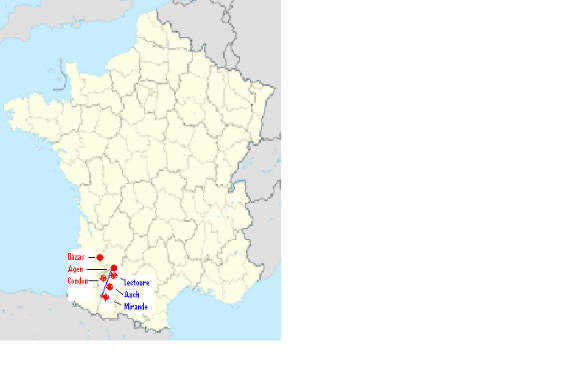
I created this map to help get a picture of the line Lectoure, Auch, and Mirande make.
Note that Agen is along the same line, only a little further north. Condom is in the same Gers department, just behind that line.
Bazas is north, along the flow of the Garonne River. Just to the northwest of Bazas is the huge mouth of the Garonne, which is where Bordeaux is a major seaport. Bordeaux will be the point of entry for the allied forces.
Nostradamus mentions a “wall falling” and he mentions a “wall will fall in the Garonne”


 Nostradamus Blog