
Back in 2016, due to aggression in the Persian Gulf by Iran, I posted an article that lists six quatrains Nostradamus wrote, regarding a naval battle. Now, after recent news has reported Iran being bombed by Israel and the United States militaries, Iran just recently retailated by sending a wave of missiles towards the U.S. military facility in Qatar. That addressed U.S. airplanes based there, which is not from from the island nation of Bahrain (just to the north of Qatar), where U.S. naval presence is based.
I will not present each of the six quatrains listed in 2016 and offer views on them individually. Just know they do not stand totally alone. While each is a divine prophecy, they gain greater strength when read as connected, in an epic poem. The epic poem that is The Prophecies of Nostradamus warns of the End Times that will be brought on by faithless human beings following demonically possessed false shepherds. The epic poem tells how to avoid this soul destruction that will bring about the earth no longer being able to sustain life as it has been (a brave new zombie world); but people prefer to skip how to save their individual soul and leap onto the frightening stuff. Onward to the frightening stuff.
Not long ago (a few days now), the news was that four Iranian patrol boats came close to a U.S. navy destroyer in the Persian Gulf, near the Strait of Hormuz. Later, the news reported that the American ship fired a warning shot (a flare) when two of the Iranian boats came as close as 300 yards to it.
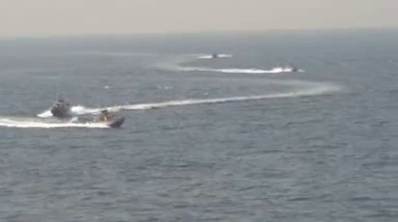
On the television news recently, a retired U.S. general was interviewed about this incident. He said the Iranians were testing the response of American ships, which is restricted by directives from the Commander in Chief – Barack Obama. While the official word from the White House was that the Iranian behavior was unacceptable, the general pointed out that the president has done nothing to establish a position that will keep future tests like this from happening. The general added that Iran is acting in ways that demonstrate its readiness to take control of the Middle East region, as the supreme power for other Islamic nations to depend on.
Within seconds of the talking head “reporter” agreeing that this is an important development, she said, “Now a look at the stock market.” This shows that important news is little more than entertainment for an audience that will forever have bad news reported, but never any reports of something being done to stop that flow of bad news. Therefore, one should expect Iran to keep testing U.S. ships in the Persian Gulf, in the Strait of Hormuz.
Later that day, as I ate lunch and watched the news, I caught the tail end of a report about a Chinese spy that was caught giving China the secret codes for the technology U.S. Navy ships have to instantly communicate with one another. This seemed to be a problem, simply because the Chinese have since installed a similar program in their fleet communication capabilities. The viewing audience was told to stay tuned for a prime time series about the spies caught stealing American secrets, which would portray the one who was caught stealing this naval intelligence program.
There was no mention of the possibility that China could sell this technology to other foreign governments, whose militaries would love to “tune in” to the chatter going on between US Navy ships. That seems like a worse danger to the safety and security of American ships and sailors.
Such news reports as these reassure me that what I have seen from putting multiple quatrains together, about a tragic naval defeat in the Persian Gulf, will come true (if “reassurance” is the right word). Erika Cheetham saw two of these quatrains linking, and she saw them as possibly about the surprise attack on Pearl Harbor, on December 7, 1941. President Franklin D. Roosevelt called that “a date that will live in infamy.” Still, as with every quatrain thought to have already been fulfilled, if it has happened once, then it can happen again. The two quatrains she noted as about Pearl Harbor (possibly, not certain) are perfect for setting up a scenario that makes the recent news reports of utmost importance … should being forewarned truly mean being forearmed.
The first quatrain I would like to present to you for consideration (as forearming information) is quatrain X-02. It states (in Old French):
Voille gallere voil de nef cachera,
La grande classe viendra sortir la moindre
Dix naves proches le torneront poulser,
Grande vaincue unies a soy joindre.
One translation (there is always more than one way to put words to a prophecy) says:
[It] Vailed galley willing of ship to catch,
There great fleet will come to issue here inferior
Ten ships close by it turning to violent challenge,
Great vanquished united ones has itself to grapple as enemies.
The main theme statement (line one) begins with the capitalized word “Voille.” A capitalized word always indicates an important statement, made in one word. The word “voile” is actually not a word, although it is easily seen as being the same as the word “voile,” so the word is translated according to the primary intent. Still, “voile” is a simple anagram, where the extra “l” must come out and be attached to the beginning. Therefore, the true important word stated is “l’Voile,” where the importance of “Veil,” “Sail,” or “Ship” (since a vessel with a sail was a ship in the 16th century) is individualized as “the Veiled.”
The reason “the Ship” is not the primary intent is the following word “gallere” means “galley,” which was a large sailing ship in the 16th century. This means the importance of “the Ship” is its ability to be “Veiled,” such that it is a “galley” with the ability to be hidden. It is like “A Ship behind a curtain.”
This has deeper meaning itself, whereas the people most commonly wearing veils are women in the Middle East, who are Muslim. Since the Middle East is known for sand and oil, rather than having large sailing ships, the “curtain” that keeps the ship from being seen is one developed by Russians, who were known for the secrecy they demands behind their forceful “veil” of iron – the Iron Curtain. Therefore, from a perspective of modern historical knowledge, line one is making the statement about a stealth naval vessel, implying it was manufactured in the former Soviet Union, and sold to the Iranians. This sale was initiated in 1991, soon after the Iron Curtain collapsed.
The word “voil” is an Ancient French form of the verb “volonté,” meaning “wish” or “will,” where a “willingness” or “desire” is the root cause for a cloaked sea vessel being developed, manufactured and sold. The owner of such a secret ship has only one reason for that possession, which is to use it in an act of revenge, from the element of surprise.
This willingness is then where one finds the third word in line one that can be translated as “ship.” The “wish” is to have the capacity “of a ship,” to use “to a ship,” to be freed “from a ship” that is superior to all the other ships one has been known for having. This means this past history of being weak in naval war capabilities will play a role in drawing in a “ship,” so it can be “caught.” Thus, the “desire” is to have a “ship” that will act as a trap that will “catch” other ships.
With the main theme focusing on a veiled alliance, where weapons are sold for cash, between two nations with a common enemy (or enemies), line two is separated by a comma at the end of line one. This separation makes the secondary theme free to associate with that enemy. Line two then seems to begin with a capitalized article, “La,” but the primary intent of this important word is not as “The,” but as “There,” where “La” is accented as “Là.” An accent mark can be added where one is not shown, but one shown can never be erased.
The adverb “la” is then written in two places in line two, one capitalized and one in the lower case. If multiple translations are possible of a word, then multiple uses should be fitted into the text. Since “la” can mean, “there, here, or then,” the opposite duality of “Here and there” or “There and here” makes for good application, but “Then” can also can and should be a consideration.
Because the trap is to be set up where least expected, drawing the enemy “There” is most important. The enemy is identified then as “great,” which is a statement about an individual or collective of individuals seen as one, who are of “great” power, wealth and influence. This greatness is then modified as being known for its “fleet,” which is rooted in the Latin word “classicus” or “classis,” meaning “the armed forces, especially the fleet.” The use of a Latin derivative in any quatrain is pointing to an association with Rome. As an enemy to both Russia and Iran, the common factor is religion, where both have disregard for Christianity. Therefore, the initial focus in the secondary theme is drawing to “There [Iran, Persian Gulf] the mighty fleet of the keepers of Christianity,” America. That “fleet will come” into that trap, in order to protect the weak nations that have plenty of oil, who need protection. The West sees those “inferior” powers as worth protecting, while they see Iran as “lesser” in power than America. The trap depends on that “great fleet” not expecting an equal or greater power lurking underwater, as “then” and “here” (the Persian Gulf) will be an “inferior” entity.
The news about Iran trying to develop a nuclear device gives the impression that the only way to obtain such weaponry is to make it yourself. In this sense, even if Iran had processed enough uranium-235 to make one atomic bomb, the number of such weapons held by the United States (not to mention its Western allies) would be far superior. This means the secondary theme is referencing the attitude, based on intelligence “here” in the United States, as of that time “then,” that it would be okay to send in a “fleet” … “There,” because of that “great” imbalance of power.
Because line two does not end with any punctuation, the statement of line three becomes an immediate flow of thought in reference to a fleet of a powerful nation arriving to present an ultimatum to an inferior power. Based on the last word of line two being “less, lesser, inferior to” and “least, smallest, most low,” line three then begins with the capitalized word “Dix,” which is the number “Ten.” The capitalization tells the reader that the “lesser” or “inferior” number is “ten,” but that number if relative to a very powerful “Ten.”
Because line one is the main theme of the “inferior,” as far as the “great fleet” is concerned, with that inferiority based on a single nation’s military might, without consideration to a “Veiled” alliance and purchased “ships” of stealth capabilities, line two is focused on the enemy of that union. Line three, however, despite being a direct flow of thought about the arrival of American warships into the Persian Gulf, is offering supporting detail to the main theme of an Iranian-Soviet [call it Russian if you want] pact. “Ten” then becomes the number of “ships” purchased, while “Ten” also represent the level of threat this confrontation will have reached.
According to the Wikipedia article about the U.S. Navy’s Fifth Fleet, it is stated:
“The Fifth Fleet of the United States Navy is responsible for naval forces in the Persian Gulf, Red Sea, Arabian Sea, and parts of the Indian Ocean. It shares a commander and headquarters with U.S. Naval Forces Central Command (NAVCENT) in Bahrain.”
About Bahrain, another Wikipedia article states:
“Bahrain is an island country situated near the western shores of the Persian Gulf in the Middle East. It is a small archipelago centered on Bahrain Island, its largest land mass.”
Google states the report made by the Washington Post that, as of February 23, 2016: “The 5th Fleet is currently deployed in the Persian Gulf, and as of Feb. 23, the naval forces included: two carriers, 20 ships, 103 strike aircraft, approximately 20,000 sailors and marines.” This is a total of 23 sea vessels, but one would assume not all would ever be in the Persian Gulf at one time, with the Fifth Fleet also patrolling the Arabian Sea and the western fringe of the Indian Ocean. Another report stated 18 ships were in the Persian Gulf, with five more headed there. Whatever the number, it is more than the “ten” stated in line three, which are “Ten ships” of significance.
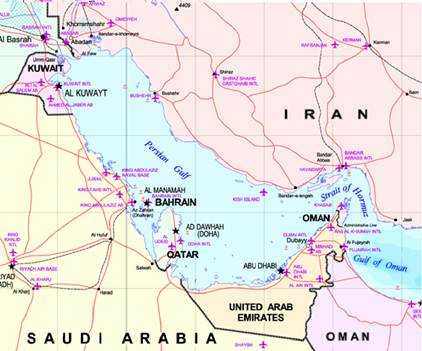
When the next words in line three it stating “close to ones” or “neighboring ones,” this is saying that the “Ten ships” are “ones nearby” to the enemy ships. This makes the aspect of “Veiled” be closely related to the “Ten,” where for them to be “close to” the enemy “ships,” they would have to either be invisible (not likely) or submerged. This means American submarines would not be able to detect their presence, nor any sonar readings of surface ships. I get the impression that the “Ten ships” are stationed on the sea floor.
From that fixed position, we are then told they “will be turning,” as if waiting for the fleet above to pass. This is probably why Iranian patrol boats have been testing American warships, as a distraction from underwater activities that take place simultaneously. In this case, the “turning” will be “to violently challenge” the superiority of the larger fleet. This violence will come as a “pulse,” “to push, thrust; inforce, compel, or violently put on; to drive on or beat in; to jostle or jolt.” This becomes the moment of action that will have been planned for decades.
Line three then ends with a comma, denoting a separation of time and/or space. This then leads to the capitalized word “Grand,” which now acts as supporting details for the use of a lower-case “grande” in line two. It is having large “fleets of ships” that makes America a most powerful “Great” nation. It has been our willingness to confront evil powers and fight so the weak are protected. America is “Great” because it has “violently challenged” the likes of Saddam Hussein and Adolph Hitler. Now, in line four, where the supporting details for the secondary theme of American warfare greatness is found, that “Great” state will suddenly be “vanquished.” San “inferior” power will “overcome, subdue, foil, surmount and overmaster,” through the elements of equal weaponry and surprise.
In the eyes of America’s enemies, this defeat will be “just,” as the playing field (or battlefield) will have been made “equal.” Just as America is called the “United” States, and just as America is “united” with Bahrain and Saudi Arabia (et al) in the Middle East, Iran and Russia will have become “united ones” against the “Great” Satan (as Iran has often called America).
Now, as I have made several leaps of assumption by naming Iran, Russia, and the United States, when neither is directly stated, I expect people to challenge what I have stated here, about quatrain X-02. A brave and courageous individual will raise a voice and question these leaps. However, a coward will simply disbelieve and walk away silently. The questions can be answered by seeing how this one quatrain does not stand alone as a single prophecy. It is one piece of a string of pieces, where the leaps are confirmed in the additional statements made in related prophecies. When many quatrains of similar verbiage are realized parts of a single story, The Prophecies of Nostradamus become evident as an epic poem, where the random presentation is like a box of puzzle pieces that need to be put together to see the whole picture.


 Nostradamus Blog