
This letter is enigmatic and difficult to grasp, but it is that way as an explanation of the ordering of the quatrains. Everything Nostradamus was divinely shown, he wrote down in the logical order that allowed him to understand this future he was shown. Thus, when Nostradamus first published a part of that which he had been divinely inspired to write (nearly a thousand poems), he did so by rearranging the logical order, so the quatrains he published in 1555 gave the appearance of individual predictions, similar to his prior publications of Almanachs.
In 1557, Nostradamus then added more of the verses he had originally written in logical order (perhaps in 1553 or earlier), again selecting random quatrains that did nothing to lead readers to believe he had written an epic poem (similar to The Iliad and The Odyssey by Homer, The Aeneid by Virgil, The Epic of Gilgamesh, and Beowulf; to be followed later by The Divine Comedy by Dante, Paradise Lost by Milton, and Faust by Goethe). It was this random presentation that kept The Prophecies of Nostradamus from being seen in that way. Therefore, before the King of France would give his approval for any new publications of Nostradamus poetry, he demanded Nostradamus appear before him in Paris and explain the meaning of the 353 poems published in 1555, along with the additions in 1557, which ran the total to 642.
Rather than appear before Herny II and be held prisoner, as Jesus would not allow him to expose the truth of his work at that time, Nostradamus was led to write a logical letter of explanation, which he then divided into pieces, tossed in the air, and reassembled into a letter that sounds like it was written by a madman. It was the presentation of the Epistle to Henry II that explained the ordering of the quatrains – everything is out of order, for a reason.
Nostradamus had published Almanachs for several years (1550-1566, including years when The Prophecies were published), which contained far less than hundreds and were understandable (with some usage of metahpor and innuendo) and seen to come true. This accuracy led people to call Nostradamus a prophet, while knowing he utilized his knowledge of celestial alignments (astrology) to calculate his future predictions, one year at a time.
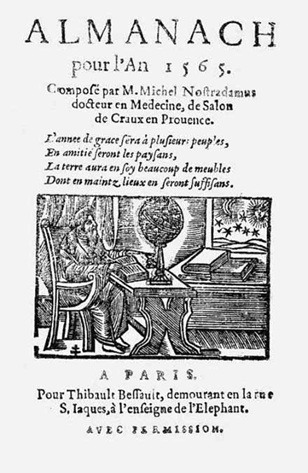
To have 342 quatrains burst into publication in 1555, not called Almanach, but The Prophecies, had people scratching their heads. Then the total ran to 642 in 1557, with none of the first figured out. It must be noted that those who say Old French is not easy to translate, the people of 1550 to 1566 all spoke Old French fluently and the royal family of France was afforded higher education. Because the Old French had figured out metaphor, symbolism, satire, and innuendo, they were not ignorant beasts. They struggled not because of the languages written (French and Latin), but because their ingrained abilities to comprehend writings by learned rules (syntax) of French and Latin did not produce meaning.
Nostradamus would write his Epistle to Henry II, King of France, in 1558. Presumably he mailed it to the king (sent by carrier), from his home in Salon-de-Provence, in southern France. One could then assume that Henry and his most educated advisors read that letter explaining The Prophecies, coming away with doubts about Nostradamus’ sanity. That doubt put a hold on further publications relative to The Prophecies, until Henry died after a jousting accident in 1559.
With his death, having several male heirs but none of whom was old enough to take over the throne of France, his wife, Catherine de Medici, became Queen Regent in Henry’s place. Catherine de Medici was very fond of Nostradamus as an astrologer and sought his readings for the princes. It was with her support that a final edition of The Prophecies would be published in 1566, the year Nostradamus died. There would be no change in anyone being able to understand the meaning of the poems (although Catherine saw one that she said predicted Henry’s death); but Nostradamus’ assistant, Jean de Chavigny, obviously was told of printing errors that needed to be corrected. So, a 1568 reprint was approved.
Simply because a reprint of unintelligible poems was done two years after Nostradamus’ death says it was important those corrections be made, for a future time, when understanding would be possible. The final editions then added a full 300 verses, bringing the total (in ten Centuries or groups of one hundred) to 942, with Centurie Septiesme (“Century Seventh”) still containing only 42 quatrains. The Epistle to Henry II was then published in both the 1566 and 1568 editions (and all subsequent ones), acting as a foreword to those added 300 verses.
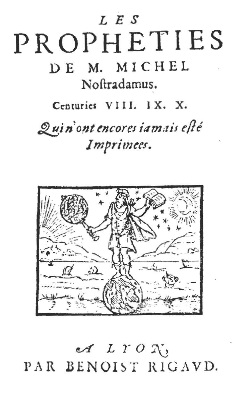
The word “foreword” is defined as “a short introduction to a book, typically by a person other than the author” Oxford Languages). This epistle was in addition to the Preface that was published in all editions, placed prior to Centurie Premiere (“Century First”); and a “preface” is defined as “an introduction to a book, typically stating its subject, scope, or aims.” This means the Preface was as it is defined, while the Epistle to Henry was an in-depth explanation (not an introduction) of the “subject, scope, and aims” of The Prophecies. This makes the two letters (Preface and Epistle to Henry) be extremely important to discern, in order to make sense of what the bulk of the work says. They must be understood first, before one can begin attempting to make sense of the verses.
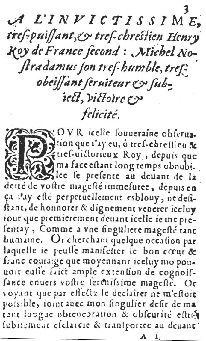
This makes realizing the Epistle to Henry II most important. It must be seen as a mini-puzzle that must be placed together in a logical order, where understanding in-depth explanation of the subject, scope, and aims of The Prophecies is possible. Simply by seeing how to divide the epistle into parts (logically) and reorder into a lucidly clear writing is vital. One must be able to read for instructions in how to discern the poems; but the simple realization that the epistle is like the quatrains and jumbled up on purpose, becomes an unstated in-depth explanation about how to make sense of the quatrains.
Then, between the introductions by the author become the logical way to defend interpretations of everything. The author must state the subject, scope, and aim of those quatrains nobody could grasp in 1555-1558, or it becomes an exercise in illogical (flawed and invalid conclusions) guesswork that is wrong (like Catherine de Medici’s belief that Nostradamus predicted Henry’s death was wrong). Logic says, an interpretation my be fully supported by what Nostradamus said would be found within.


 Nostradamus Blog